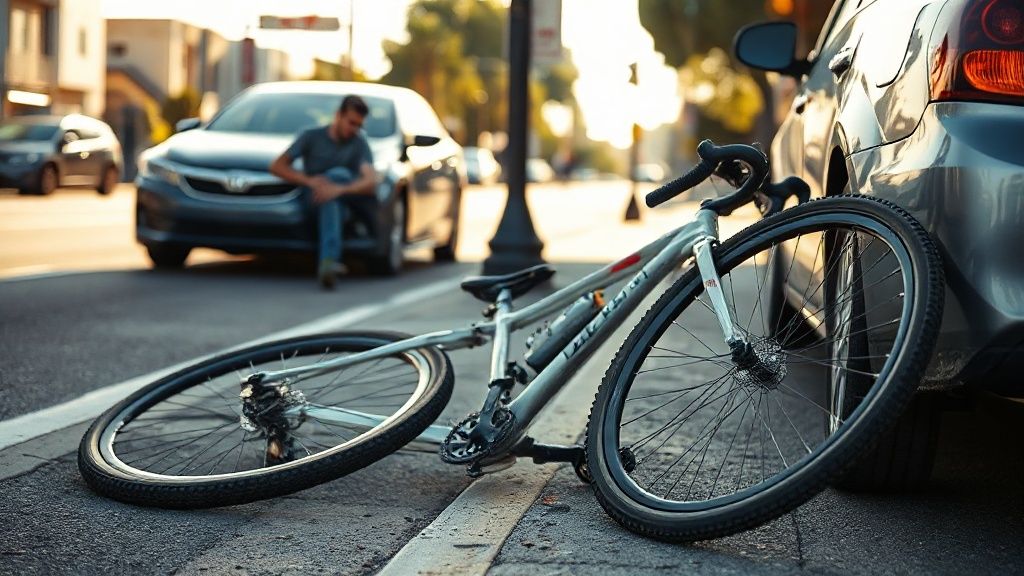
If you were hit by a car while riding your bike in California, you are dealing with real pain — and a situation that moves faster than most people realize. Insurance adjusters call quickly. Gaps in documentation close. Legal deadlines exist whether you know about them or not.
This guide covers the California-specific rules that determine who is liable, what you can actually recover, and what you need to do right now to protect your claim.
If you need to talk through your case today, call (818) 794-9947 for a free case review. No fee unless we win.
Quick Answers
- Cyclists have the same road rights as drivers under the California Vehicle Code — and the same duties.
- California's pure comparative fault rule means you can still recover even if you were partly at fault, but your compensation is reduced by your share.
- Your own auto policy's uninsured motorist (UM) coverage can pay your bicycle accident claim even though you were on a bike, not in a car.
- Adults have no helmet requirement in California. Cyclists under 18 must wear a helmet under Cal. Veh. Code §21212.
- You have two years from the date of the crash to file a lawsuit under Cal. Code Civ. Proc. §335.1. Government entity involved? That window shrinks to six months for the government claim.
- Compensation can include medical bills, lost wages, future treatment, pain and suffering, and permanent disability.
- Call (818) 794-9947 — free consultation, no fee unless we win.
Cyclists' Rights and Duties Under the California Vehicle Code
In California, cyclists have the same legal right to use public roads as drivers of motor vehicles under the California Vehicle Code.
That means a driver who hits you while you are lawfully riding your bike has potentially violated a traffic law — and that violation is evidence of negligence.
The key statutes that govern California bicycle riding include:
- Cal. Veh. Code §21200 — Cyclists have all the rights and are subject to all the duties of vehicle drivers, with specific exceptions listed elsewhere in the code.
- Cal. Veh. Code §21202 — Cyclists must ride as close to the right-hand edge of the roadway as practical, with clearly defined exceptions such as passing, turning left, avoiding hazards, and riding in a lane too narrow to safely share.
- Cal. Veh. Code §21760 — The "Three Feet for Safety Act." Drivers must give cyclists at least three feet of clearance when passing. Violating this is a traffic infraction — and strong evidence of fault in your case.
- Cal. Veh. Code §21650 — Vehicles must travel on the right side of the road, which applies equally to cyclists.
Why these statutes matter for your case: If a driver violated any of these provisions when they hit you, that is negligence per se under California law — meaning the violation itself can establish their duty and breach, making your path to compensation clearer. An experienced personal injury attorney will pull the police report, identify every code violation, and build the liability framework from there.
Common Car-on-Bike Scenarios: Right Hook, Dooring, Failure to Yield
Most bicycle accidents follow predictable patterns. Knowing which one applies to your crash helps you understand who carries the fault.
The Right Hook
A driver passes you and then immediately turns right, cutting across your path. This is one of the most common — and most serious — car-on-bike collisions. The driver likely violated Cal. Veh. Code §21804 (failure to yield when entering a roadway) or Cal. Veh. Code §22107 (unsafe lane change). If the driver passed you without leaving three feet of clearance before the turn, they also violated Cal. Veh. Code §21760.
Dooring
A parked driver or passenger swings their door open into your lane without checking for approaching cyclists.
A driver who opens a car door into the path of an oncoming cyclist can be held liable for a "dooring" accident under California Vehicle Code Section 22517.
Cal. Veh. Code §22517 prohibits opening a vehicle door on the traffic side without first checking that it is reasonably safe to do so. Dooring cases can also involve the vehicle's driver even if it was a passenger who opened the door, depending on the facts.
Failure to Yield at an Intersection
A driver runs a stop sign or red light and hits you in the intersection, or pulls out of a driveway without yielding. Cal. Veh. Code §21802 (failure to stop and yield at stop signs) and Cal. Veh. Code §21453 (red light violations) are the controlling statutes. If the driver was cited at the scene, that citation becomes important evidence in your claim.
Rear-End Collisions
A distracted or speeding driver hits you from behind. These are often the most serious collisions because cyclists have essentially no protection. Rear-end crashes create a strong presumption of driver fault under the general negligence standard.
Left-Turn Collisions
A driver turning left cuts through your lane, misjudging your speed. These crashes kill cyclists at a higher rate than almost any other scenario. Cal. Veh. Code §21801 requires drivers to yield to oncoming traffic, including cyclists, before completing a left turn.
How Your Own Auto UM/UIM and MedPay Can Cover a Bike Crash
If the driver who hit you had no insurance or not enough insurance, your own auto policy's uninsured and underinsured motorist coverage may pay your bicycle accident claim — even though you were on a bike, not in a car.
This surprises a lot of injured cyclists. Your auto policy's uninsured motorist (UM) and underinsured motorist (UIM) coverage is not limited to crashes where you are inside a car. Under California Insurance Code §11580.2, UM/UIM coverage follows you as a person — so if you are struck by an uninsured or underinsured driver while on your bicycle, your own auto policy may cover your medical bills, lost wages, and pain and suffering up to your policy's limits.
MedPay (Medical Payments coverage) works similarly. If you have MedPay on your auto policy, it typically pays your medical bills regardless of who was at fault — including when you are on a bicycle. Check your declarations page.
Homeowner's or renter's insurance sometimes includes personal liability coverage that can be relevant if there is a property dispute, though this is less common in pure collision cases.
Practical steps:
- Call your own auto insurance carrier as soon as possible after the crash and ask whether your UM/UIM and MedPay apply to bicycle accidents under your specific policy.
- Do not give a recorded statement to any insurance company — yours or the driver's — before speaking with an attorney.
- Get the other driver's insurance information at the scene, even if they say they are not at fault.
Comparative Fault: What Happens If You Were Partly at Fault
California is a pure comparative fault state, which means that even if you were partly at fault for a bicycle accident, you can still recover compensation reduced by your percentage of fault.
Under California's pure comparative negligence rule (established in Li v. Yellow Cab Co., 13 Cal.3d 804 (1975) and codified in general negligence principles), your recovery is reduced — but not eliminated — by your percentage of fault. If you are found 30% at fault and your total damages are $100,000, you can still recover $70,000.
Insurance adjusters know this rule and will often try to inflate your percentage of fault to reduce what they owe. Common arguments they make against cyclists:
- You were not wearing a helmet (adults have no legal requirement, but adjusters still raise this)
- You were riding in the lane instead of the bike lane (legal in many circumstances)
- You were going too fast (the "speed" argument)
- You ran a stop sign (if true, this matters — but doesn't eliminate your claim)
The Helmet Question for Adults
California has no helmet law for adult cyclists. However, in a case involving a head injury, a defense attorney may argue that your failure to wear a helmet was a contributing factor to the severity of your injuries — even though it was not a legal requirement. This is a comparative fault argument, not a bar to recovery. The jury or adjuster weighs it, and your attorney argues the other side.
California law requires cyclists under 18 to wear a helmet under Vehicle Code Section 21212, but adult cyclists have no helmet requirement.
For minors, not wearing a helmet is a statutory violation — which can be weighed against recovery in a comparative fault analysis, though the driver's fault for the collision itself remains the dominant factor in most cases.
What You Can Recover in a California Bicycle Accident Case
Compensation in a California bicycle accident case can include medical bills, lost wages, future medical care, pain and suffering, and permanent disability.
California law divides damages into two main categories:
Economic Damages
These are the tangible, dollar-quantifiable losses:
- Medical bills — emergency room, surgery, hospitalization, physical therapy, specialist visits, medical equipment
- Future medical costs — projected treatment costs for ongoing or permanent injuries
- Lost wages — income you missed while recovering
- Lost earning capacity — if your injuries affect your ability to work at the same level going forward
- Property damage — your bicycle, helmet, clothing, and any other gear damaged in the crash
Non-Economic Damages
These are harder to put a dollar figure on but are legally recoverable in California:
- Pain and suffering — physical pain from the injury and recovery
- Emotional distress — anxiety, PTSD, and psychological harm from the crash
- Loss of enjoyment of life — if your injuries prevent you from activities you previously could do
- Disfigurement — scarring or permanent physical changes
Important: California does not cap non-economic damages in personal injury cases the way it does in medical malpractice cases. There is no artificial ceiling on what a jury can award for pain and suffering in a bicycle accident lawsuit.
Wrongful Death
If a family member was killed in a bicycle accident, surviving family members may bring a wrongful death claim under Cal. Code Civ. Proc. §377.60. These cases involve their own procedural requirements and typically carry significant damages. Call us immediately if this applies to your situation.
Documenting Your Injuries When There Is No Vehicle Damage to Point To
In a car accident, a crumpled bumper tells a story. In a bicycle accident, the car that hit you may have barely a scratch — while you have a broken collarbone, road rash down your arm, and a traumatic brain injury.
This is the documentation challenge in bicycle cases. Insurance adjusters sometimes downplay injuries because the vehicle "doesn't show much damage." Here is how to counter that:
At the scene (if you are physically able):
- Call 911 and get a police report. A responding officer's notes and the other driver's citation are evidence.
- Photograph your injuries, your damaged bicycle, the road surface, skid marks, tire tracks, the driver's license plate, and the surrounding intersection or roadway.
- Get the names and phone numbers of any witnesses — bystanders, other cyclists, pedestrians.
- Do not say "I'm fine" or minimize your injuries at the scene. Adrenaline masks pain. Symptoms often worsen over hours and days.
In the days after the crash:
- Seek medical care the same day or the next morning, even if you think your injuries are minor. The medical record establishes when your symptoms began and creates a documented link to the crash.
- Follow every treatment recommendation. Gaps in treatment are used against injured cyclists in settlement negotiations.
- Keep a pain journal — a daily record of your symptoms, pain levels, and how your injuries affect your daily life. This supports your non-economic damages.
- Save every receipt, medical bill, and prescription record.
- Preserve your bicycle in its damaged state until an attorney advises otherwise. Do not repair it.
Why this matters for your case: Insurance carriers try to minimize payouts on bicycle claims specifically because documentation is often thinner than in car accidents. The stronger your paper trail — police report, same-day medical records, witness statements, injury photos — the harder it is for an adjuster to underpay you.
How the Statute of Limitations Affects Your Case
After a bicycle accident in California, you generally have two years from the date of the crash to file a personal injury lawsuit under California Code of Civil Procedure Section 335.1.
Two years sounds like a long time. It is not, when you factor in:
- Time to gather medical records and document the full extent of your injuries (which may not be clear for weeks or months)
- Time to identify all liable parties — the driver, their employer if they were on the job, a government entity if road conditions contributed, or a product manufacturer if a defective bicycle component was involved
- Government entity deadline — if a city, county, or state agency may be responsible (e.g., a dangerous road condition, missing bike lane markings, broken pavement), you must file a government tort claim with the agency within six months of the injury under Cal. Gov. Code §911.2. Miss that six-month window and you likely lose the right to sue that entity entirely.
The practical advice: talk to an attorney as soon as you are medically stable enough to do so. The investigation, the insurance negotiations, and the legal filings all take time — and none of it can start until someone is working the case.
When a Government Entity Is Involved
If your crash was caused or made worse by a dangerous road condition — a pothole, missing signage, broken bike lane infrastructure, or a poorly designed intersection — the city, county, or Caltrans may share liability.
Government liability cases in California follow different rules than private negligence claims. The California Tort Claims Act (Cal. Gov. Code §810 et seq.) requires that you:
- File a written claim with the responsible public entity within six months of the injury.
- Allow the entity 45 days to respond.
- If the claim is rejected, file your lawsuit within six months of the rejection.
Failure to follow these steps does not just weaken your case — it can bar your claim entirely. Government entity involvement is one of the most important reasons to involve an attorney early.
FAQ: Bicycle Accidents in California
What should I do after a bicycle accident in California?
Call 911, get a police report, photograph everything at the scene (injuries, bike damage, road surface, the driver's vehicle), collect witness contact information, and seek medical care the same day. Do not give a recorded statement to any insurance company before speaking with an attorney. Then call (818) 794-9947 for a free case review.
Do cyclists have the same rights as drivers in California?
Yes. Under Cal. Veh. Code §21200, cyclists have all the same rights to use public roads as vehicle drivers, and they are subject to the same duties. A driver who violates a traffic law while hitting a cyclist — running a red light, failing to yield, not giving three feet of clearance — has committed a negligent act that supports your injury claim.
Does my car insurance cover a bicycle accident?
It may. Your auto policy's uninsured motorist (UM) and underinsured motorist (UIM) coverage typically follows you as a person, not the vehicle — meaning it can apply when you are on a bicycle, not just when you are in a car. MedPay coverage on your auto policy may also cover your medical bills. Check your policy and call your carrier, then call us before you give any recorded statement.
Who is at fault when a car hits a cyclist?
Fault depends on the specific facts of the crash. California uses pure comparative fault, so fault can be split between the driver and the cyclist in varying percentages. A driver who violated a traffic law — like failing to give three feet of clearance, running a red light, or dooring a cyclist — carries strong presumptive fault. Even if you were partly at fault, you can still recover compensation reduced by your percentage of fault.
How much is a bicycle accident case worth in California?
There is no honest average — the value of any case depends on the severity of your injuries, your medical costs, your income and lost wages, the degree of the driver's fault, and their insurance coverage. Cases involving serious injuries like traumatic brain injury, spinal injury, or broken bones typically involve substantially higher damages than minor soft-tissue cases. We evaluate every case individually. Call (818) 794-9947 for a free, honest case review.
What if the driver who hit me had no insurance?
You may still be able to recover through your own auto policy's uninsured motorist coverage, even though you were on a bicycle. You may also be able to pursue the driver personally. An attorney can identify all available sources of recovery for your specific situation.
Does not wearing a helmet affect my bicycle accident case in California?
For adults, California has no helmet law, so not wearing one is not a statutory violation. However, a defense attorney may argue it contributed to the severity of a head injury — a comparative fault argument that could reduce (but not eliminate) your recovery. For cyclists under 18, Cal. Veh. Code §21212 requires a helmet, and not wearing one can be factored into the comparative fault analysis.
How long do I have to sue after a bicycle accident in California?
Generally two years from the date of the crash under Cal. Code Civ. Proc. §335.1. If a government entity — a city, county, or state agency — is involved, you must file a government tort claim within six months of the injury under Cal. Gov. Code §911.2. Missing that window can permanently bar your claim against that entity.
Talk to a California Bicycle Accident Attorney Today
You were riding lawfully. A driver made a mistake — or worse, a deliberate choice to ignore your presence on the road. Now you are dealing with injuries, bills, time off work, and an insurance adjuster who is not on your side.
We've recovered over $150,000,000 for injured Californians. We handle personal injury cases — including bicycle accidents — on a contingency basis, which means no fee unless we win. There is no upfront cost to speak with us.
Call (818) 794-9947 for a free case review. Available in English and Spanish.
Reviewed by Minas Nordanyan, CA Bar #296806. Last reviewed June 2026. This article is for general informational purposes and does not constitute legal advice. Your rights depend on the specific facts of your case — contact an attorney to discuss your situation.