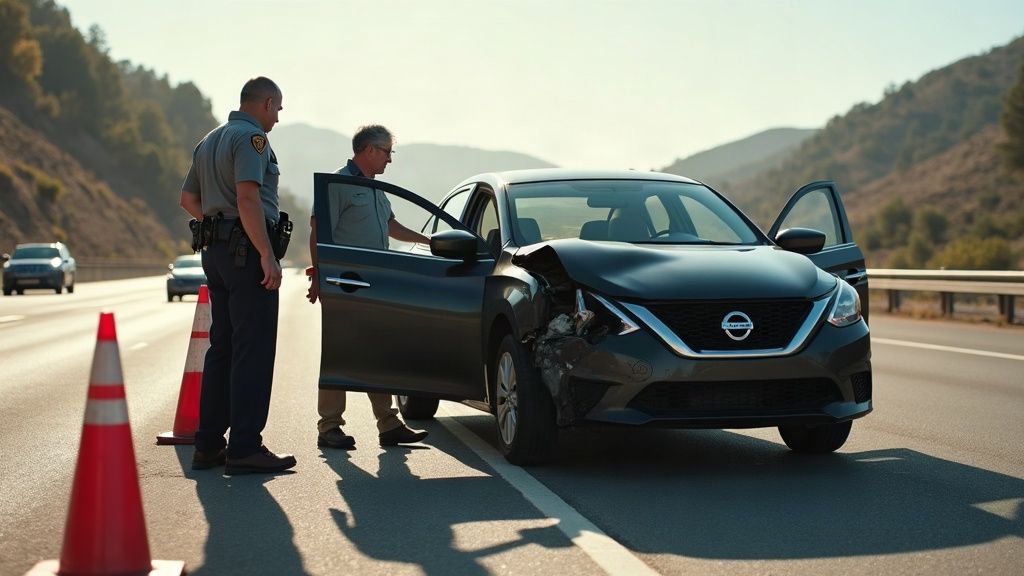
If you were in a car accident in California, your vehicle may have recorded exactly what happened in the seconds before the crash. That recording sits inside an event data recorder (EDR), sometimes called a black box, and it could be the most powerful piece of evidence in your case. It could also disappear before you ever know it existed.
We've recovered over $150,000,000 for injured people across Southern California. In disputed-fault cases, EDR data is one of the first things we move to preserve. Here are eight things every California driver should understand about this evidence.
Quick summary:
- Most modern vehicles contain an EDR, installed by the manufacturer, whether or not you knew about it.
- The recorder captures speed, braking, steering, and seatbelt status in the moments before impact.
- This sensor data is generally more reliable than human memory or witness accounts.
- California Vehicle Code Section 9951 restricts access to your EDR data without your consent or a court order.
- Insurers sometimes seek authorization to access this data immediately after a crash.
- The data can be permanently overwritten if the vehicle is repaired or scrapped before it is downloaded.
- A trained specialist with proprietary software is required to extract and interpret the data properly.
- EDR evidence can confirm or challenge disputed fault claims under California's pure comparative fault rule.
1. Most Modern Vehicles Have an Event Data Recorder, Even Without You Knowing It
Most passenger vehicles made after September 1, 2014 contain a federally required event data recorder that captures speed, braking, and steering input in the seconds before a crash.
Federal regulation 49 CFR Part 563, issued by the National Highway Traffic Safety Administration (NHTSA), requires EDRs in most new passenger vehicles sold in the United States beginning with the 2013 model year, with full compliance required by September 2014. That means if your car was manufactured in the last decade, it almost certainly has one, regardless of make or model.
The EDR is a small electronic module, typically embedded in the airbag control unit or a dedicated sensing and diagnostic module. It does not stream data anywhere or connect to the internet. It records locally and stores the data on an internal chip until a qualified technician downloads it using specialized equipment.
Many drivers are surprised to learn their vehicle has been recording this information. Manufacturers are not required to label the EDR or notify you at purchase. The requirement to disclose that an EDR is present lives in 49 CFR Part 563.11, but disclosure is buried in owner's manual language that most drivers never read.
Takeaway: Assume your vehicle has an EDR. After any crash, treat that data as potential evidence worth preserving.
2. Black Box Data Can Capture Speed, Braking, and Steering Just Before Impact
EDR data can be permanently overwritten when a new crash triggers the recorder, so downloading and preserving that data immediately after an accident is critical.
Under 49 CFR Part 563.7, EDRs in compliant vehicles must record a specific set of data elements. In the five seconds immediately before a collision, a typical EDR captures:
- Vehicle speed (in miles per hour, sampled at one-second intervals)
- Engine throttle position (what percentage the driver was pressing the accelerator)
- Brake application (whether the brake switch was on or off)
- Steering wheel angle (how sharply the driver was turning)
- Seatbelt status for the driver and front passenger
- Airbag deployment timing and sequence
- Change in velocity during the collision itself (delta-V)
- Number of crash events recorded on the module
The detail level varies by manufacturer. Newer vehicles from major automakers record more data points at higher sampling rates than the federal minimum. Some record lateral acceleration, stability control activation, and cruise control status as well.
This snapshot tells the story of what the vehicle was doing in the moments that mattered most. No driver testimony, no witness account, can match the precision of sensor-generated data captured in real time.
Takeaway: The EDR records what the vehicle was physically doing, not what any person remembers or claims. That distinction matters enormously in a disputed-fault case.
3. This Data Is Often More Reliable Than Driver Memory or Witness Accounts
Human memory is not a neutral recording device. Stress, adrenaline, and physical injury all distort how people encode and recall events. A driver who was traveling at 52 miles per hour may genuinely believe they were going 35. A witness who saw the crash from across a parking lot may be certain about details they could not physically have observed clearly.
EDR data does not have those problems. It is generated by the vehicle's onboard sensors at the moment of the event. It does not age, shift, or conform to what a person later wishes had happened.
California courts treat EDR data as electronic evidence subject to California Evidence Code Section 1553, which establishes a presumption of authenticity for electronically stored information produced under proper chain-of-custody conditions. When a certified technician downloads the data using validated equipment and documents the process correctly, that evidence arrives in court with strong foundational credibility.
Accident reconstructionists routinely use EDR data as the starting point for their analysis, treating it as the ground truth against which physical evidence (skid marks, point of impact, vehicle damage) is compared.
Takeaway: EDR data is not infallible, but it is far less susceptible to bias or distortion than human accounts. In a "he said, she said" fault dispute, it often becomes the deciding factor.
4. California Law Limits Who Can Access This Data Without Consent or a Court Order
Under California Vehicle Code Section 9951, your vehicle's event data recorder data belongs to you, and no insurer or third party can access it without your written consent or a court order.
California Vehicle Code Section 9951 is the primary statute governing EDR data in California. It states clearly that data recorded on an EDR in a motor vehicle is owned by the owner of that vehicle. The law prohibits downloading or accessing that data without:
- The written consent of the vehicle owner, or
- A court order, subpoena, or other legally valid process, or
- The need to do so for medical research related to the performance of emergency services, or
- Law enforcement acting in the course of a crash investigation.
This means your insurance company does not have an automatic right to your EDR data simply because you filed a claim. The opposing driver's insurance company has even less right. They need your written permission or a court order.
The California Department of Motor Vehicles and the DWC (relevant if the accident occurred during work duties) both operate under this framework. If a claim intersects with a workers' compensation matter because you were injured driving for your employer, the same data-access rules apply.
Takeaway: Do not sign any authorization form from an insurer without reading exactly what data access you are granting. A broad release may hand over your EDR data before you are ready.
5. Insurance Companies May Try to Pull This Data Quickly After a Crash
Insurance companies sometimes ask you to sign a broad authorization form after a crash that includes permission to access your vehicle's black box data before you have had a chance to review it.
After a crash, an insurance adjuster moves fast. Their job is to close claims at the lowest possible cost, and EDR data is a tool that helps them do that if they get to it before you do.
In practice, adjusters sometimes include EDR data access authorization language within broader "recorded statement" or "vehicle inspection" consent forms. A claimant who signs without reading carefully may hand over EDR access alongside permission for a physical inspection, without realizing the two are bundled.
Once an insurer downloads and interprets the data using their own analysts or contractors, they control the narrative around what it shows. You may not see their interpretation until settlement negotiations, when they use it as leverage to reduce your payout.
If the accident happened while you were working, a workers' compensation claim under Cal. Lab. Code §3600 may run parallel to a third-party personal injury claim against the at-fault driver. In that situation, both the workers' comp insurer and the third-party liability insurer may seek EDR access, and each has separate legal standing to do so through appropriate channels.
Takeaway: Before signing anything from an insurance company after a crash, have an attorney review the forms. An adjuster's urgency is not your emergency.
6. Data Can Be Overwritten or Lost If the Vehicle Is Repaired or Scrapped Too Soon
EDRs have limited storage capacity. Most store data from the most recent crash event, and some store only the most recent non-deployment event alongside the most recent deployment event. When a new triggering event occurs, older data is overwritten permanently.
Several common post-crash scenarios put EDR data at risk:
- Vehicle repair: If the vehicle is driven or towed and the EDR experiences a new impact or electronic reset during repairs, the crash data may be overwritten.
- Total loss processing: When an insurer declares a vehicle a total loss and transfers it to a salvage auction, the EDR travels with it. Salvage buyers are not obligated to preserve the data.
- Airbag module replacement: Replacing the airbag control module, which often houses the EDR, wipes the data stored on the old module.
- Battery disconnection: Depending on the vehicle and the EDR model, disconnecting the battery can in some cases affect stored data.
The solution is a litigation hold, also called a spoliation hold. An attorney can send a written preservation demand to all parties who have custody of the vehicle, including the opposing driver, their insurer, a body shop, or a salvage yard. This demand puts those parties on notice that the data is potentially relevant to litigation and that destroying it carries legal consequences under California law.
California courts have addressed spoliation of evidence in cases where parties failed to preserve electronic data. Depending on the circumstances, a court may instruct the jury that it can draw an adverse inference against the party who allowed the data to be destroyed.
Takeaway: If there is any dispute about fault, preserve the EDR data before the vehicle is repaired, totaled out, or moved to a salvage facility. The window can be as short as a few days.
7. A Specialist May Be Needed to Extract and Interpret the Data Correctly
A certified accident reconstructionist using specialized software is required to extract EDR data in a form that holds up in California court proceedings.
EDR data does not come out of the vehicle as a readable report. It requires proprietary hardware and software to access. The most widely used tool is the Bosch CDR (Crash Data Retrieval) system, which connects directly to the vehicle's OBD port or EDR module and downloads the raw data. Bosch licenses CDR to certified technicians, and the certification requires specialized training.
After extraction, the raw data still needs interpretation. Vehicle speed data, for example, must be correlated against the posted speed limit, road geometry, and physical evidence at the scene. Delta-V (the change in velocity during impact) must be analyzed against injury biomechanics to assess the forces experienced by occupants. That work belongs to an accident reconstructionist or forensic engineer with experience in EDR analysis.
In California civil proceedings, an expert who testifies about EDR data must qualify under the standards for expert witnesses set by the California Evidence Code Sections 801-805. Their methodology must be reliable and their opinions must assist the trier of fact. A technician who downloaded the data without proper certification, or an expert who cannot explain their analytical methodology, may face a motion to exclude their testimony.
At Nordanyan Law, when EDR evidence is relevant, we work with qualified accident reconstructionists who can extract, document, and testify to the data in a way that holds up under cross-examination. Our personal injury practice handles vehicle collision cases where this type of technical evidence makes the difference between a disputed claim and a documented one.
Takeaway: Do not attempt to access EDR data on your own or hire a generalist repair shop to retrieve it. Use a certified technician and document the chain of custody from the moment of download.
8. This Evidence Can Directly Support or Undercut a Disputed Fault Claim
If the opposing driver's EDR shows they were speeding or failed to brake, that data can directly shift liability in your favor under California's pure comparative fault rule.
California follows a pure comparative fault rule under Cal. Civ. Code §1714. That means fault is allocated as a percentage between all parties, and your recovery is reduced by your own percentage of fault. EDR data can move those percentages significantly.
Consider these scenarios:
- You were rear-ended and the other driver claims you stopped suddenly. Their EDR shows they were following at 65 mph with no brake application in the five seconds before impact. That data directly contradicts their account and eliminates any comparative fault argument against you.
- You were in an intersection collision and both drivers dispute who had the green light. Your EDR shows your vehicle accelerating from a stop, consistent with launching on a green. Their EDR shows they were already at highway speed with no deceleration, consistent with running a red.
- The other driver claims you were speeding. Your EDR shows your speed was 32 mph in a 35 mph zone with brakes applied three seconds before impact. Their narrative dissolves.
The same logic applies in the opposite direction. If your EDR data shows facts inconsistent with your account, the opposing party's attorney will use that to reduce or eliminate your recovery. This is why it is critical to have your own attorney review the data before the insurer does. You are entitled to your own data under California Vehicle Code Section 9951.
If your crash happened while you were performing job duties, the EDR data is also relevant to your workers' compensation claim. Speed and braking data can affect findings about whether the accident arose out of and in the course of employment under Cal. Lab. Code §3600.
To review your options and understand what evidence matters in your specific case, visit our free consultation page or review our case results.
Takeaway: EDR data is neutral, but the side that moves faster to preserve and interpret it gains a significant advantage in any fault dispute.
Frequently Asked Questions
What is a car's black box and does it record accidents?
A car's black box is an event data recorder (EDR), a small electronic module built into most modern vehicles. Under federal regulation 49 CFR Part 563, it records vehicle speed, braking, throttle, steering, seatbelt status, and airbag deployment in the seconds immediately before and during a crash. It is not a continuous recording device; it captures data only when the vehicle's sensors detect a triggering event such as a collision or near-collision.
Can I request my own vehicle's event data recorder information?
Yes. Under California Vehicle Code Section 9951, you own the data on your vehicle's EDR. You can request that a certified technician download and provide you with a copy of the data. Because proprietary software is required, you cannot access the raw data with standard consumer tools. A qualified accident reconstructionist or a law firm with the right forensic resources can arrange the download and provide you with an interpretable report.
How is black box data used in a California car accident claim?
EDR data is used as objective physical evidence to establish what the vehicle was doing at the moment of impact. In a disputed-fault claim, it can confirm or contradict driver statements, witness accounts, and insurance adjuster interpretations. California Evidence Code Section 1553 supports the authenticity of electronically stored information produced under proper chain-of-custody procedures. Attorneys and accident reconstructionists use EDR data to support liability arguments in settlement negotiations and at trial.
Do all cars have event data recorders?
Federal regulation requires EDRs in most passenger vehicles manufactured after September 1, 2014. Most vehicles produced in the 2013 model year and earlier also contain EDRs as a voluntary standard, since the technology has been common since the late 1990s. Heavy commercial trucks use separate electronic logging devices and engine control module data that serve similar evidentiary purposes. Motorcycles are generally not covered by the federal EDR requirement, though some newer models include similar technology.
Can an insurance company access my EDR data without my permission?
No. California Vehicle Code Section 9951 prohibits any person from downloading or accessing EDR data without the owner's written consent, a court order, a subpoena, or another legally valid legal process. An insurer cannot legally access your EDR data simply because you filed a claim. Review any authorization forms carefully before signing, and consult an attorney if you are unsure what access you are granting.
What happens if EDR data is destroyed before it can be preserved?
If a party with custody of a vehicle allows EDR data to be destroyed or overwritten after receiving notice that it may be relevant to litigation, California courts may find that party responsible for spoliation of evidence. A court can instruct the jury to draw an adverse inference against the spoliating party, meaning the jury may assume the destroyed data would have been unfavorable to that party. This makes early preservation critical for both sides of a dispute.
How quickly should EDR data be preserved after a crash?
As soon as possible. There is no fixed legal deadline in California for preserving EDR data, but the practical window is short. If the vehicle is driven again after the crash, repaired, declared a total loss, or transferred to a salvage yard, the data may be overwritten or lost entirely. An attorney can send a written preservation demand within days of a crash, putting all parties on notice of their obligation to protect the evidence.
What is the difference between EDR data and GPS or telematics data?
EDR data is recorded locally by the vehicle's internal sensors and covers only the seconds immediately before and during a crash. GPS and telematics data, such as data collected by a usage-based insurance program or a fleet tracking system, may record continuous location, speed, and driving behavior over longer periods. Both types of data are potentially discoverable in California litigation, but they are governed by different statutes and require different methods of preservation and production.
If you were injured in a car accident in California and fault is being disputed, every day matters. EDR data can disappear before you know it needs to be saved. Call (818) 794-9947 for a free consultation with a workers' comp and personal injury attorney. No fee unless we win.