If you were hurt in a car accident in California, the evidence you gather in the days and weeks after the crash determines how much compensation you can recover. Insurance adjusters are trained to find gaps in your documentation and use those gaps to reduce or deny your claim. The good news: you can close those gaps before they open.
We've recovered over $150,000,000 for injured workers and accident victims across Southern California since 2014. In our experience, the cases that settle at full value are the ones where the client walked in with organized, complete documentation. The cases that settle low are the ones where key records are missing.
Below is the complete list of documents you need to build a strong car accident claim in California, with the specific legal reason each one matters.
Quick summary:
- The police or traffic collision report
- Photos of vehicles, the scene, and your injuries
- Names and contact information of witnesses
- Medical records and bills
- Proof of lost wages from your employer
- The other driver's insurance information
- Repair estimates and property-damage records
- A written timeline and recovery journal
1. The Police or Traffic Collision Report
A California police or traffic collision report is the official record of the crash and is often required by insurers before they will open a claim.
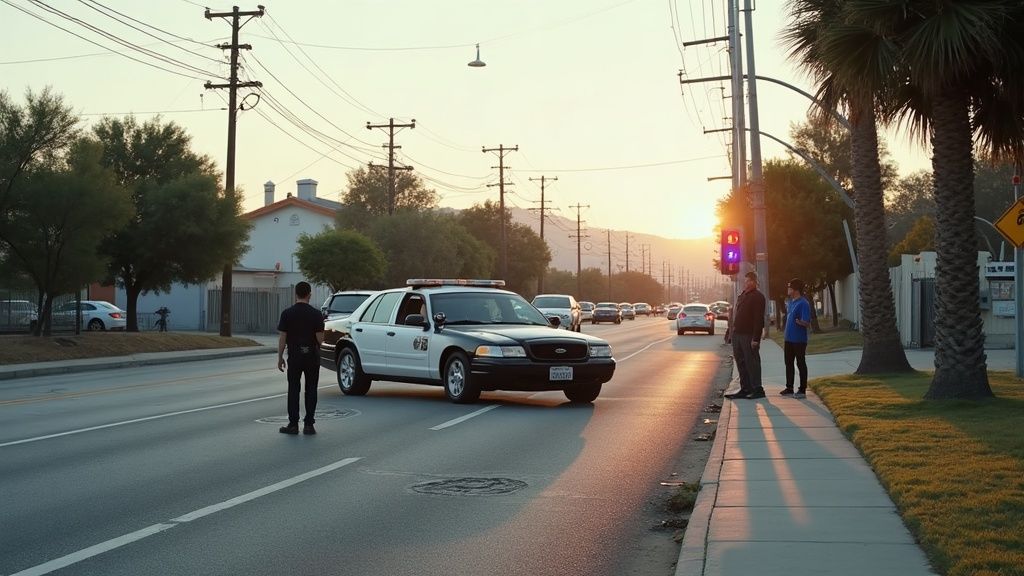
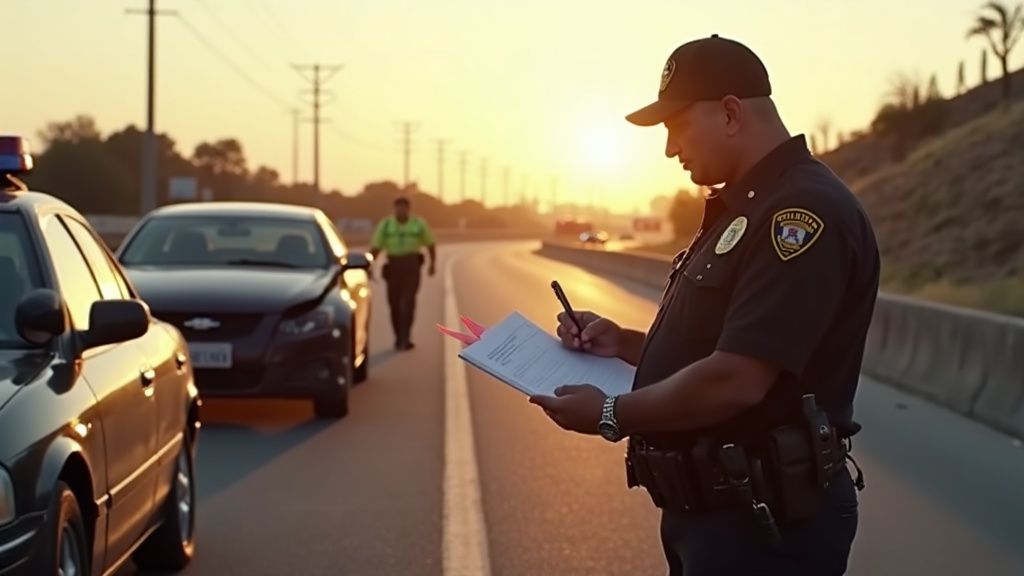
When a police officer responds to the scene, they prepare an official collision report that identifies the drivers, records the officer's observations, notes any citations issued, and sometimes includes a preliminary determination of fault. That report is one of the first documents an insurance adjuster or opposing attorney will request.
If no officer responded to your crash, California law still requires you to act. Under California Vehicle Code §16000, you must file a Report of Traffic Accident Occurring in California (SR-1) with the California DMV within 10 days of the collision when property damage exceeds $1,000 or when anyone was injured or killed, regardless of who was at fault. Missing this filing can create complications with your own insurance coverage.
Practical takeaway: Request a copy of the official collision report from the responding agency (CHP, LAPD, LASO, or your local department) as soon as it is available. Most agencies release reports within 5-10 business days of the crash.
2. Photos of Vehicles, the Scene, and Your Injuries
If property damage exceeds $1,000 or anyone was injured, you must file an SR-1 report with the California DMV within 10 days of the crash.
Photographs are the most durable evidence in a car accident claim because they capture conditions that change fast. Skid marks fade. Vehicles get repaired or crushed. Bruises heal. A photo taken at 3:47 p.m. on the day of the crash cannot be disputed the way a verbal description can.
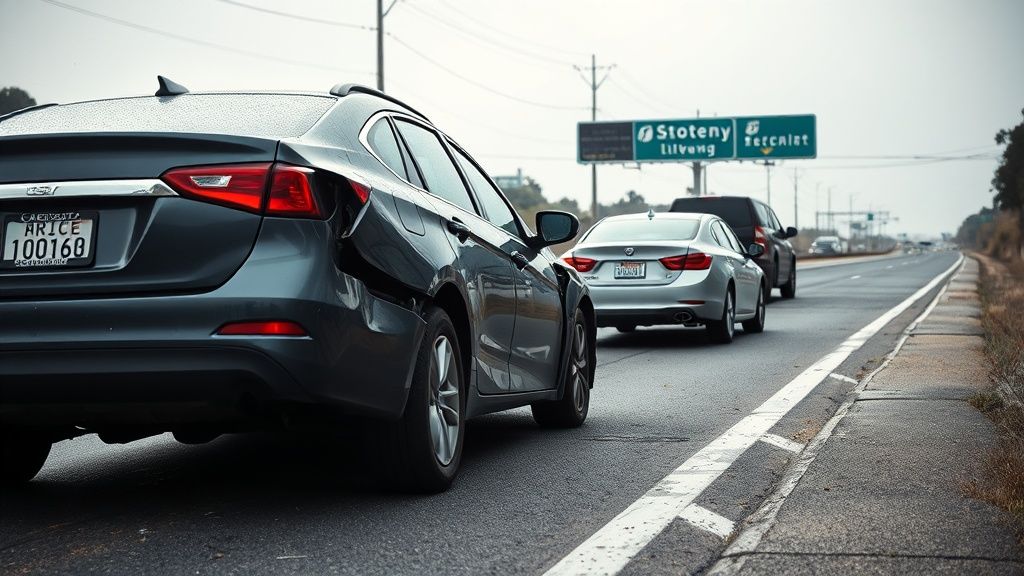
Shoot all four sides of every vehicle involved, the license plates, the point of impact, any debris on the road, skid marks, road conditions (wet pavement, potholes, missing signage), the surrounding intersection or highway, and any visible injuries on your body before medical staff treat them. If your phone was damaged in the crash or you were too injured to shoot photos yourself, ask a bystander, family member, or the responding officer.
Many newer vehicles have dashcams or event-data recorders. If the other vehicle is a commercial truck or fleet vehicle, its electronic logging device and dashcam footage may be the most important evidence in your case, but that data is often overwritten within 30 days. An attorney can send a litigation hold letter to preserve it.
Practical takeaway: Take at minimum 30 photographs at the scene: wide establishing shots, close-ups of damage, and close-ups of any injuries. Back them up to cloud storage immediately so they cannot be lost with a damaged phone.
3. Names and Contact Information of Witnesses
Independent witness contact information collected at the scene is far more reliable than information gathered days later, when witnesses become difficult to locate.
An independent witness, someone with no relationship to either driver, is one of the most persuasive forms of evidence available in a disputed-liability case. When your word directly contradicts the other driver's account, a neutral bystander who saw what happened can tip the scales.
At the scene, collect the full legal name, cell phone number, and home address of every witness willing to provide it. Do this before anyone leaves. People who say "I'll give you my card" rarely follow through, and witnesses who disperse into the community are hard to track down weeks later.
If witnesses give statements to the responding officer, those statements may appear in the official collision report. Ask the officer whether witness information will be included, but do not rely on the report alone, officers sometimes omit bystander contact details.
Practical takeaway: Approach every bystander who stopped to watch before they walk away. A 30-second conversation at the scene is worth hours of investigative work later.
4. Medical Records and Bills
Medical records that begin on the day of the crash and continue without gaps are the single strongest piece of evidence linking your injuries to the collision.
Your medical records serve two functions in a California personal injury claim. First, they establish causation: they document that your injuries began on the date of the crash and are consistent with the mechanism of injury. Second, they establish damages: every bill, invoice, and statement of charges is a line item in your economic damages calculation.
Collect records and billing statements from every provider who treated you: the emergency room, the ambulance service, your primary care physician, any specialist (orthopedist, neurologist, spine surgeon), physical therapists, chiropractors, and any mental health provider you saw because of the accident. Save every prescription receipt.
One of the biggest mistakes injured accident victims make is delaying medical care. If you wait two weeks to see a doctor, the insurer will argue that you were not seriously hurt, or that your injuries were caused by something that happened after the crash. Seek care the day of the crash or the day after, even if you believe your injuries are minor. Soft tissue injuries and traumatic brain injuries (TBIs) frequently have delayed symptom onset.
Under California Civil Code, economic damages in a personal injury case include all reasonable and necessary medical expenses, past and future. Future medical expenses require documentation too: a physician's letter or medical expert report projecting the cost of ongoing care, surgery, or long-term treatment.
Practical takeaway: See a doctor the day of the crash, keep every appointment, and never let a gap in treatment go undocumented. Gaps give adjusters an opening to deny or minimize your claim.
5. Proof of Lost Wages from Your Employer
Lost-wage documentation must include your rate of pay and the specific dates of missed work, typically provided in a signed employer letter, to be recoverable as economic damages under California tort law.
If your injuries forced you to miss work, California law allows you to recover those lost earnings as economic damages. But you have to prove them. Saying "I missed three weeks of work" without documentation leaves the adjuster room to dispute both the amount and the connection to the crash.
The standard form of proof is a signed letter from your employer on company letterhead that states: your position, your hourly rate or annual salary, the dates you were absent due to your injuries, and whether your absence was authorized. Attach recent pay stubs (typically the last three to four before the crash) to corroborate your stated rate of pay.
If you are self-employed, proof of lost income is more complex. You will need tax returns, profit-and-loss statements, client contracts, or invoices that demonstrate what you normally earn, paired with documentation showing the work you could not perform during your recovery.
If the crash caused a permanent disability that limits your future earning capacity, an economist or vocational rehabilitation expert may need to prepare a report projecting lifetime lost earnings. This is a separate, larger category of damages that requires expert testimony.
Practical takeaway: Ask your employer for a lost-wage letter within the first week of your absence. The details are easiest to document while the dates are fresh.
6. The Other Driver's Insurance Information
California Vehicle Code §16025 requires every driver involved in a collision to exchange name, address, driver's license number, vehicle registration number, and insurance policy information at the scene. This is not optional, and refusing to exchange information is itself a violation of California law.
From the other driver, you need: their full legal name, home address, driver's license number, vehicle license plate, the name of their insurance company, their policy number, and the insurer's claims phone number. Most drivers keep this information on their insurance ID card.
Photograph the other driver's insurance card with your phone rather than copying the number by hand. Handwritten numbers are frequently transposed; a photo is an exact reproduction.
If the other driver refuses to provide insurance information, or if they flee the scene, note their license plate, vehicle make, model, and color, and report it to the responding officer immediately. In a hit-and-run, your own uninsured motorist (UM) coverage under California Insurance Code §11580.2 may be your primary recovery vehicle.
Practical takeaway: Photograph the other driver's insurance card and driver's license at the scene. Never rely on the other driver to send this information later.
7. Repair Estimates and Property-Damage Records
Property damage is a tangible, dollar-quantifiable component of your claim, and it is typically the easiest to document fully. Do not skip it.
Obtain written repair estimates from at least two licensed auto repair shops. Some insurers will send their own appraiser and offer a lower estimate; having independent estimates from reputable shops gives you a documented basis to challenge that figure.
If your vehicle was declared a total loss, the insurer is required to pay you the fair market value of the vehicle as of the date of the crash, not the retail replacement cost. Research comparable vehicles on published databases and keep those records in case you need to dispute the insurer's valuation.
Also document every related out-of-pocket expense: rental car costs while your vehicle was being repaired or replaced, rideshare receipts if you had no rental, towing fees, and storage fees charged by the impound yard. These are all recoverable economic damages.
Practical takeaway: Keep a dedicated folder, physical or digital, for every receipt and estimate related to your vehicle and transportation. These are direct reimbursable expenses and are easy to overlook.
8. A Written Timeline and Recovery Journal
A personal recovery journal that records daily pain levels, treatment visits, and activity restrictions creates contemporaneous evidence of non-economic damages that insurers and juries can evaluate.
Non-economic damages, pain and suffering, emotional distress, loss of enjoyment of life, and loss of consortium, are real compensable harms under California law, but they are subjective by nature. A jury or adjuster cannot see your pain. A journal written in the days, weeks, and months after the crash is the closest thing to a contemporaneous record of what you actually experienced.
Start your journal the evening of the crash. Write at minimum three to four times per week, and ideally every day. Record: your pain level on a scale of 1 to 10, the location and character of your pain, which activities you were unable to perform (cooking, driving, lifting, sleeping, playing with your children, exercising), how your injuries affected your mood and relationships, and every medical appointment and what was discussed.
A journal that begins weeks after the crash is far less credible than one that starts immediately. Gaps in the journal create the same problem as gaps in your medical records: they give the opposing side room to argue that you were not suffering during the undocumented periods.
Your attorney will review your journal before it is produced in discovery. Keep it factual and specific. Avoid hyperbole. An entry that reads "I could not lift my left arm above shoulder height to reach the cabinet and had to ask my wife to help me dress" is far more useful than "I was in terrible pain all day."
Practical takeaway: Start your recovery journal tonight, not next week. Every day you wait is a day of undocumented suffering that you cannot recover.
How These Documents Work Together
No single document wins a California car accident claim on its own. The police report establishes the basic facts of the crash. The photographs confirm the physical reality of those facts. The witness statements corroborate your account. The medical records connect your body to the event. The lost-wage documentation converts your suffering into a dollar amount. The insurance information tells you who is paying. The repair estimates quantify the property damage. And the journal gives a human face to the non-economic harm.
An insurance adjuster evaluating your claim is doing a simple calculation: how much will this case cost us at trial compared to what we can settle it for now? Every document on this list raises that trial-cost estimate in the adjuster's model. The more complete your documentation, the less leverage the adjuster has to push the settlement below full value.
If your documentation is incomplete, call an attorney before you accept any settlement offer. Once you sign a release under California Code of Civil Procedure §877.6 and related provisions, you generally cannot go back and claim additional compensation, even if you later discover your injuries were more serious than you thought.
We handle every case as if it were going to trial, because insurance companies settle for more when they know the other side is prepared to fight. If you've been in a car accident in California and need help organizing your documents or evaluating your claim, call (818) 794-9947 for a free case review. No fee unless we win.
Frequently Asked Questions
What documents do I need for a car accident claim in California?
The core documents are: the police or traffic collision report, photographs of the vehicles, scene, and injuries, witness contact information, complete medical records and bills from the date of the crash forward, proof of lost wages from your employer, the other driver's insurance information, repair estimates and property-damage receipts, and a written personal recovery journal. Together these documents establish liability, causation, and the full value of your economic and non-economic damages.
Do I need a police report for a car accident claim?
A police report is not legally required to file a claim, but it is one of the most important documents you can have. Insurers frequently require it to open a third-party liability claim. If no officer responded to your crash, file an SR-1 with the California DMV within 10 days under California Vehicle Code §16000 when damage exceeds $1,000 or anyone was injured.
What evidence most helps a car accident case?
Medical records that begin the day of the crash and continue without gaps are the single most valuable piece of evidence, because they establish both the existence of your injuries and their direct link to the collision. Photographs taken at the scene and independent witness testimony are the next most important, because they address liability.
How long do I have to file a car accident lawsuit in California?
Under California Code of Civil Procedure §335.1, the statute of limitations for a personal injury claim arising from a car accident is two years from the date of the injury. If your claim is against a government entity (for example, a city bus or a county vehicle), California Government Code §945.4 requires you to file an administrative claim within six months of the incident, a much shorter window.
What if the other driver has no insurance?
If the at-fault driver is uninsured, your recovery options include your own uninsured motorist (UM) coverage under California Insurance Code §11580.2 and, in some cases, a judgment against the at-fault driver personally. Document everything the same way you would in any other claim. Your insurance policy's UM coverage triggers when the at-fault driver cannot pay.
Do I need an attorney to gather these documents?
You can gather these documents yourself. However, an attorney adds value by sending litigation hold letters to preserve dashcam footage and electronic data before it is overwritten, by subpoenaing employer and medical records that providers sometimes delay, and by ensuring that your documented damages are presented in the format insurers and courts expect. Attorney-represented claimants in California personal injury cases generally recover more than unrepresented claimants, even after the attorney's contingency fee.
Should I give a recorded statement to the insurance company before I have my documents together?
No. You are not legally required to give a recorded statement to the other driver's insurer, and doing so before you have organized your documentation puts you at a disadvantage. Adjusters are trained to ask questions in ways that can be used to minimize your claim. Speak with an attorney first. Call (818) 794-9947 for a free consultation before you give any recorded statement.
Can I still file a claim if I did not see a doctor right away?
Yes, but the gap in care will be used by the insurer to argue that your injuries were not caused by the crash, or that they are less serious than you claim. See a doctor as soon as possible, explain the delay honestly, and document your symptoms from the date of the crash in your recovery journal. An attorney can help you address the gap in your medical narrative when negotiating with the insurer.
Reviewed by Minas Nordanyan, CA Bar #296806. If you've been injured in a California car accident, call (818) 794-9947 for a free case review. No fee unless we win. Available in English and Spanish.