If you were bitten by a dog in California, the law is on your side in ways most people never learn about. California is one of the toughest states in the country for dog bite claims — and that means more rights for you, not fewer. Under California Civil Code §3342, you don't have to prove the owner was careless or that the dog had a dangerous history. You just have to prove the bite happened.
Below is a plain-English breakdown of every right you have as a California dog bite victim — backed by the statutes, not slogans.
Quick summary — your 7 rights:
- California is a strict-liability state, so the owner is liable even on the dog's first bite.
- You can recover all medical bills, including reconstructive surgery.
- You can recover for scarring, disfigurement, and emotional trauma.
- Lost wages and future earning loss are fully recoverable.
- Being on the owner's property does not bar your claim if you were lawfully there.
- Homeowner's or renter's insurance usually pays — not the owner personally.
- You have two years to file; six months if a government agency owned the dog.
1. California Is a Strict-Liability State
California Civil Code §3342 makes dog owners strictly liable for bite injuries — you do not need to prove the owner knew the dog was dangerous.
Under Cal. Civ. Code §3342, an owner "is liable for the damages suffered by any person who is bitten by the dog" when that person was in a public place or lawfully in a private place. The rule applies regardless of the dog's prior behavior. There is no "one free bite" in California — a legal myth that other states still allow. The first bite is enough.
This is what lawyers mean when they say California is a "strict liability" state. You don't need to find old bite reports, vet records showing aggression, or neighbor complaints. You need to show three things: a dog bit you, the defendant owned the dog, and you were lawfully present when it happened.
Practical takeaway: Focus on documenting the bite and the owner's identity — not on proving the owner should have known the dog was dangerous.
2. You Can Recover for All Medical Bills, Including Reconstructive Surgery
California dog bite victims can recover for medical bills, lost wages, scarring, disfigurement, and emotional trauma in a single civil claim.
California personal injury law entitles you to full compensation for every medical expense caused by the attack. That includes the emergency room visit, wound cleaning, rabies prophylaxis, antibiotics, follow-up care, physical therapy, and — critically — reconstructive or cosmetic surgery to address permanent scarring or functional damage.
Dog bites frequently damage facial tissue, hands, and arms — areas where reconstructive surgery is both medically necessary and expensive. Courts and insurance adjusters cannot force you to "live with" a preventable disfigurement to save money. If a surgeon recommends reconstruction, that cost belongs in your claim.
Future medical expenses are recoverable too. If your treating physician documents ongoing treatment — additional procedures, scar revision, therapy — those projected costs are part of your damages today, even if the bills haven't arrived yet.
Practical takeaway: Keep every medical record, every bill, and every physician recommendation. Future care projections from your doctor are as important as what you've already spent.
3. You Can Recover for Scarring, Disfigurement, and Emotional Trauma
A dog bite that happens on the owner's private property does not automatically bar your claim, as long as you were lawfully present.
Beyond medical bills — called economic damages — California law allows you to recover non-economic damages for what you've lost that doesn't come with a receipt. Permanent scarring and disfigurement are compensable as non-economic harm. So is the psychological impact of the attack.
Dog attack survivors frequently develop clinical anxiety, phobias (fear of dogs, of being outdoors), and post-traumatic stress disorder (PTSD). These are real, documented medical conditions, and California courts treat them as recoverable harm. A mental health diagnosis from a licensed provider strengthens this part of your claim significantly.
There is no statutory cap on non-economic damages in a California dog bite case — unlike, say, medical malpractice claims, which are capped under the MICRA framework. The value depends on the severity of the scarring, its location (facial vs. non-visible), its permanence, and the documented psychological impact.
Practical takeaway: Start mental health treatment promptly after the attack and document your symptoms. Those records directly support the non-economic portion of your claim.
4. Lost Wages and Future Earning Loss Are Recoverable
Lost wages and reduced earning capacity are compensable economic damages in a California dog bite case — both what you've already lost and what you stand to lose in the future.
If a bite on your dominant hand prevents you from returning to your trade, your career-long income loss is part of your claim. California courts allow expert testimony from vocational rehabilitation specialists and economists to quantify future earning loss, particularly when the injury is permanent.
This right matters most for workers who depend on physical ability — tradespeople, healthcare workers, drivers, laborers. A bite to the hand, wrist, or arm can end or permanently limit a career in ways a simple soft-tissue injury cannot. Don't accept a settlement that only covers past lost paychecks without accounting for what you can no longer earn.
Practical takeaway: Collect pay stubs, W-2s, and employer documentation of any shifts or hours you missed. If the injury is permanent, ask your doctor to document functional limitations in writing.
5. You May Have a Claim Even on the Owner's Property
A dog bite that happens on the owner's private property does not automatically bar your claim, as long as you were lawfully present.
Cal. Civ. Code §3342 explicitly covers bites that occur "in a private place" as long as the victim was "lawfully in such private place." The statute lists invited guests, but the lawful-presence standard extends broadly.
Who counts as lawfully present on private property?
- Invited social guests — you were invited, directly or impliedly
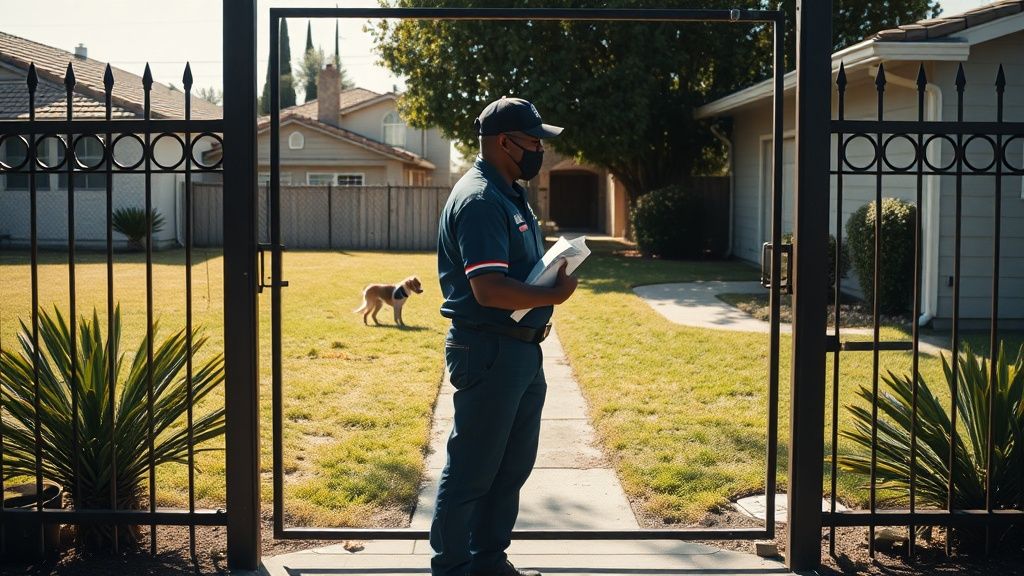
- Postal carriers and delivery workers — performing a mail or package delivery under federal or private authority (courts have consistently recognized their lawful-presence status)
- Contractors and service workers — electricians, plumbers, landscapers performing authorized work
- Children visiting a playmate — typically covered, even without an explicit invitation from an adult homeowner
Who is generally excluded from §3342's strict-liability protection?
- Trespassers — people who entered without permission and without lawful authority. Note that a trespasser may still have a negligence claim under general premises liability law, but the strict-liability path is closed.
If you were bitten while working on someone's property — say, during a maintenance call or a delivery — your rights may also intersect with workers' compensation if the dog's owner was your employer or a customer of your employer. Those two claims can run in parallel.
Practical takeaway: If you were invited, working, or delivering when bitten, you were almost certainly lawfully present. Don't assume being on private property bars your claim.
6. Homeowner's or Renter's Insurance Often Covers the Payout
Most California homeowner's and renter's insurance policies cover dog bite liability, so the insurance carrier — not the owner out of pocket — typically pays.
Most standard California homeowner's insurance policies include personal liability coverage — typically ranging from $100,000 to $300,000 per occurrence — that covers dog bite claims. Renter's insurance policies carry comparable personal liability limits. This means that when you file a dog bite claim, you are almost always negotiating with an insurance adjuster, not directly with an individual who has to write a personal check.
There are exceptions. Some insurers exclude certain breeds (commonly Pit Bulls, Rottweilers, German Shepherds, and Akitas) from coverage, either entirely or through a rider. If the owner's policy excludes the breed, coverage may be denied, and you may be pursuing the owner personally.
What to do: Request proof of the owner's homeowner's or renter's insurance as early as possible. An attorney can send a preservation demand to the insurer directly, locking in the policy information before the owner has an opportunity to let coverage lapse or deny the claim.
Practical takeaway: The existence of insurance coverage changes the practical path to recovery. Identifying the carrier early is one of the most important first steps in a dog bite case.
7. You Have 2 Years to File — Shorter for Government-Owned Dogs
The deadline to file a California dog bite lawsuit is two years from the date of the attack under Code of Civil Procedure §335.1.
Cal. Code Civ. Proc. §335.1 sets the personal injury statute of limitations at two years from the date of the injury. Miss that window and California courts will dismiss your case regardless of how serious your injuries are or how clear the owner's liability is.
If a government agency owned the dog, you must file a written claim under the Government Claims Act within six months of the bite.
The government exception is critical. If the dog was owned or controlled by a government entity — a city police K-9, a county animal control dog, a state park service dog — you must first file a written claim with that government agency under the California Government Claims Act (Gov. Code §911.2) within six months of the date of the attack. If the agency sends you a written rejection, you then have six months from that rejection to file suit; if the agency never responds in writing, you generally have two years from the incident to sue. Miss the six-month government claim window and you are generally barred from any recovery.
Practical timeline guide:
Private owner's dog: 2 years from bite date (CCP §335.1)
Government agency's dog: 6 months to file government claim; 6 months after rejection to sue (Gov. Code §911.2)
Victim is a minor: Statute may be tolled (paused) until the minor turns 18 — consult an attorney
Even though two years sounds like plenty of time, evidence disappears fast. Surveillance footage is routinely overwritten within 30 to 90 days. Witnesses forget details. The owner may relocate, change insurance, or surrender the dog. Starting the claim process within weeks — not months — of the bite protects your ability to build the strongest possible case.
Practical takeaway: The two-year deadline is the outer limit, not the target date. Acting early preserves evidence and prevents the government claim trap from catching you off guard.
What to Do Immediately After a Dog Bite in California
Knowing your rights matters. Protecting your ability to exercise them requires action in the hours and days after the bite.
- Get medical care first. Dog bites carry serious infection risk, including rabies and Pasteurella bacteria. Even a bite that seems minor should be evaluated. Your medical records are also your first piece of evidence.
- Identify the dog's owner. Get a full name, address, and phone number. Ask for the dog's vaccination records — rabies vaccination status affects your medical treatment plan.
- Photograph everything. The wound before treatment, the location of the attack, the dog if safe to do so, and any torn clothing.
- Report the bite. California requires dog bites to be reported. Contact your local animal control or DIR for workplace bites. A report creates an official record.
- Preserve insurance information. Ask the owner for their homeowner's or renter's insurer.
- Contact an attorney before speaking to the owner's insurer. Insurance adjusters work to minimize the payout. Anything you say — including an offhand comment about not feeling that bad — can be used to reduce your claim.
Frequently Asked Questions
Is California a strict liability dog bite state?
Yes. Under Cal. Civ. Code §3342, a dog owner in California is liable for bite injuries regardless of the dog's prior behavior. There is no "one free bite" rule in California — the owner is responsible from the very first bite.
Can I sue for a dog bite in California?
Yes. You can file a civil personal injury lawsuit against the dog's owner for a bite that occurred in a public place or while you were lawfully on private property. You can recover medical bills, lost wages, pain and suffering, scarring, and emotional distress.
Does homeowner's insurance cover dog bites in California?
In most cases, yes. Standard homeowner's and renter's insurance policies include personal liability coverage that pays dog bite claims. However, some policies exclude specific dog breeds. Identifying the owner's insurer early is a key step in the claims process.
What if the dog bite happened on the owner's property?
Being on the owner's property does not bar your claim. Cal. Civ. Code §3342 specifically covers bites on private property as long as you were lawfully present — whether as a guest, a delivery worker, a contractor, or any other person with a right to be there.
How long do I have to file a dog bite claim in California?
You have two years from the date of the bite under Cal. Code Civ. Proc. §335.1. If a government agency owned the dog, you must file a written claim with that agency within six months under the Government Claims Act — or you lose the right to sue entirely.
What if the bite was from a police dog?
Government-owned dogs — including law enforcement K-9s — are still subject to California's strict liability statute in many circumstances, but you must comply with the Government Claims Act and file your written government claim within six months of the incident. Missing that deadline ends your case.
Can a child recover for a dog bite in California?
Yes. A child who is bitten by a dog has the same right to compensation as an adult. In most cases, the statute of limitations is tolled (paused) until the minor turns 18, giving additional time to file. A parent or guardian can also file on the child's behalf before that date.
What if the dog scratched me but didn't bite me?
Cal. Civ. Code §3342 applies specifically to bites. For other injuries caused by a dog — a scratch, a knockdown, or a chase that caused you to fall — you may have a claim under general negligence principles rather than the strict-liability statute, but you must show the owner knew or should have known the dog posed a risk. An attorney can evaluate whether your specific facts support a negligence claim.
Do I need an attorney for a dog bite claim?
You are not required to hire an attorney, but insurance adjusters are experienced negotiators whose job is to minimize payouts. An attorney who handles dog bite claims can document your full damages — including future medical expenses and non-economic harm that adjusters routinely undervalue — and build a claim that reflects what you are actually owed.
California's dog bite law gives you real, enforceable rights. But those rights only pay off if you act before evidence disappears, before insurance adjusters lock in a lowball number, and before a deadline quietly runs out.
If you or someone you care about was bitten by a dog in California, we're ready to walk through the facts of your case — at no cost and with no fee unless we win. Call (818) 794-9947 for a free case review. Available in English and Spanish.
Reviewed by Minas Nordanyan, CA Bar #296806 — Nordanyan Law, Van Nuys, California. Last reviewed June 2026. This article is for general informational purposes and does not constitute legal advice. For advice specific to your situation, call (818) 794-9947.