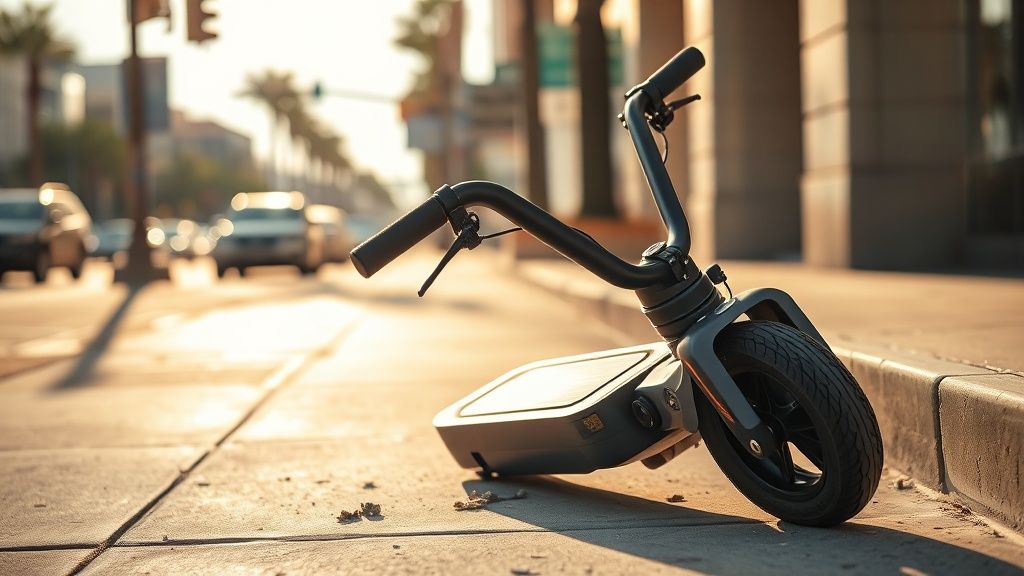
If you were hurt in an electric scooter crash in California — or hit by a rider on one — the first question everyone asks is: who pays?
The honest answer is: it depends. California e-scooter liability is a patchwork of state statutes, local ordinances, rental company contracts, and insurance gaps that can leave injured people confused about where to turn. This guide cuts through the clutter.
Quick-answer summary:
- California classifies e-scooters as motorized scooters under Cal. Veh. Code §407.5 — specific traffic rules apply
- Liability can fall on the rider, the rental company (Lime, Bird), or the scooter manufacturer depending on the facts
- App user agreements include arbitration clauses — but those clauses have limits under California law
- Sidewalk riding is illegal; a rider who hits a pedestrian doing it may be negligent per se
- California's two-year personal injury statute of limitations applies (Cal. Code Civ. Proc. §335.1)
- A free case review costs you nothing — call (818) 794-9947
The Patchwork of CA E-Scooter Rules and Local Ordinances
In California, electric scooters are legally classified as motorized scooters under Vehicle Code §407.5, which sets the rules for where they can ride, how fast they can go, and who is responsible when something goes wrong.
Under state law, riders must:
- Be at least 16 years old (Cal. Veh. Code §21235)
- Wear a helmet if under 18 (adults are exempt from the state helmet requirement, though some cities add their own)
- Ride in a bike lane where one exists, or as close to the right curb as practicable
- Stay under 15 mph
- Not ride on a sidewalk
Here is where it gets complicated. State law sets the floor. Cities and counties add their own rules on top. Los Angeles, San Francisco, Santa Monica, and San Diego each have local ordinances that govern permitted operating areas, parking zones, speed limits, and which companies are allowed to deploy scooters. Those local ordinances affect where a rider is allowed to be at the moment of a crash — and that matters when assigning fault.
If a rider was in a zone where scooters were banned by local ordinance at the time of your crash, that fact is relevant evidence in a negligence claim.
Suing the Rental Scooter Company vs. a Defective Scooter Claim
Most people assume Lime or Bird automatically pays if their scooter hurt someone. The reality is more complicated — but there are two separate legal theories that can apply.
Negligence by the rental company
Rental companies have a duty to maintain their fleets in reasonably safe working condition. If a scooter had a known defect — worn brakes, a battery fire risk, a throttle that sticks — and the company failed to inspect or repair it before deploying it, they may be liable for the resulting injuries.
If a negligently maintained scooter — a broken brake, a faulty throttle, a defective battery — caused your crash, you may have a product liability claim against the company that owns or manufactured it, separate from any negligence claim.
Building a case against Lime or Bird requires evidence: maintenance logs, prior incident reports, the specific scooter's service history, and expert testimony about the defect. These companies are sophisticated defendants with legal teams. The sooner you preserve evidence — including the specific unit ID on the scooter and photos from the scene — the better.
Product liability against the manufacturer
If the scooter itself was defectively designed or manufactured — not just poorly maintained — the manufacturer may be a separate defendant. California recognizes strict product liability, meaning you do not have to prove the manufacturer was careless. You only have to prove the product was defective and that the defect caused your injury.
This theory applies whether you are the rider injured by a malfunction or a pedestrian hurt by a scooter that behaved unexpectedly.
Arbitration Clauses in App User Agreements — and Their Limits
Before anyone rides a Lime or Bird scooter, they agree to a lengthy terms-of-service. Buried in that agreement is almost always an arbitration clause: a provision requiring you to resolve disputes through private arbitration rather than in court.
For many injured riders, this clause is the first obstacle they hit when they try to hold the company accountable.
Most rental scooter apps include an arbitration clause that requires you to resolve disputes outside of court, but California courts have found some of these clauses unenforceable when they are unconscionable or buried in fine print.
Here is what you need to know:
- Arbitration is not automatic. A California court will only enforce the clause if the company can show the user had meaningful notice and an opportunity to review the terms. Courts look at whether the clause was clearly presented or buried in a scroll-through screen.
- Unconscionability is a defense. Under California law, courts can refuse to enforce a contract clause — including an arbitration clause — that is both procedurally unconscionable (you had no real choice) and substantively unconscionable (the terms are shockingly one-sided). See Cal. Civ. Code §1670.5.
- Third parties are not bound. If you are a pedestrian or another vehicle occupant who was hurt by a Lime or Bird scooter — and you never signed their user agreement — the arbitration clause does not apply to you. You can sue in court.
If you are a rider who signed the agreement, do not assume arbitration is a dead end. Many attorneys have successfully challenged these clauses. Talk to a lawyer before you decide arbitration is your only option.
Pedestrians Struck by Scooters and Sidewalk-Riding Violations
If a scooter rider hit you while you were walking, your claim is a straightforward pedestrian injury case — but California law gives you a useful legal tool if the rider was on the sidewalk.
Riding an electric scooter on a sidewalk is illegal in California under Vehicle Code §21235, and a rider who hits a pedestrian while doing so can be found negligent per se — meaning their violation of the law is itself evidence of fault.
Negligence per se is a doctrine under California law. When someone violates a statute designed to protect a specific class of people from a specific type of harm, that violation is treated as evidence of negligence. You still have to prove causation and damages, but you do not have to separately prove the rider was acting unreasonably — the law already says they were.
Practically speaking, this means:
- You document that the rider was on the sidewalk (witness statements, security footage, photos)
- You establish that Cal. Veh. Code §21235 prohibits sidewalk riding
- You are in the class of people that statute protects (pedestrians)
- The sidewalk riding caused your injury
From there, the fight shifts to damages — medical bills, lost wages, pain and suffering — and any comparative fault argument the rider's insurer might raise.
Insurance Gaps That Leave Victims Uncovered
This is where e-scooter cases get particularly difficult. The insurance picture is full of holes.
Riders often have no liability coverage. Personal auto insurance typically covers cars — not motorized scooters. Some homeowner's and renter's policies include personal liability coverage that might apply, but many do not. A rider who hits you may have no insurance that covers the incident at all.
Rental companies disclaim liability in their terms. Lime and Bird both attempt to contractually limit their liability in their user agreements. Whether those limitations hold up depends on the specific facts and whether the arbitration clause is enforceable.
The result: an injured victim can find themselves dealing with a rider who has no relevant insurance, a company hiding behind a user agreement, and a manufacturer in another state or country.
If the scooter rider who hit you was uninsured and you have uninsured motorist coverage, your own auto policy may cover your injuries — call your insurer and an attorney before signing anything.
A few insurance angles worth exploring:
- Your own auto policy's uninsured motorist (UM) coverage — California requires insurers to offer UM coverage; if a scooter qualifies as a motor vehicle under your policy's definitions, your UM coverage may apply
- Your health insurance — covers medical bills regardless of fault, which buys time to build the liability case
- The rental company's commercial general liability policy — Lime and Bird carry commercial insurance; whether it applies to your specific claim is a factual and legal question
An attorney can pull the coverage picture together and identify every source of recovery before you decide how to proceed.
Comparative Fault: What Happens If You Were Partly to Blame
Not every e-scooter crash is entirely someone else's fault. Maybe you stepped into a bike lane without looking. Maybe you were distracted. California's comparative fault rule determines what happens next.
California follows a pure comparative fault rule under Civil Code §1714, which means you can recover damages even if you were partly at fault — your award is simply reduced by your percentage of responsibility.
Under Cal. Civ. Code §1714, California uses a pure comparative fault system. That means:
- If you were 20% at fault and the rider was 80% at fault, you recover 80% of your damages
- If you were 60% at fault, you recover 40%
- There is no threshold that bars you from recovering — even a mostly-at-fault plaintiff can still receive something
Defense lawyers for scooter companies and riders will almost always try to argue that you share some of the blame. An experienced personal injury attorney knows how to push back on inflated comparative fault arguments.
What to Do After an E-Scooter Accident in California
Whether you are the injured rider or the person who was hit, the steps you take in the hours and days after a crash directly affect what you can recover.
1. Call 911 and get a police report. A police report documents the scene, the parties, and any traffic law violations — including sidewalk riding.
2. Photograph everything. The scooter (especially the unit ID number on the deck), the scene, your injuries, any skid marks or debris, and the road or sidewalk conditions.
3. Get witness information. Names and phone numbers. Witnesses are often gone within minutes.
4. Seek medical care immediately. Even if you feel okay. Adrenaline masks pain. Some serious injuries — concussions, internal bleeding — show symptoms hours later. Your medical records are the foundation of your damages claim.
5. Do not sign anything from the scooter company or their insurer. A quick settlement offer — especially one that arrives fast — is almost always for less than your case is worth. Once you sign a release, you cannot come back for more.
6. Preserve the scooter information. Note the operator (Lime, Bird, or another company), the unit ID visible on the scooter, and the approximate GPS area so the company can identify the specific vehicle.
7. Call an attorney before you talk to any adjuster. Adjusters are trained to minimize what they pay. They are not on your side. An attorney is.
You have two years from the date of an e-scooter accident to file a personal injury lawsuit in California under Code of Civil Procedure §335.1, but evidence disappears fast — the sooner you act, the stronger your case.
FAQ
Who is liable in an electric scooter accident in California?
Liability depends on the facts. The rider can be liable for negligent operation — speeding, running a red light, riding on the sidewalk. The rental company (Lime, Bird) can be liable if a defective or poorly maintained scooter caused the crash. A manufacturer can be liable under product liability theory if the scooter was defectively designed or built. In many crashes, more than one party shares responsibility. California's pure comparative fault rule means each party pays their share.
Can I sue Lime or Bird after a scooter accident?
Yes, but it is not automatic. You need facts that support liability — typically evidence that the company deployed a scooter it knew or should have known was unsafe, or that a design or manufacturing defect caused the crash. The company will point to its user agreement as a defense. Whether that agreement protects them depends on whether the arbitration clause is enforceable and whether your claim falls within its scope. If you were a pedestrian who never signed the agreement, you are not bound by it at all.
Does the rider agreement waive my rights?
It limits them — but does not necessarily eliminate them. California courts will not enforce arbitration clauses that are unconscionable under Cal. Civ. Code §1670.5. The clause also only binds people who actually signed the agreement. If you were a pedestrian, bystander, or anyone other than the rider, the user agreement is irrelevant to your claim.
What if a scooter rider hit me as a pedestrian?
You have a personal injury claim against the rider for negligence. If the rider was on the sidewalk at the time, you can invoke the negligence per se doctrine under Cal. Veh. Code §21235 — the illegal sidewalk riding is itself evidence of fault. You can also explore claims against the rental company if a mechanical defect contributed to the crash. Gather as much evidence from the scene as possible, get medical care right away, and call an attorney before speaking to any insurer.
What insurance covers e-scooter accidents in California?
Coverage is fragmented. Riders typically do not have scooter-specific liability insurance. Their homeowner's or renter's policy may include personal liability coverage — but many do not. The rental company carries commercial insurance, but whether it covers your specific claim depends on the circumstances. Your own auto policy's uninsured motorist coverage may apply if the scooter qualifies as a motor vehicle under the policy. Your health insurance covers your medical bills regardless. An attorney can map out every available source of recovery.
How long do I have to file a lawsuit after an e-scooter accident in California?
Two years from the date of the accident under Cal. Code Civ. Proc. §335.1. However, if the at-fault party is a government entity — say, a city that owns or operates scooters — you may have as little as six months to file a government tort claim under Cal. Gov. Code §911.2. Do not wait. Evidence disappears, witnesses forget details, and scooter companies delete maintenance records. The sooner you act, the stronger your position.
Does it matter if I was not wearing a helmet?
For adult riders, California state law does not require a helmet — so riding without one is not itself a traffic violation for adults. However, a defense lawyer may argue that not wearing a helmet contributed to your head injuries and use that to reduce your damages under comparative fault. Helmet use (or the lack of it) becomes a factual argument about causation and damages, not a per se bar to recovery.
Can a scooter rider be at fault if they hit a car?
Yes. If the rider ran a red light, failed to yield, or was riding in a prohibited area and struck your vehicle, they are potentially liable for property damage and personal injury. The same negligence and comparative fault principles apply. If the rider has no relevant insurance, your own collision and uninsured motorist coverage may be your first line of recovery.
The Bottom Line
E-scooter accident cases in California involve multiple potential defendants, a web of contractual defenses, and genuine insurance gaps that can make recovery difficult without experienced legal help. The law is still catching up to how widely these vehicles are used — which means the outcome of your case often turns on exactly how the facts are documented and how aggressively the claims are pursued.
We've recovered over $150,000,000 for injured Californians. No fee unless we win.
If you were hurt in an e-scooter accident — as a rider, a pedestrian, or anyone else — call (818) 794-9947 for a free case review. We'll walk through the facts, identify every potential source of recovery, and tell you honestly what we think your options are.
You can also request a free consultation online or learn more about our personal injury practice.
Reviewed by Minas Nordanyan, CA Bar #296806. Last reviewed June 2026. This article is for general informational purposes only and does not constitute legal advice. Your rights depend on the specific facts of your situation. Call (818) 794-9947 to discuss your case.