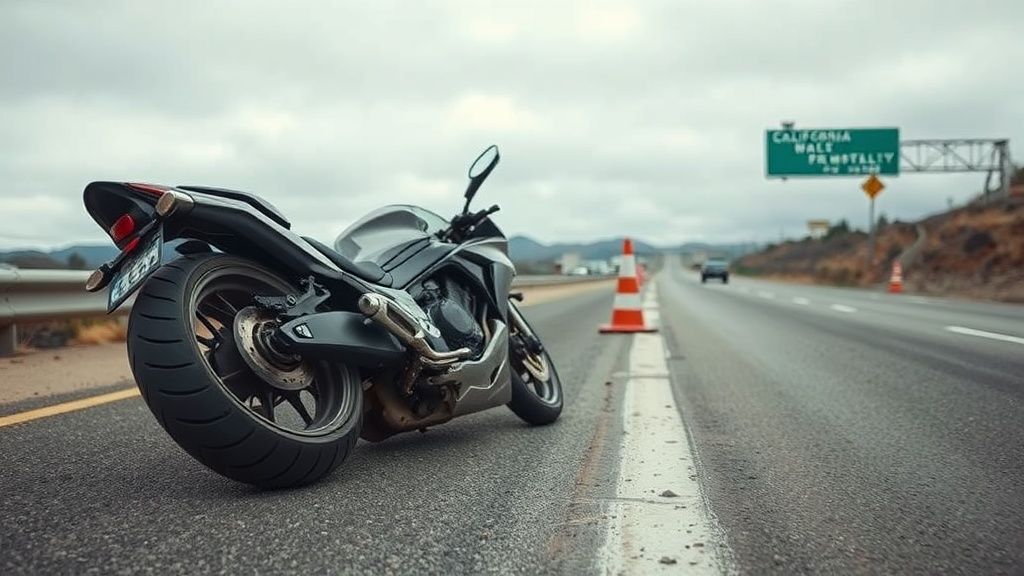
If you were hurt in a motorcycle accident in California, you are facing two fights at once: recovering from a serious injury and dealing with an insurance company that is already looking for reasons to pay you less.
This guide explains your rights under California law, the most common mistakes riders make after a crash, and what an experienced motorcycle accident attorney actually does to protect your claim.
Call (818) 794-9947 for a free case review. No fee unless we win.
Quick Answers (TL;DR)
- California's helmet law (Cal. Veh. Code §27803) requires every rider and passenger to wear a DOT-approved helmet — no exceptions.
- Lane splitting is legal in California under Cal. Veh. Code §21658.1, but insurers still use it against you.
- California follows pure comparative fault — you can still recover damages even if you were partly at fault, though your award is reduced by your share of responsibility.
- The statute of limitations for most motorcycle injury claims is two years from the date of the crash under Cal. Code Civ. Proc. §335.1.
- Motorcycle injuries are disproportionately severe, which means insurers scrutinize these claims more aggressively — not less.
- Common causes include left-turning vehicles, dooring, road hazards, and distracted drivers — all areas where the other party (or a government entity) may be fully liable.
- A free consultation with a California personal injury attorney costs you nothing and gives you a clear picture of what your claim is actually worth.
California's Universal Helmet Law (Cal. Veh. Code §27803) and How It Affects Your Claim
In California, every motorcycle rider must wear a safety helmet that meets federal DOT standards under Vehicle Code §27803 — no exceptions, regardless of age or experience.
That is a harder rule than most states. California does not have an "adults can choose" helmet exemption. If you were riding without a compliant helmet when you crashed, expect the other side's insurance adjuster to make that fact the center of their defense — even if the helmet had nothing to do with the collision itself.
What "DOT-approved" actually means
A DOT-approved helmet carries a certification label from the U.S. Department of Transportation's Federal Motor Vehicle Safety Standard 218. Novelty helmets, half-shells without proper liner thickness, and bicycle helmets do not qualify. If you were wearing a non-compliant helmet, you were violating Cal. Veh. Code §27803, which insurers will argue is evidence of recklessness.
Does not wearing a helmet bar your claim?
Not wearing a helmet does not automatically bar you from recovering compensation in California, but an insurance company will argue it contributed to your head or facial injuries — which can reduce the damages you receive.
California's pure comparative fault rules (discussed below) mean the jury or adjuster will assign a percentage of fault to your helmet decision. If your injuries are primarily to your torso, legs, or internal organs — not your head — the helmet argument carries far less weight. If your injuries are primarily traumatic brain injury (TBI) or facial trauma, the argument carries more weight and your attorney needs to challenge it directly with expert testimony.
The mistake most riders make: They assume that because they know the helmet "had nothing to do with it," the insurer will agree. Insurers do not agree — they use the violation as leverage in every negotiation. Document your helmet and its DOT label immediately after any crash, and preserve it as evidence.
Lane Splitting Is Legal — And Insurers Still Use It Against You
Lane splitting is legal in California under Vehicle Code §21658.1, making California the first state to formally legalize the practice.
California's Cal. Veh. Code §21658.1 authorizes lane splitting — riding a motorcycle between lanes of same-direction traffic — and directed the California Highway Patrol (CHP) to develop safety guidelines. The CHP guidelines recommend riding no more than 10 mph faster than surrounding traffic and avoiding lane splitting above 30 mph, though the statute itself does not codify those specific numbers as law.
Why this matters for your injury claim
Many drivers — and some insurance adjusters — still believe lane splitting is illegal. When a car changes lanes without signaling and clips a lane-splitting rider, the adjuster's first move is often to shift blame to the motorcycle. "You shouldn't have been there" is the argument, even though the law says you had every right to be.
An experienced motorcycle accident attorney knows how to document that your lane splitting was lawful, challenge the "reckless rider" narrative with CHP guidelines, and focus liability back on the driver who failed to check their mirrors.
The mistake most riders make: They apologize or hedge when speaking to the other driver's insurance adjuster. "I was lane splitting, but I was doing it safely" is a concession the adjuster records and uses. Say nothing about fault to any insurance company before you speak with an attorney.
Why Motorcycle Injuries Are More Severe — And How Insurers Exploit That
A motorcycle offers no crumple zone, no airbag, and no steel cage. The rider's body absorbs the collision directly. The result is that motorcycle crashes produce injuries that are, on average, far more serious than comparable car accidents — including traumatic brain injuries, spinal cord injuries, severe road rash requiring skin grafting, multiple fractures, and internal organ damage.
That severity cuts two ways:
- Your damages are real and large. Past and future medical bills, lost wages during recovery, permanent disability, pain and suffering, and loss of enjoyment of life can add up to far more than an insurer's first offer suggests.
- Insurers use the severity against you. When a claim is large, carriers invest more resources in minimizing it. They will send field adjusters to your home early, request recorded statements while you are still in the hospital, demand your complete medical history looking for pre-existing conditions to blame, and push a quick low settlement before you know the full extent of your injuries.
Never accept a first offer before you reach Maximum Medical Improvement (MMI)
MMI (maximum medical improvement) is the point at which your treating physician determines your condition has stabilized — either fully recovered or as recovered as you will get. Accepting a settlement before MMI means you are settling for a number that does not account for future surgeries, ongoing physical therapy, or permanent disability. Under a Compromise & Release agreement in California, a settlement is generally final. Once you sign, you cannot come back for more money when your condition turns out to be worse than the early diagnosis suggested.
Common Causes of Motorcycle Accidents in California
Understanding what caused your crash matters because it determines who is liable — and liability determines who pays.
Left-turning vehicles
The single most common motorcycle crash scenario: a car turning left at an intersection fails to yield to an oncoming motorcycle. The driver misjudges the motorcycle's speed or simply does not see it. California Vehicle Code §21801 requires drivers to yield to oncoming traffic before completing a left turn. When a driver violates that rule and hits you, liability is typically clear — but insurers will still argue you were speeding or contributed to the collision.
Dooring
A driver or passenger opens a car door into the path of a lane-splitting or lane-adjacent rider. California Vehicle Code §22517 prohibits opening a vehicle door on the side of moving traffic unless it is safe to do so. Dooring crashes cause severe injuries because the rider has almost no time to react. Liability rests with the person who opened the door.
Road hazards and government liability
Potholes, cracked pavement, missing guardrails, oil spills, and unmarked construction debris affect motorcycles far more severely than cars — a small hazard that a car drives over without incident can throw a motorcycle rider.
If a defective road surface, missing guardrail, or unmarked hazard caused or contributed to your crash, you may have a claim against a government entity under California Government Code §835.
Claims against government entities in California require a formal Government Tort Claim filed with the relevant agency within six months of the date of the incident under Cal. Gov. Code §911.2. Miss that six-month window and you lose the right to sue the government entity — even if the road defect was obvious and documented. This deadline is one of the most overlooked and most damaging mistakes riders make.
Distracted and impaired drivers
California Vehicle Code §23123.5 bans handheld cellphone use while driving. Despite the law, distracted driving remains one of the leading causes of motorcycle crashes. When a driver's phone records show they were texting or on social media at the time of the crash, that evidence is powerful for establishing liability and potentially supporting a punitive damages claim.
Comparative Fault and the "Reckless Rider" Stereotype
California uses a pure comparative fault system, which means you can still recover compensation even if you were partly at fault for the crash — your damages are simply reduced by your percentage of fault.
Under Cal. Civ. Code §1714 and the California Supreme Court's ruling in Li v. Yellow Cab Co. (1975), comparative fault is apportioned between all parties. If you are found 20% at fault and your damages total $500,000, you recover $400,000.
How insurers weaponize the "reckless rider" stereotype
Motorcycle riders face a documented bias in claims handling. Adjusters and sometimes jurors arrive with a pre-formed belief that motorcyclists ride recklessly by default. Insurance defense teams exploit this by:
- Emphasizing any prior traffic violations in your record, regardless of relevance
- Arguing that lane splitting proves recklessness (even though it is legal)
- Claiming you were speeding based on "the nature of the crash" with no physical evidence
- Using your helmet status (or lack thereof) as a proxy for overall recklessness
An experienced California motorcycle accident attorney anticipates these tactics. The response is documentary: accident reconstruction experts, CHP collision reports, surveillance footage, eyewitness statements, and electronic data from the other vehicle's event data recorder (EDR) all help establish what actually happened — not what the adjuster assumes happened.
The Two-Year Deadline You Cannot Miss
The statute of limitations for a motorcycle accident personal injury claim in California is two years from the date of the crash under Code of Civil Procedure §335.1.
Two years sounds like enough time. It is not — not if you are spending the first six months in surgery and rehabilitation and the next six months trying to return to work. Evidence disappears, witnesses move, and surveillance footage gets overwritten. The earlier you retain an attorney, the better the evidentiary record that can be preserved.
Critical exceptions that shorten your deadline:
- Government entity claims: Six months for the initial Government Tort Claim as noted above (Cal. Gov. Code §911.2). The six-month clock starts on the injury date, not when you feel better.
- Minors: The two-year clock tolls (pauses) while the injured person is under 18, but specific rules apply — get legal advice early.
- Wrongful death: The two-year period runs from the date of death, not the date of the crash if they are different.
Common Mistakes That Hurt Motorcycle Accident Claims in California
Giving a recorded statement to the other driver's insurer
You are not legally required to give a recorded statement to the at-fault driver's insurance company. Adjusters are trained to ask questions that elicit statements like "I think I might have been going a little fast" and to use that admission to reduce your settlement. Politely decline and call an attorney first.
Posting about the accident on social media
Insurance defense teams search social media. A photo of you hiking three weeks after the crash, even if you are actually still in significant pain, will be used to argue your injuries were not serious. Say nothing about the accident or your physical condition on any platform while your claim is open.
Settling before you understand the full cost of your injuries
Initial diagnoses after a crash are often incomplete. Spinal injuries that appear minor on early imaging may require surgery months later. A quick settlement offer — even one that feels large — may be a fraction of your actual lifetime costs. Do not sign a release until your medical team has a complete picture of your prognosis.
Assuming the at-fault driver's liability limits are adequate
California's minimum liability insurance for drivers is $15,000 per person under Cal. Ins. Code §11580.1b — a number that covers almost nothing in a serious motorcycle crash. Your attorney needs to investigate whether the at-fault driver has umbrella coverage, whether multiple parties share liability, and whether your own uninsured/underinsured motorist (UM/UIM) coverage applies. UM/UIM coverage is one of the most important protections a rider can carry, and many injured riders do not know to pursue it.
FAQ: Motorcycle Accidents in California
Who is usually at fault in a motorcycle accident in California?
The most common scenario is a car driver who failed to yield, changed lanes without checking mirrors, turned left without seeing an oncoming motorcycle, or was driving distracted or impaired. California law does not create a presumption of fault against motorcycle riders — fault is determined by the specific facts of each crash. An accident reconstruction expert and a thorough investigation of the police report, witness statements, and physical evidence are the tools that establish who was actually responsible.
Does not wearing a helmet affect my claim?
It can — but it does not automatically bar you from recovering anything. California's pure comparative fault system means your damages are reduced by whatever percentage of fault is assigned to you. If your head injuries are connected to not wearing a helmet, that percentage could be significant. If your injuries are not to your head, the helmet argument has much less force. The calculation is fact-specific, which is why talking to a California motorcycle accident attorney before accepting any offer matters.
Is lane splitting legal in California?
Yes. California Vehicle Code §21658.1 expressly legalizes lane splitting and requires the California Highway Patrol to develop safety guidelines. No other state has done this — California stands alone. Being a lane-splitting rider when you were hit does not make you at fault for the collision. What matters is whether you were lane splitting in a manner consistent with the CHP guidelines and whether the other driver's actions caused the crash.
How are motorcycle injury settlements different from car accident settlements?
Motorcycle injury settlements tend to be larger because the injuries are more severe. They also tend to be more contested because the amounts are larger and because insurers apply the "reckless rider" bias more aggressively. Medical documentation is more complex because motorcycle injuries often involve multiple body systems. Expert witnesses — accident reconstruction, medical, vocational rehabilitation — are more commonly needed. And the insurance coverage picture is more complicated, because many riders are underinsured by the at-fault driver and need to pursue their own UM/UIM policy.
How long does a motorcycle accident claim take in California?
It depends on the severity of your injuries, whether liability is disputed, and whether the case settles or goes to trial. A claim with clear liability and injuries that resolve within a few months can settle in six to twelve months. A claim involving disputed fault, catastrophic injuries, or government-entity defendants can take two to three years or longer. Your attorney should set realistic expectations from the first consultation — not promise a timeline they cannot deliver.
What is my motorcycle accident case worth?
There is no honest answer to that question without reviewing your medical records, your income documentation, your prognosis, the insurance policies involved, and the specific facts of the crash. Any attorney who gives you a number in the first five minutes without reviewing those materials is not being straight with you. What we can tell you is that unrepresented riders consistently recover far less than represented riders — because insurers know what they can get away with when the other side is not prepared to fight.
Can I still file a claim if the other driver had no insurance?
Yes. California requires insurers to offer uninsured motorist (UM) coverage to their policyholders under Cal. Ins. Code §11580.2. If you carry UM coverage on your motorcycle policy, you can file a claim against your own policy when the at-fault driver has no insurance or flees the scene. If you carry underinsured motorist (UIM) coverage, you can use it when the at-fault driver's liability limits are not enough to cover your damages. Your attorney will identify every available source of recovery — not just the one that is most obvious.
What should I do immediately after a motorcycle accident in California?
Call 911 and get a police report filed — this is your foundational evidence document. Photograph the scene, your motorcycle, the other vehicle, your injuries, and any road hazard that contributed to the crash. Get the names, contact information, and insurance information of all drivers involved. Get contact information for any witnesses. Seek emergency medical care immediately, even if you feel you can walk it off — adrenaline masks pain, and many serious injuries are not felt immediately. Do not give a recorded statement to any insurance company, including your own, before speaking with an attorney. Call (818) 794-9947 for a free case review.
We Fight for Injured Motorcycle Riders in California
Nordanyan Law has recovered over $150,000,000 for injured workers and accident victims in Southern California. We handle every case as if it were going to trial — because insurance companies settle for more when they know the other side is prepared to fight. Our personal injury practice includes motorcycle accident claims across Los Angeles, San Bernardino, Riverside, and the surrounding counties.
Every injured person deserves the same quality of legal representation as any corporation. That is the principle this firm was built on.
If you were hurt in a motorcycle crash in California, the clock is already running. Evidence is being lost. The other side's insurer has already assigned an adjuster to your claim.
Call (818) 794-9947 today for a free, confidential case review. No fee unless we win. Available in English and Spanish.
Or schedule your free consultation online and we will call you back within one business day.
Reviewed by Minas Nordanyan, CA Bar #296806. Last updated June 2026. This article is for general informational purposes and does not constitute legal advice. The facts of your case determine your rights — call (818) 794-9947 to discuss your specific situation.