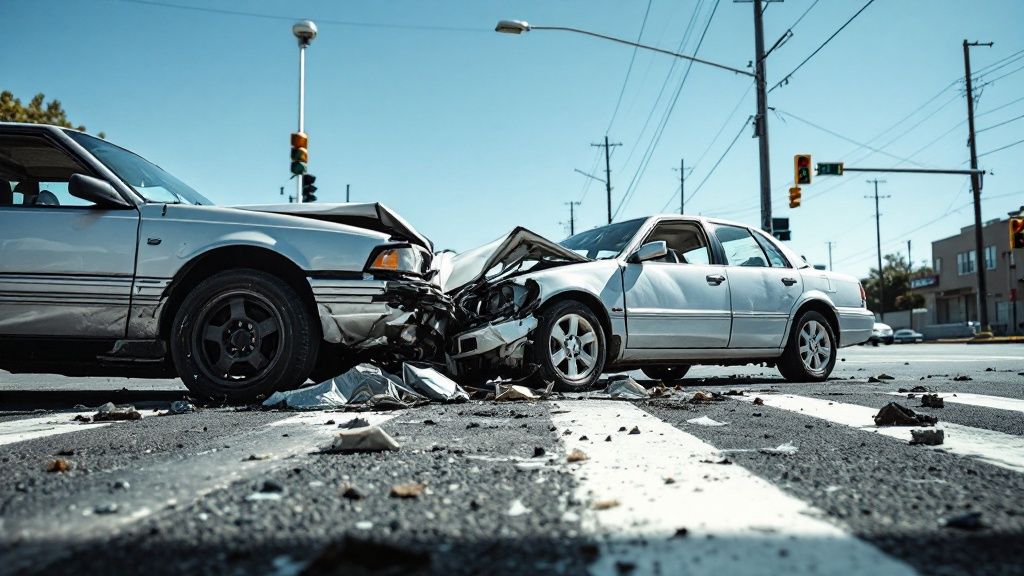
If you were hurt on the job and someone other than your employer caused the injury — a reckless driver, a defective machine, a negligent subcontractor — you may be standing at a crossroads most injured workers don't know exists.
You could have two separate legal claims: a workers' compensation claim against your employer's insurance carrier, and a personal injury (PI) lawsuit against the at-fault third party.
Understanding the difference between these two systems — and knowing when both apply — could be the most important thing you read after a work injury in California.
If you think you have a cross-claim situation, call (818) 794-9947 for a free consultation. We handle both workers' comp and personal injury cases, and no fee applies unless we win.
Quick-Answer Summary
- Workers' comp pays medical bills and partial wage replacement regardless of fault, but it does not pay for pain and suffering.
- Personal injury (PI) lets you sue a third party (not your employer) for full damages including pain and suffering — but only if someone else's negligence caused the injury.
- Under California law, you can file both claims at the same time if a third party was involved.
- The two filing deadlines run independently: one year for WC under Cal. Lab. Code §5405, two years for PI under Cal. Civ. Code §335.1.
- The workers' comp carrier will place a lien on your PI settlement to recover what it paid — this must be managed carefully.
- One firm handling both claims protects you from strategies that help one case while hurting the other.
The Fundamental Difference: Fault Doesn't Matter in WC — It's Everything in PI
In California, workers' compensation covers almost any on-the-job injury regardless of who was at fault — but it limits what you can recover.
Workers' compensation is a no-fault system created by the California Labor Code. Under Cal. Lab. Code §3600, you are entitled to benefits the moment a work-related injury occurs — whether the accident was your fault, your employer's fault, or nobody's fault at all. You do not have to prove negligence. You do not have to sue your employer.
The tradeoff is that workers' comp limits what you can collect:
- Medical treatment paid by the carrier (through an MPN — Medical Provider Network)
- Temporary disability (TD) payments equal to two-thirds of your average weekly wage, capped annually under Cal. Lab. Code §4453
- Permanent disability (PD) benefits based on a rated impairment
- Supplemental Job Displacement Benefit (SJDB) voucher for retraining if you can't return to your old job
- Death benefits for dependents
What workers' comp does not pay: pain and suffering, emotional distress, full lost wages (only two-thirds), or future non-medical losses. That's the ceiling.
A personal injury claim against a third party — someone other than your employer — can pay for pain and suffering, full lost wages, and future damages that workers' comp does not cover.
A PI claim is a civil lawsuit. You must prove that someone owed you a duty of care, breached it, and that breach caused your injury. If you prove it, the damages available are far broader: all medical expenses (past and future), 100% of lost wages, loss of earning capacity, pain and suffering, emotional distress, and in cases of egregious conduct, punitive damages.
The limitation: you can only bring a PI claim against a third party — not your employer. Cal. Lab. Code §3602 generally bars you from suing your employer in civil court once workers' comp applies. But it does not protect anyone else who caused your injury.
Side-by-Side: What Each System Pays
Benefit: Medical bills · Workers' Comp: Yes — carrier pays through MPN · Personal Injury (3rd-Party Lawsuit): Yes — full, past and future
Benefit: Temporary lost wages · Workers' Comp: 2/3 of pre-injury wages (capped) · Personal Injury (3rd-Party Lawsuit): 100% of lost wages
Benefit: Permanent disability · Workers' Comp: Yes — rated by formula · Personal Injury (3rd-Party Lawsuit): Yes — jury/settlement value
Benefit: Pain and suffering · Workers' Comp: No · Personal Injury (3rd-Party Lawsuit): Yes
Benefit: Emotional distress · Workers' Comp: No · Personal Injury (3rd-Party Lawsuit): Yes
Benefit: Future earning capacity · Workers' Comp: Limited · Personal Injury (3rd-Party Lawsuit): Full calculation
Benefit: Punitive damages · Workers' Comp: No · Personal Injury (3rd-Party Lawsuit): Sometimes
Benefit: Fault required · Workers' Comp: No · Personal Injury (3rd-Party Lawsuit): Yes
Benefit: Who you're claiming against · Workers' Comp: Employer's WC carrier · Personal Injury (3rd-Party Lawsuit): The at-fault third party
The potential value of a PI claim often exceeds a WC claim significantly — which is why identifying cross-claim situations is so important, and why insurers work to discourage injured workers from pursuing both.
6 Cross-Claim Scenarios Where Both Claims Apply
Common cross-claim scenarios in California include car accidents on the job, injuries caused by defective equipment, and construction site injuries caused by a subcontractor's negligence.
Not every work injury creates a PI claim. These six scenarios are where both claims most commonly arise in Southern California:
1. Car Accident While Working
A delivery driver, sales rep, nurse making a home visit, or any employee driving for work purposes is rear-ended by another driver. The employer's workers' comp carrier covers the injury. The at-fault driver's auto insurance (and the driver personally) is the third-party PI defendant. Both claims exist simultaneously.
2. Defective Equipment or Machinery
A warehouse worker's hand is crushed by a forklift with a known defect. The employer's WC carrier pays. But the forklift manufacturer, distributor, or maintenance contractor may be liable under products liability — a PI claim entirely separate from workers' comp. Under California's strict products liability doctrine, the injured worker does not have to prove the manufacturer was negligent — only that the product was defective and caused the injury.
3. Construction Site Injury Caused by a Subcontractor
California's construction industry is layered with general contractors, subcontractors, and specialty trades. If a subcontractor's employee or equipment injures a worker from a different company, that subcontractor is a third party. The injured worker files WC with their own employer's carrier and a PI lawsuit against the negligent subcontractor. General contractors may also carry premises liability for unsafe job site conditions.
4. Premises Liability at a Third-Party Location
A technician or service worker is injured at a client's property — a slip on an unmarked wet floor, a structural collapse, an unsecured hazard. The employer's WC carrier covers the injury. The property owner or occupier may be liable under premises liability for failing to maintain a safe environment under Cal. Civ. Code §1714.
5. Workplace Assault by a Non-Employee
A retail worker is assaulted by a customer. A hospital employee is attacked by a patient. Workers' comp covers the physical injury. If the assailant is identifiable and the property owner's security negligence contributed to the attack, a PI claim against the property owner (or even the assailant directly) may be viable.
6. Rideshare or Gig Driver Hit by Another Vehicle
An Uber or Lyft driver active on the platform is struck by a negligent driver. The rideshare company's commercial insurance triggers at certain activity stages under California law. The at-fault driver is a PI defendant. The gig driver may also have a WC claim depending on their employment classification — a complex, evolving area of California law after Proposition 22.
The 5-Question Decision Flowchart
Work through these five questions to determine which claim types apply to your situation:
Question 1: Were you injured while performing work for your employer?
- Yes → Workers' comp almost certainly applies. Continue to Question 2.
- No → Workers' comp does not apply. Consult a PI attorney directly.
Question 2: Did someone other than your employer or a co-employee contribute to causing the injury?
- Yes → A third-party PI claim may be available. Continue to Question 3.
- No → Workers' comp only. No PI claim against a co-employee exists unless the co-employee's conduct was intentional (assault) or outside the scope of employment.
Question 3: Was that third party negligent, or did they manufacture/distribute a defective product?
- Yes → PI claim is likely viable. Continue to Question 4.
- Not sure → This is where an attorney's analysis matters. The answer is not always obvious. Call (818) 794-9947.
Question 4: Were you seriously injured — meaning your damages (medical costs, lost wages, pain, future losses) likely exceed what workers' comp will pay?
- Yes → Pursuing both claims is almost certainly worth pursuing. Continue to Question 5.
- Minor injury → Workers' comp may resolve the matter adequately; PI litigation costs may not justify the benefit.
Question 5: Is the third party identifiable and collectible (they have insurance, assets, or both)?
- Yes → File both claims. Time is short — especially on the WC side (30-day employer notice under Cal. Lab. Code §5400, one-year filing deadline under Cal. Lab. Code §5405).
- Uncertain → Still worth a consultation. California's uninsured motorist coverage, excess liability, and umbrella policies sometimes cover what first-party insurance does not.
Statutes of Limitations: Two Clocks, Running at the Same Time
California workers' comp claims must be filed within one year of the injury date under Cal. Lab. Code §5405, while most personal injury lawsuits must be filed within two years under Cal. Civ. Code §335.1 — the clocks run separately.
Missing either deadline can extinguish your rights entirely. Here is the framework:
- Report the injury to your employer within 30 days under Cal. Lab. Code §5400. Failing to report can bar your claim entirely.
- File a workers' comp claim (DWC-1 form) within one year of the injury date under Cal. Lab. Code §5405.
- For cumulative trauma claims, the one-year clock typically starts when you knew or should have known the injury was work-related.
Personal Injury:
- File a civil lawsuit within two years of the injury date under Cal. Civ. Code §335.1.
- Against a government entity (e.g., a municipal vehicle or public property hazard), you must file a government tort claim within six months under Cal. Gov. Code §911.2 — a much tighter deadline that many injured workers miss.
- Discovery rule: in some cases the two-year clock starts when you discovered (or reasonably should have discovered) the injury — relevant for latent conditions like toxic exposure.
The practical danger: Many injured workers focus on the WC claim, let the PI deadline slip, and lose the higher-value claim permanently. Working with a firm that handles both claims from day one protects both clocks.
Subrogation: How the WC Carrier Shares in Your PI Settlement
When you settle a personal injury case after receiving workers' comp benefits, the workers' comp insurance carrier has a lien on your PI settlement and can recover what it paid for your medical care and temporary disability.
This is one of the most misunderstood parts of cross-claim cases — and one of the most expensive to get wrong.
Under Cal. Lab. Code §3856, when a workers' comp carrier has paid benefits and you later recover from a third party in a PI case, the carrier is entitled to reimbursement from your PI settlement. This is called subrogation.
Here is how it works in practice:
- You receive $80,000 in workers' comp benefits (medical + temporary disability).
- You settle your PI lawsuit for $350,000.
- The WC carrier asserts a $80,000 lien on your $350,000 settlement.
- After lien negotiations (yes, liens are negotiable), attorney fees, and costs, your net recovery is calculated.
The good news: California law limits what the carrier can recover. Under Cal. Lab. Code §3856(b), if the injured worker's attorney successfully prosecuted the PI case, the attorney is entitled to a fee from the lien recovery — which incentivizes the PI attorney to negotiate the lien down aggressively, not just pay it.
Why this matters for choosing a firm: If your WC attorney and your PI attorney are at different firms, lien negotiations become a three-party dispute. When one firm handles both, lien strategy is coordinated from the start — protecting more of your net recovery.
Why Both-Practices Matters: One Firm vs. Two
Hiring one firm that handles both workers' comp and personal injury means both claims are coordinated from day one, protecting you from strategies that benefit one case while damaging the other.
When WC and PI claims are handled by separate firms, coordination failures are common:
- Medical records conflict. Statements made to the QME (qualified medical evaluator) in the WC case can be used by the PI defendant to minimize your injury. When both claims share a legal team, doctors are briefed consistently.
- Settlement timing mismatch. Settling the WC case before the PI case resolves can limit what the PI claim recovers — or vice versa. Coordinated timing protects both.
- Lien disputes eat net recovery. When separate attorneys are billing separate fees, lien negotiations become adversarial. One firm negotiates on your behalf only.
- Recorded statements. The WC carrier and the PI defendant may both seek recorded statements. Inconsistencies between them become ammunition. One legal team prepares you once, consistently.
At Nordanyan Law, our practice is 95% workers' compensation with targeted personal injury for exactly this situation — the cross-claim worker. We've recovered over $150,000,000 for injured workers, and we handle both sides of cross-claim cases under one roof.
We believe every injured worker deserves the same quality of legal representation as any corporation. That includes cross-claim workers, whose cases are often the most complex — and the most valuable.
5 Mistakes Cross-Claim Workers Make
Mistake 1: Filing only the WC claim and missing the PI deadline.
The one-year WC deadline feels urgent. The two-year PI deadline feels distant. Many workers discover too late that their PI claim has expired. Both deadlines must be tracked from day one.
Mistake 2: Giving a recorded statement to the PI defendant's insurer without an attorney.
The third-party insurer will call quickly. They are not on your side. Anything you say can be used to minimize the PI claim — and potentially imported into the WC case. Do not give any recorded statement without legal counsel.
Mistake 3: Settling the WC claim without accounting for the PI case.
A Compromise and Release (C&R) settlement in the WC case can include language affecting your PI claim or the lien. Read every settlement document carefully — or have a both-practices attorney read it for you.
Mistake 4: Assuming your WC attorney handles PI (or vice versa).
Most workers' comp firms do not litigate personal injury cases, and most PI firms do not handle workers' comp proceedings. Ask explicitly, and verify. Assuming the answer is yes can leave one claim unrepresented at a critical moment.
Mistake 5: Waiting to see "how the WC case goes" before contacting a PI attorney.
Witnesses disappear. Surveillance footage is overwritten (often within 30-90 days). Police reports age. The evidence that makes a PI case strong is time-sensitive. Contact an attorney for both claims at the same time — ideally within the first two weeks.
FAQ
Can I file both workers' comp and a personal injury lawsuit in California?
Yes. California law allows an injured worker to file a workers' comp claim with their employer's carrier and a personal injury lawsuit against a negligent third party at the same time. The two claims are independent proceedings. The only limitation is that you generally cannot sue your own employer in civil court because workers' comp is the exclusive remedy against employers under Cal. Lab. Code §3602 — but a third party who caused or contributed to the injury is fair game.
What's the difference between workers' comp and personal injury?
Workers' comp is a no-fault system that pays medical bills and partial wage replacement regardless of who caused the injury. Personal injury is a fault-based civil lawsuit that can pay for pain and suffering, full lost wages, and future damages — but only if a negligent third party (not your employer) caused the injury. WC is typically faster but pays less. PI takes longer but can recover far more.
Which pays more — workers' comp or personal injury?
In most cross-claim situations, the personal injury settlement significantly exceeds the workers' comp award. Workers' comp does not pay for pain and suffering, caps temporary disability at two-thirds of pre-injury wages, and values permanent disability through a formula rather than a jury. A serious injury with a third-party PI claim can recover multiples of what workers' comp alone would pay.
Do I need a different lawyer for each claim?
No — and you are better off with one firm that handles both. When separate attorneys manage WC and PI simultaneously, coordination failures around medical records, recorded statements, settlement timing, and lien negotiations can reduce your net recovery. A both-practices firm coordinates everything under one roof.
How does the workers' comp lien work when I settle my PI case?
Under Cal. Lab. Code §3856, the workers' comp insurance carrier has a right to recover what it paid in benefits from your PI settlement. This lien is negotiable — a skilled attorney can often reduce it substantially. The lien amount, net of attorney fees and costs, is deducted from your PI settlement before you receive the balance. Proper lien management is one of the most important factors in maximizing your net recovery.
What if a coworker caused my injury — can I sue them?
Generally, no. Workers' comp is the exclusive remedy against your employer and co-employees acting within the scope of their employment. However, if a co-employee's conduct was intentional (assault) or was outside the scope of employment, a civil claim may be available. This is a fact-specific analysis — call (818) 794-9947 to walk through the details of your situation.
What if a government vehicle or government property caused my injury at work?
A government tort claim must be filed within six months of the injury date under Cal. Gov. Code §912.2 — far shorter than the two-year PI statute of limitations. Missing this deadline can bar the claim entirely. If a city vehicle, county equipment, or government-owned property was involved, contact an attorney immediately.
How long does a cross-claim case take in California?
Workers' comp cases typically resolve in six to eighteen months. Personal injury lawsuits, particularly those that go through discovery and trial, can take two to four years. In cross-claim cases, the WC case often resolves first. Settlement of the WC case must be structured carefully so it does not undermine the ongoing PI case. Both claims are typically resolved before trial on the PI side, but having a trial-ready team accelerates settlement on both tracks.
The Bottom Line
Most law firms will tell you to file your workers' comp claim and move on. A both-practices specialist will ask a different question: who else caused this injury, and can we hold them accountable?
The difference between a workers' comp-only recovery and a cross-claim recovery — WC benefits plus a third-party PI settlement — can mean the difference between covering your medical bills and genuinely rebuilding your financial life after a serious injury.
We've built Nordanyan Law to handle exactly this situation. Our 95% workers' comp focus and targeted personal injury practice exist in the same firm because cross-claim workers deserve coordinated representation — not two attorneys who have never spoken to each other.
If you were hurt at work and a third party may have contributed to the injury, call (818) 794-9947 for a free consultation. We'll walk through the five-question framework with you, identify which claims apply, and explain what both paths could recover. No fee unless we win.
Reviewed by Minas Nordanyan, CA Bar #296806. Last reviewed May 2026. This article is for educational purposes and does not constitute legal advice. Your case facts determine your rights — call (818) 794-9947 to discuss your specific situation.