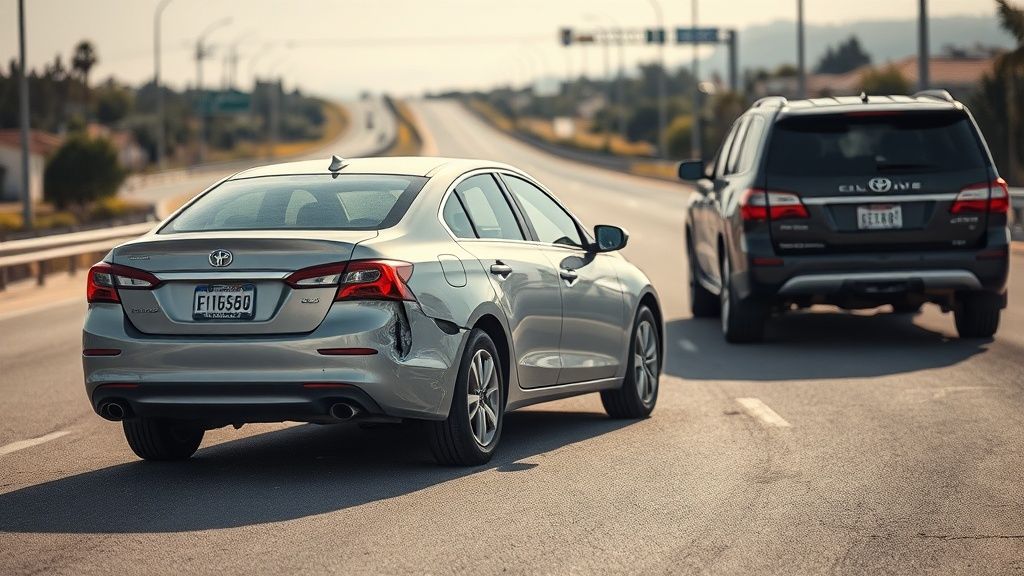
Rear-End Collisions in California: Fault, Injuries, and Your Claim
If you were rear-ended in California, you are probably dealing with a sore neck, a pile of insurance paperwork, and an adjuster who is already downplaying how hurt you are. You are not alone. Rear-end crashes are the most common type of collision on California roads, and they produce some of the most contested injury claims — precisely because the damage often looks minor on the outside while the injury is anything but.
This article explains how California law determines fault in rear-end crashes, why insurers routinely undervalue these claims, and what you need to do to protect your right to full compensation.
Quick answers:
- The rear driver is presumed at fault under California law — but that presumption can be rebutted.
- California's pure comparative fault rule means you can still recover even if you were partially responsible.
- Whiplash and disc injuries can take days or weeks to show up fully — document everything now.
- "Low damage = low injury" is an insurance myth, not science.
- If you were rear-ended on the job, you may have both a workers' comp and a personal injury claim.
- You have two years from the date of the crash to file a personal injury lawsuit in California.
The Presumption That the Rear Driver Is at Fault — and How It's Rebutted
In California, the driver who rear-ends another vehicle is presumed to be at fault because every driver has a legal duty to maintain a safe following distance under California Vehicle Code §21703.
The logic behind this presumption is straightforward: if you are following closely enough to hit the car in front of you, you were not leaving enough space to stop safely. California Vehicle Code §21703 specifically prohibits following another vehicle more closely than is "reasonable and prudent." When a rear-end crash happens, the law treats a violation of that duty as the starting point for fault analysis.
That said, the presumption is rebuttable. The rear driver can argue — and sometimes prove — that the front driver bears some or all of the fault. Common scenarios where this argument has merit:
- Sudden, unexpected reversal. If the front driver shifted into reverse without warning and struck the rear vehicle.
- Cut-off with no room to brake. If the front driver changed lanes and cut directly in front of the rear driver at very close range, leaving no reasonable stopping distance.
- Brake-check road rage. If the front driver intentionally braked hard to provoke a collision.
- Broken brake lights. If the front vehicle's brake lights were non-functional and the rear driver had no visual warning.
- Debris or obstruction on the road. If the front driver stopped suddenly due to a hazard they could have avoided.
In practice, rebuttal arguments rarely succeed fully — but they can reduce the rear driver's percentage of fault, which matters because California uses a pure comparative fault system.
California follows a pure comparative fault rule, which means your compensation is reduced by your percentage of fault — but not eliminated, even if you were partly responsible for the crash.
This rule comes from Cal. Civ. Code §1714 and was confirmed by the California Supreme Court in Li v. Yellow Cab Co. (1975). What it means practically: if your damages are $100,000 and a jury finds you were 20% at fault, you recover $80,000 — not zero. This is more favorable to injured victims than the "contributory negligence" rule still used in a handful of other states, where any fault on your part can bar recovery entirely.
Whiplash and Soft-Tissue Injuries Insurers Love to Minimize
Whiplash is the most common injury in rear-end crashes. It happens when your head is snapped forward and backward rapidly — often in less than a second — straining or tearing the muscles, tendons, and ligaments in your neck and upper back. The forces involved can also herniate discs in the cervical (neck) or lumbar (lower back) spine.
Whiplash and soft-tissue injuries may not appear on early X-rays or even an initial MRI, but that does not mean they are not real or compensable under California law.
Insurance adjusters know this, and they use it. The standard playbook: obtain your early medical records showing "no acute fracture" on the ER X-ray, then argue your injury is exaggerated or pre-existing. Do not let them do it.
Common rear-end crash injuries:
- Cervical strain and sprain (whiplash)
- Herniated or bulging cervical discs
- Lumbar disc injuries
- Thoracic spine strain
- Concussion or mild traumatic brain injury (TBI) — more common than people realize, especially if your head struck the headrest, steering wheel, or airbag
- Shoulder tears (rotator cuff) from bracing against the steering wheel
- Temporomandibular joint (TMJ) dysfunction from jaw impact
- Psychological injuries: post-traumatic stress, anxiety, sleep disruption
The severity of these injuries has no reliable relationship to the visible damage on your car. Biomechanical studies have consistently shown that rear-end impacts at speeds as low as 5-10 mph can generate enough cervical loading to produce lasting soft-tissue damage — particularly in smaller occupants, older adults, and passengers who were not bracing for impact.
Documenting Injuries That Don't Show on Early Scans
The gap between the crash and your worst symptoms is the window insurers exploit most aggressively. Here is how to close it.
Step 1 — Seek medical care the same day or the next morning. Even if your pain feels manageable, get evaluated. An ER visit or urgent care visit creates a dated medical record linking the crash to your symptoms. Waiting several days gives the adjuster a gap to fill with "the injury must not be from the crash."
Step 2 — Be specific with every doctor about every symptom. Tell them about neck stiffness, headaches, shoulder pain, dizziness, jaw soreness, memory fog, sleep problems — everything. Medical records that don't mention a symptom are treated as proof it didn't exist.
Step 3 — Follow your treatment plan completely. Missing appointments, stopping physical therapy early, or refusing recommended imaging creates gaps in your record that the defense will use to argue you are not seriously hurt or not credible.
Step 4 — Request an MRI if symptoms persist. X-rays show bones; they do not show discs, soft tissue, or nerve root involvement. If your doctor has not ordered an MRI after 10-14 days of persistent symptoms, ask for one. A disc herniation confirmed on MRI is a materially different claim than "soft-tissue neck pain."
Step 5 — Keep a symptom diary. Write down your pain level, what activities you cannot do, how your sleep is affected, and any emotional impact. One sentence per day, dated. This documentation is admissible and persuasive.
Step 6 — Photograph everything. Your vehicle, the crash scene, any visible bruising or swelling, and your car in the weeks after repairs (to preserve the before/after). Insurers sometimes dispute that a crash happened the way you describe — photographs close the door on that argument.
Chain-Reaction (Multi-Car) Rear-End Crashes and Shared Fault
Multi-car pile-ups — the kind where one car stops short and three cars behind it pile into each other — are common on California freeways and in stop-and-go traffic. These crashes are legally more complex because fault can be distributed across multiple drivers.
In a chain-reaction rear-end crash involving three or more vehicles, fault can be shared among multiple drivers, and California's comparative fault rule applies to each party separately.
In a three-car crash, the analysis typically goes like this:
- Car A (the front car) is struck by Car B and pushed forward. Car A's driver is usually not at fault unless they contributed to the initial chain.
- Car B (the middle car) rear-ended Car A. Car B's driver bears primary fault for that impact — but may also have a claim against Car C, which hit Car B first.
- Car C (the rear car) struck Car B and may have initiated the chain. Car C bears the most fault.
In reality, California courts and juries apportion fault percentages to each party based on the specific facts — following distance, speed, reaction time, road conditions, and whether any driver had an opportunity to avoid the crash after the first impact.
Practical implication: If you were the driver of Car B, you may simultaneously be a plaintiff (suing Car C for hitting you) and a defendant (with Car A's driver claiming against you). This is exactly the kind of case where having an attorney managing the parallel claims and insurance negotiations matters — because insurers for multiple defendants will try to point the finger at each other while minimizing what they pay you.
When the at-fault driver has insufficient insurance to cover all claimants, California's underinsured motorist (UIM) coverage under your own policy — governed by Cal. Ins. Code §11580.2 — may fill the gap. This is often overlooked in multi-vehicle crashes.
Dealing With the 'Low Property Damage = Low Injury' Myth
The "low property damage equals low injury" argument is a standard insurance tactic with no scientific basis — California courts have repeatedly allowed injury claims to proceed even when vehicle damage was minor.
Here is why the argument is junk science: modern vehicles are designed with energy-absorbing bumpers that are engineered to minimize visible damage at low speeds. The forces that these bumpers absorb do not disappear — they are transferred to the vehicle's occupants. A bumper that "pops back out" after a 10-mph impact may have absorbed and transmitted enough force to hyperextend a cervical spine.
Insurance companies know this. They hire biomechanical consultants — sometimes called "low velocity impact" (LVI) experts — to testify that the crash was too minor to cause injury. California courts have been skeptical of this testimony when it is not grounded in the specific occupant's health history, vehicle geometry, seating position, and awareness at the time of impact.
How to counter the LVI argument:
- Document your symptoms thoroughly and consistently (see the documentation steps above).
- Obtain medical records that describe the mechanism of injury, not just the diagnosis.
- Work with your attorney to retain a treating physician or biomechanical expert who can explain the relationship between the specific impact forces and your specific injuries.
- Gather evidence of how the crash actually felt — your description, passenger testimony, and the repair estimate (even a "minor" repair can document the impact forces involved).
Do not let an adjuster convince you that a low-damage crash means a low-value claim. The law measures your injury — not your car's repair bill.
If You Were Rear-Ended While Working
One more situation worth addressing directly: what if the crash happened while you were on the job?
If you were driving for your employer, making a delivery, traveling between job sites, or otherwise acting within the scope of your employment at the time of the crash, you likely have two separate claims:
- A workers' compensation claim against your employer's workers' comp insurer under the California Labor Code. This covers your medical treatment and a portion of lost wages, regardless of who was at fault.
- A personal injury (third-party) claim against the at-fault driver — which can recover pain and suffering, the full value of lost earnings, and damages that workers' comp does not cover.
These two claims run in parallel. Workers' comp pays first; then your employer's insurer typically has a lien on your PI recovery for what it paid out. Coordinating these claims correctly — and making sure the lien is negotiated, not simply paid in full — is where experienced representation pays for itself.
For a deeper look at how these two claims interact, visit our workers' compensation practice area page.
What Your Rear-End Accident Claim May Be Worth
We will not invent a number. Every rear-end crash claim in California is fact-specific, and no honest attorney will quote you a settlement figure before reviewing your medical records, liability evidence, and insurance coverage.
What we can tell you is what California law allows you to recover in a personal injury claim:
- Medical expenses — past and future, including emergency care, imaging, physical therapy, chiropractic, specialist visits, and any future surgery your doctors project.
- Lost wages — earnings you have already lost and future earning capacity you may lose because of lasting injury.
- Pain and suffering — California does not cap pain-and-suffering damages in ordinary personal injury cases (unlike medical malpractice, which is subject to the cap under Cal. Civ. Code §3333.2).
- Loss of consortium — for a spouse or domestic partner whose relationship has been damaged by your injury.
- Property damage — the cost to repair or replace your vehicle.
The value of your specific claim depends on the severity and permanence of your injuries, the strength of the liability evidence, the at-fault driver's insurance limits, your own UIM coverage, and how well your damages are documented. That is a case-specific analysis — which is why the most useful next step is a conversation with an attorney, not a settlement calculator.
FAQ
Who is at fault in a rear-end collision in California?
In California, the rear driver is presumed at fault because they have a legal duty to maintain a safe following distance under California Vehicle Code §21703. That presumption can be rebutted if the front driver contributed to the crash — for example, by cutting off the rear driver without warning, brake-checking intentionally, or having non-functional brake lights — but full rebuttal is uncommon. In most rear-end crashes, the rear driver bears the primary fault.
Can the rear driver ever not be at fault?
Yes, though it is the exception rather than the rule. If the front driver reversed unexpectedly, made a sudden and dangerous lane change directly in front of the rear driver, or deliberately brake-checked the rear driver, a court or jury could assign significant fault to the front driver. California's pure comparative fault system allows any combination of fault percentages, including 100% to the front driver if the facts support it.
What injuries are common in rear-end crashes?
The most common injuries are whiplash (cervical strain), herniated or bulging discs, lower back strain, concussion, shoulder injuries, and TMJ dysfunction. These injuries often do not reach their full severity for 24-72 hours after the crash, and soft-tissue injuries may not appear on early X-rays at all. An MRI is usually the appropriate imaging study for diagnosing disc and soft-tissue injuries after a rear-end crash.
How much is a rear-end accident worth in California?
There is no honest average to cite. Claim value depends on the severity and permanence of your injuries, your total medical expenses, the amount of income you lost, the at-fault driver's insurance limits, and your own coverage. Serious disc injuries, surgery, or lasting neurological symptoms produce materially higher claim values than fully-resolved soft-tissue injuries. The only reliable way to estimate your claim's value is to have an attorney review your specific facts.
How long do I have to file a rear-end accident claim in California?
For most personal injury claims in California, the statute of limitations is two years from the date of the crash under Cal. Civ. Code §335.1. If the at-fault driver was a government employee or the vehicle was a government vehicle, a government tort claim must be filed within six months under the Government Claims Act — a much shorter deadline. Missing either deadline typically bars your claim entirely.
What if I was partially at fault for the rear-end crash?
Under California's pure comparative fault rule, your recovery is reduced by your percentage of fault — but not eliminated. If a jury finds your damages were $100,000 and you were 25% at fault, you recover $75,000. You are not barred from recovery simply because you share some responsibility for the crash.
What should I do immediately after being rear-ended in California?
Call 911 if anyone is injured. Get a police report — it creates an official record of the crash. Exchange insurance and contact information with all drivers. Photograph the scene, vehicle damage, and any visible injuries. Seek medical care the same day, even if your pain seems manageable. Do not give a recorded statement to the other driver's insurance company before speaking with an attorney. Contact a personal injury attorney as soon as possible — early legal involvement protects your claim and your evidence.
Does the other driver's insurance have to pay if I was rear-ended?
If the other driver was at fault and they carry liability insurance, their insurer is responsible for your damages up to the policy limits. California requires minimum liability coverage of $30,000 per person and $60,000 per accident under Cal. Ins. Code §11580.1b, though these minimums are often not enough to cover serious injuries. If the at-fault driver is uninsured or underinsured, your own uninsured/underinsured motorist coverage under Cal. Ins. Code §11580.2 may cover the gap.
Talk to a California Personal Injury Attorney — Free
If you were rear-ended in California, the window to preserve evidence and protect your claim is shorter than most people realize. Insurance adjusters begin building their defense on the day of the crash.
We've recovered over $150,000,000 for injured clients across Southern California. We handle personal injury and workers' compensation claims with no fee unless we win — $0 upfront, ever.
Call (818) 794-9947 for a free case review. Available in English and Spanish. We come to you if you can't travel.
Reviewed by Minas Nordanyan, CA Bar #296806. Last reviewed June 2026.