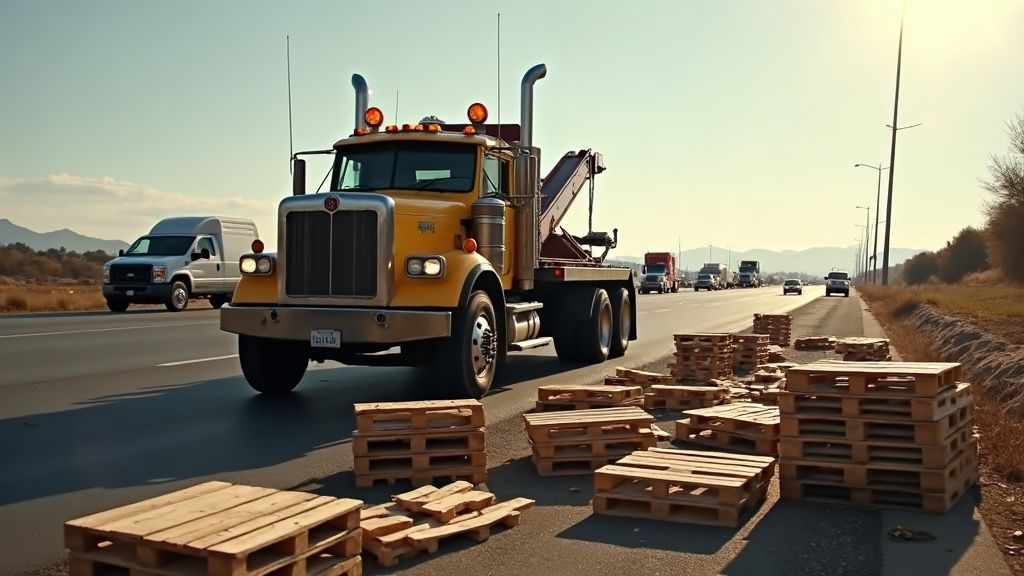
If you have been hit by road debris or forced off the road by a falling load on a California highway, you are dealing with one of the most frustrating accident types in personal injury law. The vehicle that caused the crash may be long gone. The debris may be cleared before you think to photograph it. And you may have no idea who is responsible or whether your insurance will help.
This article answers the 10 most important things to understand about road debris and unsecured cargo accidents in California, from who is liable to how long you have to file.
Quick summary:
- Road debris crashes happen far more often than most drivers realize, and California law already prohibits dropping cargo.
- California Vehicle Code §23114 sets the cargo-securement standard that applies to every driver on the road.
- Investigators use physical evidence, part numbers, and camera footage to trace debris to a specific vehicle.
- When a vehicle cannot be identified, your own uninsured motorist coverage becomes your first line of recovery.
- Liability can fall on the driver, the trucking company, the loader, and others simultaneously.
- Evidence at debris scenes disappears within hours, so fast action is critical.
- Dashcam footage can make or break these cases.
- Insurance handling depends on whether the responsible vehicle is identified.
- Injuries range from lacerations to traumatic brain injuries, often from secondary crashes.
- A two-year statute of limitations applies to personal injury debris claims under Code of Civil Procedure §335.1.
1. Road Debris Crashes Are More Common Than People Think
California Vehicle Code §23114 makes it illegal for any driver to allow cargo, debris, or any load to fall or blow from a vehicle onto a public highway.
Road debris is a leading cause of highway fatalities and injuries across the United States. The AAA Foundation for Traffic Safety has studied this category of crash extensively and found that lost vehicle parts and unsecured loads are responsible for thousands of serious injuries every year. California's size, volume of commercial truck traffic, and miles of Interstate highway put it among the highest-exposure states in the country.
The problem is not limited to large commercial trucks. Pickup trucks hauling landscaping material, construction workers transporting lumber, and moving vans with improperly latched cargo doors all generate road debris regularly. Any vehicle whose load can shift, tip, or slide presents a hazard.
Practical takeaway: If you were injured by road debris, do not assume the incident is too unusual to support a claim. This category of crash is well-recognized in California courts, and the law already draws a clear line on who is responsible for preventing it.
2. California's Cargo-Securement Requirements in Plain Language
Cal. Lab. Code §23114, technically California Vehicle Code §23114, requires every driver to prevent any load from dropping, sifting, leaking, blowing, or otherwise escaping from a vehicle. The statute applies to personal vehicles and commercial trucks alike. Violating it is a misdemeanor.
For commercial motor carriers operating in California, an additional layer of federal regulation applies. The Federal Motor Carrier Safety Administration (FMCSA) cargo-securement rules under 49 CFR Part 393 set specific requirements for tie-down anchor strength, the number of tie-downs required by load weight and length, and special standards for particular cargo types such as logs, steel coils, and automobiles.
When a commercial truck drops a load, attorneys and investigators examine both California Vehicle Code §23114 and the federal FMCSA standards to determine which rules were broken. A violation of either can be introduced in a civil case as evidence of negligence per se, meaning the violation itself establishes the duty-of-care breach without requiring additional expert argument.
Practical takeaway: A police report that cites the driver for a Vehicle Code §23114 violation is valuable evidence in your civil claim. Ask for a copy as soon as it is available.
3. How Investigators Trace Debris Back to a Specific Vehicle
A trucking company can be held liable for a debris accident even if the driver who dropped the load is never identified, because the company bears responsibility for its loading and securement practices.
Connecting debris to a specific vehicle is detailed forensic work, but it is done successfully in many cases. Here is what investigators and attorneys look for:
- VIN-stamped or part-numbered components. Trailer hitches, truck bed liners, and commercial equipment often carry serial numbers or manufacturer codes that trace directly to a specific unit.
- Paint transfer and materials analysis. A chunk of concrete, a steel bar, or a load of gravel can sometimes be matched to a specific quarry, supplier, or job site by materials testing.
- Fleet or company markings. Even a partial glimpse of a company logo or fleet number on passing video is enough to subpoena the company's dispatch records for that day and route.
- Traffic and toll camera footage. California's network of Caltrans traffic cameras, Bay Area toll cameras, and local intersection cameras can often place a specific vehicle on a stretch of road within minutes of a debris event.
- Bill-of-lading and manifest records. Commercial carriers are required to document what they are hauling and when. A freight manifest can confirm that a particular load of the debris type in question was on a specific route.
- Witness accounts. Other drivers who saw the debris fall and noted a partial license plate, a vehicle color, or a company name are among the most valuable sources an attorney can develop quickly.
Practical takeaway: Give your attorney every detail you remember about the vehicle, including color, approximate size, any visible markings, and the direction it traveled. Even partial information can open an investigation.
4. What to Do If You Cannot Identify the Vehicle That Dropped the Load
Not every debris case produces a traceable vehicle. Sometimes the load was deposited hours before anyone hit it. Sometimes the only witness was the injured driver, who was too focused on avoiding the crash to read a plate.
California treats an unidentified vehicle that causes a crash as an uninsured motorist under Insurance Code §11580.2. That means your own uninsured motorist (UM) coverage, if you carry it, becomes your primary path to compensation for bodily injury. Uninsured motorist property damage (UMPD) coverage, or your collision coverage, applies to vehicle damage.
There is one important procedural requirement: California generally requires that there be some physical contact between the unidentified vehicle and your vehicle, or corroboration beyond your own testimony alone, before a UM claim on an unknown vehicle will proceed. An attorney can advise you on whether the facts of your specific crash satisfy that standard.
Practical takeaway: If you cannot identify the vehicle, do not wait. File a UM claim with your own insurer promptly and preserve every piece of evidence from the scene, because corroboration is often what determines whether the claim succeeds.
5. Why These Claims Often Involve Multiple Potentially Liable Parties
California uses a pure comparative fault system, which means you can recover compensation even if you were partly at fault for a debris accident, your award is simply reduced by your percentage of fault.
One of the defining features of road debris litigation is the number of parties who may share responsibility. In a single unsecured-load crash, liability can potentially fall on:
- The driver, for failing to secure the load before departing.
- The trucking company, under respondeat superior, because California holds employers vicariously liable for employee negligence committed within the scope of employment.
- The cargo loader, if a separate company or crew loaded the vehicle and created an inherently unstable load condition.
- A freight broker, in some cases, if the broker directed the carrier to haul a load type the carrier was not equipped to handle safely.
- A vehicle maintenance company, if a failed tie-down anchor or a defective trailer latch contributed to the loss of cargo.
- A government agency, if improperly maintained road conditions caused an already-borderline load to shift and fall. Government liability claims in California require a government tort claim under Government Code §910 filed within six months of the incident.
California's Li v. Yellow Cab Co. pure comparative fault rule means that each defendant pays in proportion to their share of fault. An injured driver's recovery is reduced only by their own percentage of fault, and they can pursue all responsible parties at once.
Practical takeaway: Do not assume only one person is responsible. An attorney can investigate every link in the chain from the loader to the road to identify all recoverable sources.
6. How Evidence Disappears Fast at Debris Accident Scenes
Road debris is often cleared within hours of a crash, so preserving evidence immediately is one of the most important steps an injured driver can take.
The evidence window in a debris accident is measured in hours, not days:
- Physical debris is treated as a road hazard. Caltrans and local public works crews are dispatched to clear it quickly. Once cleared, debris is typically disposed of, not stored.
- Traffic and dashcam footage is usually overwritten on a rolling basis, often every 24 to 72 hours depending on the system.
- Electronic logging device (ELD) data from commercial trucks records hours of service, location, and speed in real time, but federal regulations only require carriers to retain it for a limited period. An ELD preservation letter sent immediately after the crash can invoke the duty to preserve.
- Cargo manifests and dispatch records may be digitally stored but are subject to routine purging.
- Eyewitness memory fades. Names and contact information for witnesses at the scene should be collected before anyone leaves.
An attorney can send a formal spoliation letter to any known carrier or company within days of the crash, putting them on notice that destroying evidence could expose them to sanctions in litigation.
Practical takeaway: Photograph everything at the scene, collect witness contact information, and call an attorney the same day. Every hour of delay narrows the evidence you can recover.
7. What Role Dashcam Footage Plays in These Cases
Dashcam footage is arguably the single most powerful piece of evidence in a road debris case. A dashcam that was recording at the moment of impact can show the jury exactly what the driver experienced: the debris in the lane, the evasive maneuver, and the vehicle that lost the load.
California courts treat dashcam footage as admissible evidence under the California Evidence Code, and the footage can establish:
- The exact moment debris entered the roadway.
- The approximate speed of the debris-dropping vehicle.
- Any visible load-securement failures (an open tailgate, a shifting pile, a flapping tarp).
- The make, model, color, and any visible plate or marking on the responsible vehicle.
Your dashcam is not the only one that may matter. Other vehicles traveling in the same direction may have been recording. Commercial vehicles in California are frequently equipped with outward-facing cameras as part of fleet management systems, and a subpoena can compel production of that footage if the trucking company can be identified.
Practical takeaway: If your vehicle has a dashcam, do not overwrite the footage. Remove the SD card or disable the loop-recording function immediately after the crash and preserve it as you would any other evidence.
8. How Insurance Handles Hit-and-Run-Style Debris Claims
When the vehicle that dropped the load drives away and is never identified, the injured driver's own insurance policy becomes the primary source of recovery. Here is how the layers typically work:
Uninsured motorist bodily injury (UMBI) coverage: This pays for your medical expenses, lost wages, and pain and suffering when an at-fault driver is unidentified or uninsured. [SPEAKABLE] For auto insurance policies issued or renewed on or after January 1, 2025, California's minimum uninsured motorist bodily injury coverage is $30,000 per person and $60,000 per accident under SB 1107. Drivers who purchased higher limits before that date may carry different amounts. The UM coverage limit on your policy is the ceiling of what this coverage will pay.
Uninsured motorist property damage (UMPD) coverage: This applies to vehicle damage caused by an unidentified driver, subject to a $250 deductible under California Insurance Code §11580.2. UMPD is separate from collision coverage and carries its own limit.
Collision coverage: If you carry collision on your policy, it can pay for vehicle damage without requiring you to identify the at-fault driver. Your deductible applies, and your insurer may subrogate against any party who is later identified.
Health insurance and med-pay: Your health insurance and any medical payments (med-pay) endorsement on your auto policy can cover immediate medical costs regardless of fault determination.
Practical takeaway: Review your declarations page to confirm what UM and UMPD limits you carry. A debris accident involving an unidentified vehicle is exactly the scenario those coverages were designed for.
9. Common Injuries from Swerving or Debris-Strike Accidents
Road debris accidents produce two categories of injury, and both can be severe.
Direct-strike injuries occur when debris contacts the vehicle or its occupants:
- Windshield shattering from a rock or metal object can cause facial lacerations, eye injuries, and concussions.
- Large falling objects can penetrate the roof or hood and cause crush injuries or traumatic brain injuries.
- Tire blowouts caused by debris in the lane can result in loss of vehicle control at highway speed.
Secondary crash injuries occur when a driver swerves to avoid debris and collides with a barrier, another vehicle, or a roadside feature:
- Whiplash and cervical spine injuries are common from rapid directional changes.
- Thoracic and lumbar spine fractures can result from side-impact or rollover collisions.
- Traumatic brain injuries (TBI) occur when the head contacts the interior of the vehicle or the airbag deploys.
- Broken bones, internal organ injuries, and soft tissue damage are consistent with the forces involved in highway-speed secondary crashes.
Secondary crash injuries are frequently underestimated in the immediate aftermath. A driver who was shaken but seemed uninjured may develop significant symptoms in the days following the crash. Medical documentation of every symptom, no matter how minor it seems initially, protects your claim.
Practical takeaway: Seek medical evaluation on the day of the crash, even if you feel only minor discomfort. Document every symptom to your treating physician and follow all recommended treatment plans.
10. Steps to Protect a Debris-Related Claim
California's statute of limitations for personal injury claims, including road debris accidents, is two years from the date of injury under Code of Civil Procedure §335.1.
The actions you take in the first 48 hours after a debris accident can determine whether your claim succeeds or fails. Here is what to do:
- Call law enforcement. A CHP or local police report creates an official record of the crash location, road conditions, and any debris description. This is the foundation of your case file.
- Document the scene before anything is moved. Photograph debris, tire marks, your vehicle damage, and any visible road damage. If you are injured and cannot do this yourself, ask a bystander to take photos immediately.
- Collect witness information. Names, phone numbers, and a one-sentence description of what each witness saw. Do this before anyone leaves the scene.
- Preserve your dashcam footage. Remove or protect the recording immediately. Do not allow the device to overwrite.
- Save any debris. If a piece of debris is safe to handle, place it in a bag and retain it. It may be traceable.
- Seek same-day medical evaluation. Emergency room, urgent care, or your primary physician. Medical records from the day of the crash are the clearest evidence that your injuries are accident-related.
- Do not give a recorded statement to any insurance adjuster before speaking with an attorney. Adjusters are trained to ask questions whose answers can limit your recovery.
- Contact a personal injury attorney promptly. An attorney can send preservation letters to carriers, issue subpoenas for camera footage, and begin an investigation while evidence still exists.
- Note the two-year deadline. Under Code of Civil Procedure §335.1, you have two years from the date of the crash to file a personal injury lawsuit. If a government agency is potentially responsible for a road hazard, the Government Code §910 claim must be filed within six months, do not miss that shorter window.
Practical takeaway: The debris is gone within hours. Your claim is preserved by the steps you take today.
Frequently Asked Questions
Who is liable if debris falls off a truck and causes a crash in California?
The driver who lost the load is the primary liable party under California Vehicle Code §23114. The trucking company can also be held liable under respondeat superior if the driver was acting within the scope of their employment. Cargo loaders, freight brokers, and maintenance companies may share liability depending on the facts. California's pure comparative fault system allows an injured driver to pursue all responsible parties simultaneously.
Can I sue if road debris damages my car in California?
Yes. If you can identify the vehicle that dropped the debris, you can pursue a personal injury or property damage claim against that driver and potentially their employer. If the vehicle cannot be identified, your own uninsured motorist property damage (UMPD) coverage or collision coverage typically handles vehicle damage. You should consult an attorney to evaluate all available options.
What does California law say about securing cargo?
California Vehicle Code §23114 requires every driver to prevent cargo from falling, blowing, sifting, leaking, or escaping from a vehicle onto a public highway. Violation is a misdemeanor. Commercial carriers must additionally comply with FMCSA cargo-securement standards under 49 CFR Part 393, which specify tie-down requirements by load weight, length, and type.
How do you identify who owned the debris after a crash?
Investigators use part numbers, VIN-stamped components, materials analysis, fleet markings, and traffic camera footage to trace debris to a specific vehicle. Bill-of-lading and dispatch records can connect a load to a specific carrier and route. Witness accounts of vehicle color, size, or partial plate are also useful starting points.
Does California require physical contact with an unidentified vehicle for a UM claim?
California Insurance Code §11580.2 generally requires that a UM claim involving an unknown vehicle either involve physical contact between the vehicles or be supported by corroboration beyond the claimant's own testimony alone. This rule is designed to prevent fraudulent hit-and-run claims. An attorney can evaluate whether the facts of your crash satisfy this standard.
What is the deadline to file a road debris accident claim in California?
The standard personal injury statute of limitations is two years from the date of the crash under Code of Civil Procedure §335.1. If a government agency is potentially liable for a road hazard that contributed to the accident, a government tort claim under Government Code §910 must be filed within six months of the incident. Missing either deadline can bar your claim permanently.
What if the debris was already in the road when I hit it, not freshly dropped?
If debris was left on a public road for an extended period, Caltrans or a local government agency responsible for road maintenance may share liability for failing to clear a known or reasonably discoverable hazard. This is where the six-month government tort claim deadline becomes especially important. Document the debris condition and location in as much detail as possible.
If you were injured by road debris or an unsecured load anywhere in California, the path to full compensation is narrower than most people realize, and it closes faster than you think. We've recovered over $150,000,000 for injured Californians, and we fight for every dollar you deserve from the moment we take your case. Call (818) 794-9947 for a free consultation. No fee unless we win.
Reviewed by Minas Nordanyan, CA Bar #296806. Last reviewed August 2026.