If you slipped and fell on someone else's property in California, the first question you are probably asking is: can I actually hold the property owner responsible?
The honest answer is — it depends on what they knew, when they knew it, and whether they did anything about it. California law does not make every property owner automatically liable for every fall. You have to prove they were negligent. This article walks you through exactly what that means, what evidence you need, and what deadlines you cannot afford to miss.
If you've been hurt and want to talk through your specific situation now, call (818) 794-9947 for a free consultation. No fee unless we win.
Quick-Answer Summary
- California slip-and-fall cases are premises-liability claims under Cal. Civ. Code §1714.
- You must prove four elements: ownership/control, an unsafe condition, notice (the owner knew or should have known), and causation of your injuries.
- Actual notice means the owner was directly told about the hazard. Constructive notice means the hazard existed long enough that a reasonable owner should have discovered it.
- California uses pure comparative fault — you can still recover even if you were partly to blame.
- Standard filing deadline: 2 years from the date of the fall (Cal. Code Civ. Proc. §335.1).
- Falls on government property: 6 months to file a government tort claim (Cal. Gov. Code §911.2).
- Surveillance footage is often overwritten in 30–72 hours — act fast to preserve evidence.
The Four Elements of a California Premises-Liability Claim
Cal. Civ. Code §1714 sets the foundation: every person is responsible for injuries caused by their failure to use ordinary care in the management of their property.
To win a slip-and-fall case in California, you must prove all four of these elements:
1. The defendant owned, leased, or controlled the property.
A grocery chain is liable for its store floors. A landlord may be liable for common areas. A contractor may share liability for a hazard they created on a job site. Control, not just ownership, is the test.
2. The property contained an unsafe condition.
A wet floor with no warning sign. A broken stair railing. A pothole in a parking lot. Uneven pavement hidden by leaves. The condition has to be something that creates an unreasonable risk of harm — not merely a minor imperfection.
3. The owner knew or should have known about the unsafe condition.
This is the element that decides most slip-and-fall cases. It is called the notice element, and it comes in two forms — actual and constructive. We cover this in detail in the next section.
4. The unsafe condition caused your injuries.
You must connect the specific hazard to your specific injuries. If you fell but cannot show the fall caused your broken wrist — for example, if you had a pre-existing fracture — the defense will challenge causation. Your medical records, the timeline, and a treating physician's opinion matter here.
To win a slip-and-fall case in California, you must prove four things: the defendant owned or controlled the property, the property was in an unsafe condition, the owner knew or should have known about the hazard, and that hazard caused your injuries.
Actual vs. Constructive Notice — Proving the Owner Knew or Should Have Known
In California, a slip-and-fall lawsuit is a premises-liability claim governed by California Civil Code Section 1714, which requires property owners to use ordinary care to keep their property safe for visitors.
The notice element is where most slip-and-fall cases live or die.
Actual Notice
Actual notice is straightforward: someone told the owner about the hazard before you fell. A customer complained about the leaking freezer aisle. An employee noted the broken step in a shift log. A manager's own inspection report flagged the uneven mat. If you can find that evidence, you have actual notice.
Where to look:
- Incident report logs
- Internal maintenance work orders
- Employee shift notes or inspection checklists
- Prior complaints filed with the store or building management
- Social media comments or online reviews mentioning the same hazard
Constructive Notice
Constructive notice is harder to show — but it wins just as many cases. The argument is: the hazard existed for long enough that a reasonably careful property owner, exercising regular inspections, would have discovered it and fixed it.
California courts look at factors like:
- How long the hazard existed. A spill that formed five minutes before you fell is harder to attribute to the store than a spill that had dried edges and shopping cart tracks through it, suggesting it had been there for hours.
- Whether the condition was visible and apparent. A large dark puddle in a well-lit aisle is harder for management to claim they missed than a nearly-invisible clear liquid.
- The property owner's inspection schedule. If a grocery store policy calls for floor checks every 30 minutes but the last log entry was two hours before your fall, that gap helps establish constructive notice.
- Whether the hazard was reasonably foreseeable. A produce section is expected to have wet floors. A store that fails to have anti-slip mats or regular sweeps in a produce aisle may face a higher standard because the hazard is predictable.
Practice tip: The "dried edges" or "dirty footprints through the spill" argument has changed the outcome of countless California premises cases. If you can photograph the scene before it is cleaned up, do it immediately.
Common Venues: Grocery Stores, Apartments, Parking Lots, Restaurants
Slip-and-fall cases arise everywhere, but these four settings account for the majority of premises-liability claims we handle.
Grocery Stores and Retail Stores
Under California law, a store owner is not automatically liable for every fall that happens in their store — the injured person must show the store knew or should have known about the dangerous condition before the fall.
The key evidence in a store fall is the store's own inspection log. California courts have held that a store's failure to conduct reasonable floor inspections — or failure to document them — can support a constructive notice finding. Ortega v. Kmart Corp., 26 Cal. 4th 1200 (2001) remains controlling authority: a store is not an insurer against all falls, but it must conduct reasonable inspections and act on what is found.
Apartment Buildings and Residential Properties
Landlords owe a duty of reasonable care to tenants and their guests. Under Cal. Civ. Code §1941, landlords must keep rental properties in a habitable and reasonably safe condition. Falls caused by broken stair railings, uneven walkways, poor exterior lighting, or deteriorating common-area flooring frequently meet the notice threshold — especially when the tenant has submitted prior repair requests.
Parking Lots
Parking lot falls involve potholes, crumbling asphalt, unmarked elevation changes, and inadequate lighting. The property owner — whether a private business or a commercial landlord — controls the lot and owes the same duty of care. Surveillance cameras often cover parking lots, making evidence preservation especially time-sensitive here.
Restaurants and Bars
Restaurant liability often involves wet floors near drink stations, outdoor patio hazards, poorly lit stairwells, or entrance mats that curl and trip guests. California's Department of Industrial Relations (DIR) publishes workplace floor-safety standards that can be used to establish what a reasonable operator should have done — even in a civil premises case.
Comparative Fault and the "Open and Obvious" Defense
Pure Comparative Fault in California
California follows a pure comparative fault rule, meaning you can still recover damages even if you were partially at fault for the fall — your award is simply reduced by your percentage of fault.
California adopted pure comparative fault in Li v. Yellow Cab Co., 13 Cal. 3d 804 (1975). Under this system:
- If you are found 30% at fault and your total damages are $100,000, you recover $70,000.
- Unlike some states, California does not bar recovery if you are more than 50% at fault. Even a claimant who is 80% at fault can recover the remaining 20%.
The defense will try to assign you as much fault as possible. Common arguments:
- You were looking at your phone instead of where you were walking.
- You were wearing inappropriate footwear.
- You ignored a clearly posted warning sign.
- You were in an area where customers are not permitted.
Your job — and ours — is to counter those arguments with the facts.
The "Open and Obvious" Defense
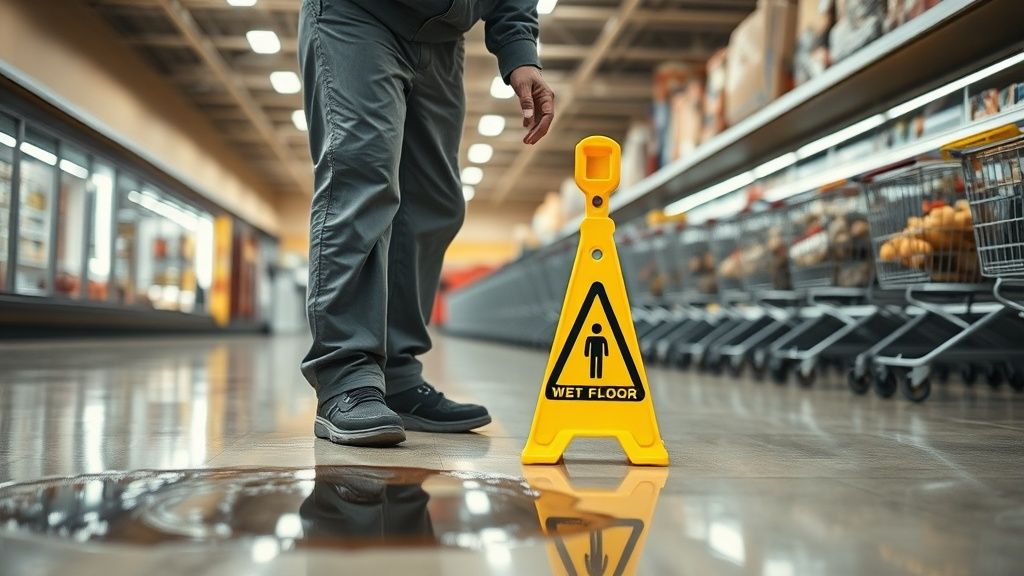
If the hazard was so obvious that any reasonable person would have noticed and avoided it, California law may reduce or eliminate the property owner's liability. A large, brightly colored wet-floor sign standing directly over a spill is a strong "open and obvious" argument. Courts use a reasonableness standard: would an ordinary person have seen this hazard?
This defense does not automatically end your case. If the property owner created a situation where you had no reasonable way to avoid the hazard — for example, the only path to a store exit crosses a wet area — courts may find the hazard was not truly "open and obvious" in any meaningful sense.
Evidence That Vanishes Fast
Fast action on evidence is one of the most important things you can do after a slip-and-fall. Here is what disappears and why:
Surveillance footage.
Surveillance footage is typically recorded over within 30 to 72 hours, which is why sending a written evidence-preservation demand to the property owner as soon as possible after a fall is critical.
Most commercial properties record over footage on a 24- to 72-hour loop. Once it is gone, it is almost always gone. An attorney can send a written litigation hold letter demanding the property owner preserve all footage from the relevant time window. Do not wait on this.
The hazard itself.
Spills get cleaned. Cracked sidewalks get patched. Broken railings get replaced. Photograph everything at the scene, from multiple angles, immediately after the fall — or have someone with you do it.
The incident report.
Ask the store manager or property owner to create an incident report before you leave the scene. Get a copy if possible. This locks in the date, time, location, and the owner's own description of conditions at the time of your fall.
Witness information.
Other customers, employees, or bystanders saw what happened. Their memory fades fast, and they move on. Get names and phone numbers at the scene.
Your own physical condition.
Photographs of your injuries — bruising, swelling, lacerations — taken in the first 24 to 48 hours are far more persuasive than photos taken a week later when bruising fades.
The 2-Year Deadline — and 6 Months if a Government Property
Standard Deadline: Two Years
The standard deadline to file a slip-and-fall lawsuit in California is two years from the date of the fall, under the California Code of Civil Procedure Section 335.1.
Under Cal. Code Civ. Proc. §335.1, you have two years from the date of injury to file a personal injury lawsuit in California. Miss this deadline and the court will almost certainly dismiss your case — no matter how strong it is.
Two years sounds like a long time. It is not. Investigation takes time. Obtaining medical records takes time. Negotiating with an insurance carrier takes time. And the best evidence — surveillance footage, inspection logs, the witness who saw the fall — all starts disappearing immediately.
Government Property: Only Six Months
If you fell on government-owned property — such as a city sidewalk, a public school, or a county park — you have only six months to file a government tort claim under California Government Code Section 911.2.
If the property where you fell is owned or operated by a government entity — a city sidewalk, a public school, a state park, a county library, a public transit platform — a different and much shorter timeline applies.
Under Cal. Gov. Code §911.2, you must file a government tort claim with the responsible public agency within six months of the date of injury. This is not the lawsuit itself — it is the administrative notice that must precede any lawsuit against a government entity.
If you miss the six-month window, you lose the right to sue the government entity entirely, with very limited exceptions.
Who counts as a government entity?
- Cities and counties
- State of California agencies
- Public school districts and community colleges
- University of California and California State University campuses
- Public transit agencies (Metro, BART, Caltrans)
- Water districts and other special districts
If you are not sure whether the property is government-owned, assume it might be and act as if the six-month clock is running.
How a Workers' Compensation Claim Intersects With a Premises Claim
If you fell on someone else's property while you were on the job — for example, a delivery driver who falls on a client's wet loading dock, or a caregiver who slips in a patient's home — you may have two separate claims:
- A workers' compensation claim against your own employer for lost wages and medical treatment under Cal. Lab. Code §3600.
- A third-party premises-liability claim against the property owner whose negligence caused the fall.
These claims run on separate tracks and are not mutually exclusive. In fact, recovering on a third-party premises claim while simultaneously receiving workers' comp benefits is one of the ways injured workers recover the most complete compensation. Workers' comp covers lost wages and medical bills; a third-party claim can add non-economic damages like pain and suffering, which workers' comp does not pay at all.
If your slip-and-fall happened while you were working, call (818) 794-9947) — we handle both sides of these cases.
What Damages Can You Recover?
A successful California premises-liability claim can include:
- Medical expenses — past and future, including surgery, physical therapy, and specialist visits
- Lost wages and lost earning capacity — if the injury kept you from working or limits you going forward
- Pain and suffering — non-economic damages for physical pain, emotional distress, and reduced quality of life
- Property damage — if personal property (eyeglasses, phone, clothing) was damaged in the fall
- Punitive damages — in rare cases involving egregious or intentional misconduct by the property owner (these are genuinely uncommon and not guaranteed)
California does not cap non-economic damages in personal injury cases (unlike medical malpractice, which has a separate cap). The value of any specific case depends on the severity of your injuries, the strength of the evidence, and the specific facts — which is why honest lawyers do not quote "average settlement amounts" on a website. What we can tell you is that represented claimants consistently recover significantly more than those who negotiate directly with an insurance carrier.
FAQ
What do I have to prove in a slip-and-fall case in California?
You must prove four elements: (1) the defendant owned, leased, or controlled the property; (2) the property had an unsafe condition; (3) the owner had actual or constructive notice of that condition — meaning they knew about it, or it existed long enough that a reasonable owner should have found it; and (4) the unsafe condition caused your injuries. All four elements must be established for you to recover.
How long do I have to file a slip-and-fall claim in California?
If the property is privately owned, you have two years from the date of the fall under Cal. Code Civ. Proc. §335.1. If the property is owned by a government entity — a city, county, school district, or state agency — you have only six months to file a government tort claim under Cal. Gov. Code §911.2. Missing either deadline almost always ends your case.
What if I was partly at fault for the fall?
California uses a pure comparative fault system. Your damages are reduced by your percentage of fault, but you are not barred from recovering entirely — even if you were more than 50% at fault. If you are found 40% at fault and your damages are $80,000, you recover $48,000. The defense will argue your fault was higher; your attorney's job is to counter that argument with evidence.
Can I sue a store for a fall?
Yes — but you must show the store knew or should have known about the hazardous condition before your fall. A store is not automatically liable for every fall on its premises. You need evidence of notice: inspection logs showing the hazard was reported, surveillance footage showing the spill sat there for an extended period, or maintenance records showing the condition was known and not repaired.
What if the property owner says they put up a warning sign?
A wet-floor sign does not automatically eliminate the owner's liability. California courts look at whether the warning was adequate and whether the hazard was avoidable given the circumstances. If the only path to the exit crossed the wet area, or if the sign was small and placed behind a display, the "open and obvious" defense may not hold. The totality of circumstances matters.
How soon should I contact an attorney after a fall?
As soon as possible — ideally within 24 to 48 hours. Surveillance footage is typically overwritten within 30 to 72 hours. Spills get cleaned, conditions get repaired, and witnesses move on. An attorney can send an immediate evidence-preservation demand letter and begin investigating before the best evidence disappears. Waiting weeks or months can materially weaken your case even if you are still well within the statute of limitations.
What if I fell at an apartment building I do not live at?
The landlord owes a duty of reasonable care to guests and visitors as well as tenants. If you were a lawful visitor — accompanying a tenant, attending an event, or making a delivery — you are entitled to the same protections as a tenant under California premises-liability law. You do not need to live at the property to bring a claim against the landlord.
Does it cost anything to talk to a lawyer about my fall?
No. Our consultations are free. We represent slip-and-fall clients on a contingency basis — no fee unless we win. You pay nothing upfront. If we do not recover for you, you owe us nothing.
Talk to a California Premises-Liability Attorney Today
Slip-and-fall cases in California turn on evidence — and evidence disappears fast. If you were hurt on someone else's property, the time to act is now, not after the surveillance footage is gone and the inspection log has been conveniently "misplaced."
We have recovered over $150,000,000 for injured workers and injury victims across Southern California. Our attorneys handle both premises-liability claims and the workers' compensation side of on-the-job falls, so if your injury happened while you were working, we can protect both claims.
Call (818) 794-9947 for a free consultation. No fee unless we win. Available in English and Spanish.
Reviewed by Minas Nordanyan, CA Bar #296806. Last reviewed 2026-06-24. This article is for general informational purposes only and does not constitute legal advice. Your situation may involve facts that change the analysis. Call (818) 794-9947 to discuss your specific case.