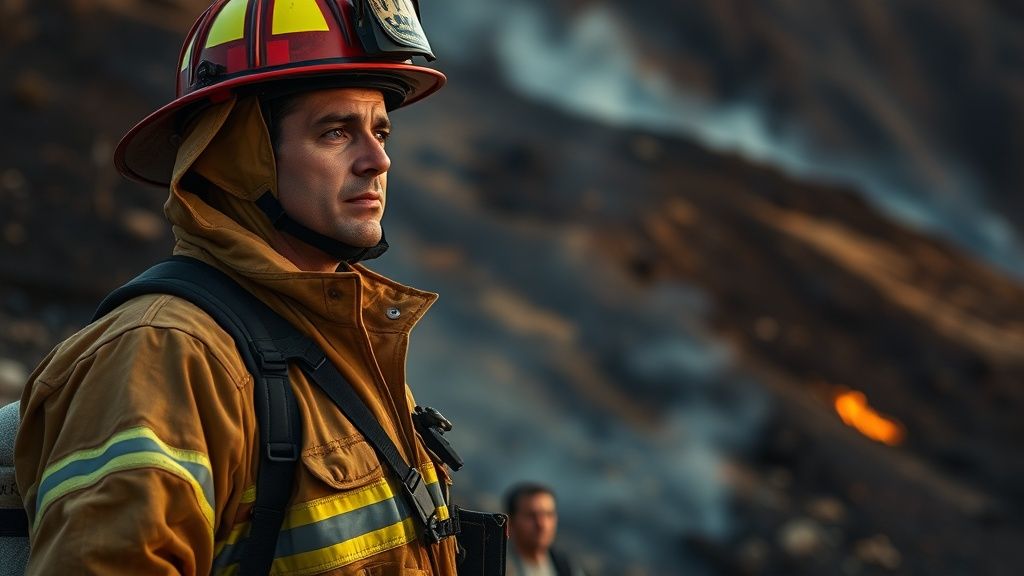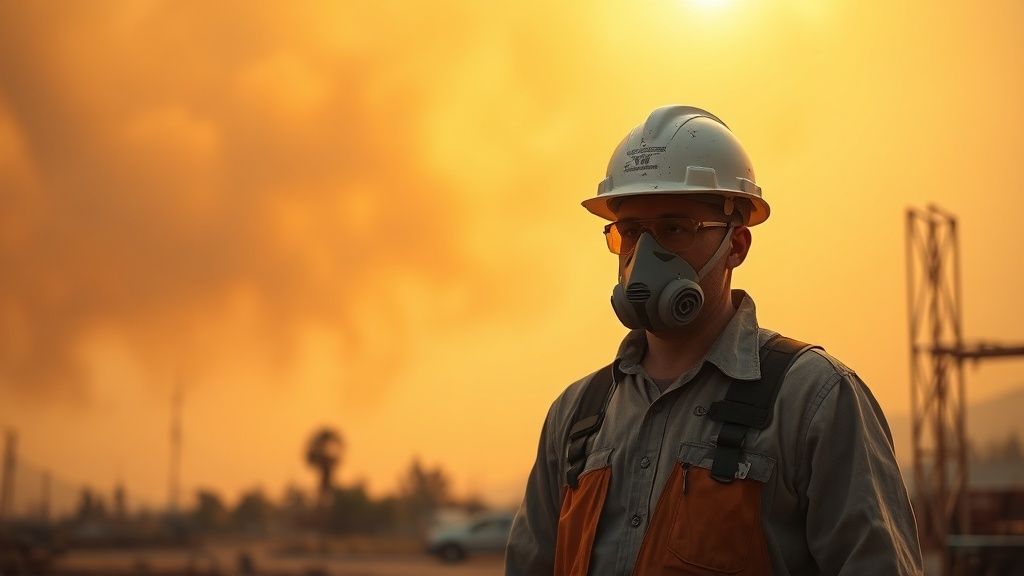
If you work outdoors in California and wildfire smoke made you sick, you may have a workers' comp claim — and your employer's failure to protect you under the Cal/OSHA Wildfire Smoke Standard can be a key part of proving it.
Here is what you need to know.
Quick Answer (TL;DR)
- Yes, smoke inhalation can be a compensable workers' comp injury in California if the exposure occurred during your job.
- The Cal/OSHA Wildfire Smoke Standard (Cal. Code Regs. tit. 8 §5141.1) requires employers to act when the AQI for PM2.5 reaches 151 or higher.
- If your employer ignored that standard — no N95 respirators, no training, no schedule changes — that failure strengthens your claim.
- Construction workers, farmworkers, landscapers, delivery drivers, and first responders face the highest occupational risk.
- Firefighters and certain first responders get an extra protection: a legal presumption under Cal. Lab. Code §3212.1 that respiratory disease is work-related.
- You have one year from the date of injury to file under Cal. Lab. Code §5405.
- Call (818) 794-9947 for a free, confidential eligibility review. No fee unless we win.
Smoke Inhalation as a Compensable Injury Under California Workers' Comp
In California, smoke inhalation is a compensable injury under workers' compensation if the exposure happened while you were performing your job duties.
Under Cal. Lab. Code §3208, a covered "injury" includes any illness or disease that arises out of and in the course of employment. Smoke inhalation fits squarely inside that definition. You do not need a single dramatic exposure event — repeated, cumulative exposure to wildfire smoke over days or weeks also qualifies.
There is one more important rule: even if you had a pre-existing respiratory condition like asthma or COPD before the wildfire season started, your employer's workers' comp insurance must cover any aggravation of that condition caused by work-related smoke exposure. [SPEAKABLE] Even if you have a pre-existing respiratory condition like asthma, a wildfire smoke exposure that aggravates that condition can still be compensable under California workers' compensation law.
What this means practically: a doctor's note linking your worsened breathing, your new bronchitis diagnosis, or your asthma flare-up to the wildfire smoke you breathed on the job site is often the key piece of evidence your claim rests on. Document your symptoms the same day they start, and tell your treating physician exactly where and when the exposure happened.
The Cal/OSHA Wildfire Smoke Standard (Cal. Code Regs. Tit. 8 §5141.1) — When AQI > 150, Employers Must Act
The Cal/OSHA Wildfire Smoke Standard, found at California Code of Regulations title 8, section 5141.1, requires employers to protect outdoor workers any time the Air Quality Index for PM2.5 particles reaches 151 or higher.
This regulation — enforced by California's Division of Workers' Compensation (DWC) and the DIR (Department of Industrial Relations) — covers any employer whose workers perform outdoor work for more than one hour during a shift. That includes:
- Construction and demolition sites
- Agricultural operations (farms, vineyards, orchards)
- Landscaping and groundskeeping
- Road and infrastructure work
- Package delivery and last-mile logistics
- Outdoor security and event staff
The AQI threshold matters because it creates a documented, objective trigger. Cal/OSHA requires employers to check AQI data from official government sources before and during each shift when wildfire smoke is present. If the AQI hit 151 or above on the day you got sick — and your employer kept you working outdoors without protection — that is not just a safety violation. It is evidence that your exposure was both foreseeable and preventable.
What Employers Must Provide Under §5141.1
When the AQI for PM2.5 crosses 151, Cal. Code Regs. tit. 8 §5141.1 requires employers to take these steps:
At AQI 151–500 (Unhealthy through Hazardous):
- Communicate wildfire smoke hazards to workers, in a language they understand.
- Provide training on smoke risks, symptoms of exposure, and how to use respiratory protection.
- Identify ways to reduce exposure — moving workers indoors, rescheduling tasks, increasing rest breaks.
- Provide and ensure the use of NIOSH-approved respirators (N95 or better) for voluntary use at AQI 151–500, and for mandatory use when the employer cannot otherwise reduce exposure.
At AQI 500+ (Hazardous — Extremely Rare):
- Respirator use becomes mandatory without exception.
A few things workers miss:
- The N95 must fit. An N95 respirator hanging around your neck or worn below your nose provides essentially no protection. Under §5141.1, employers are required to provide a properly fitted respirator and training on how to wear it correctly. A mask handed to you without a fit test or instructions does not satisfy the standard.
- "It was only a short exposure" is not a defense for the employer. The regulation covers any outdoor work lasting more than one hour per shift. A four-hour framing job in smoke at AQI 200 is covered.
- You have the right to know the AQI. If your employer never checked or communicated the AQI to you, that itself is a regulatory violation. Keep a note of the date, location, and conditions — and take a screenshot of AQI data for that day from a source like AirNow.gov.
When Employer Non-Compliance Creates a Workers' Comp Claim
If your employer failed to provide a properly fitted N95 respirator when the AQI exceeded 151, that non-compliance can strengthen your workers' comp claim.
California workers' comp is a no-fault system, which means you do not need to prove your employer was negligent to receive benefits. What you need to prove is that your injury arose out of and in the course of employment — that the smoke exposure happened at work. Full stop.
But employer non-compliance with §5141.1 still matters — for two reasons:
- It closes the causation gap. An employer who ignored a documented AQI of 200, kept workers outside without respirators, and gave no safety training cannot credibly argue the injury "wasn't work-related." The Cal/OSHA records create a paper trail that directly ties your exposure to your job.
- It may support a Serious and Willful Misconduct claim. Under Cal. Lab. Code §4553, if your employer's knowing violation of a safety regulation caused your injury, you may be entitled to a 50% increase in your workers' comp benefits. This is a separate claim that requires clear proof the employer knew about the hazard and ignored it — but documented AQI data plus a missing-respirator record is exactly that type of evidence.
If you have medical bills, a missed-work record, and an AQI screenshot from the day you got sick, you have a real claim. Call (818) 794-9947 to walk through your specific facts with a workers' comp attorney — free, confidential, no fee unless we win.
Outdoor Occupations Most at Risk
Outdoor workers in construction, agriculture, landscaping, and delivery are among the highest-risk groups for compensable smoke-inhalation injuries in California.
Construction workers: Long shifts, physically demanding work, and high breathing rates mean more PM2.5 particles inhaled per hour than almost any other occupation. Framing, roofing, and concrete crews operating near active fires or in heavy smoke corridors are frequently affected.
Agricultural workers: Farmworkers may spend eight to ten hours per day in open fields with no overhead cover during fire season. Many work for employers who have historically under-resourced safety compliance. The combination of high exposure volume and low compliance rate makes agricultural smoke claims among the most legitimate — and most under-filed — in California.
Landscaping and groundskeeping: Leaf blowers, mowers, and outdoor power equipment actually concentrate airborne particles further. A landscaper working at AQI 180 with a leaf blower is generating a localized cloud of particulates on top of the ambient smoke.
Delivery drivers: Package and food delivery drivers who spend time outside vehicle cabins — loading, unloading, running to doors — have documented exposure windows that are easy to establish via GPS logs and delivery records.
Firefighters and first responders: Covered separately below because they have additional legal protections.
Common Smoke-Related Conditions Your Claim Can Cover
Workers' comp covers medical treatment and wage replacement for any work-related illness. Wildfire smoke exposure can cause or worsen all of the following:
- Acute bronchitis — inflammation of the airway lining, causing persistent cough and mucus production
- Asthma exacerbation — smoke is a well-documented trigger; a pre-existing asthma condition that worsens after occupational exposure is still compensable
- COPD (chronic obstructive pulmonary disease) aggravation — if you have COPD and your symptoms spike after on-the-job smoke exposure, the aggravation is covered
- Chemical pneumonitis / pneumonia — from deep inhalation of combustion byproducts
- Eye and upper respiratory tract irritation — less severe, but still covered for treatment
- Cardiovascular effects — PM2.5 particles cross into the bloodstream; emerging research links high wildfire smoke exposure to increased cardiac risk
Under Cal. Lab. Code §4600, your employer's workers' comp insurer must cover all reasonably required medical treatment — including specialist pulmonology visits, pulmonary function tests, bronchodilator prescriptions, and any hospitalization — for a compensable smoke-inhalation injury.
First Responders: The §3212.1 Respiratory Presumption
Under California Labor Code section 3212.1, active firefighters and certain first responders are entitled to a rebuttable presumption that any heart or respiratory disease they develop is work-related.
This is a significant legal advantage. For most workers, you must produce evidence showing the injury arose from your job. Under Cal. Lab. Code §3212.1, the burden is flipped: the employer or insurer must prove the heart or respiratory disease did not come from your work. That is a much harder burden for them to meet.
The §3212.1 presumption applies to:
- Active firefighters employed by the state, a county, city, or district
- Active peace officers in specific categories
- Specified first responders with documented wildfire or fire-suppression exposure
If you are a firefighter diagnosed with any respiratory condition — asthma, COPD, reactive airway dysfunction syndrome, or others — after working wildfire assignments, you should talk to a workers' comp attorney before you accept any carrier determination that the condition is "not work-related." The presumption is yours to claim. The insurer will try to overcome it with medical evidence. Our job is to make sure they don't.
For a full breakdown of how the firefighter presumption works and who qualifies, see our guide to the firefighter respiratory presumption in California.
Filing the Claim: What to Document Before You Call an Attorney
Getting your documentation right from the start makes a meaningful difference in how your claim is handled. Here is what to collect:
1. Establish the exposure date and conditions.
Write down (or note in your phone) every date you worked outdoors during a smoke event, the location, the duration, and any protective equipment you were or were not given. Screenshot AQI data from AirNow.gov for those dates and locations. The data is publicly archived.
2. Report the injury to your employer in writing.
Under Cal. Lab. Code §5400, you must notify your employer of a work injury. For a smoke-inhalation illness, the clock starts when you know — or should reasonably know — that your condition is work-related. Do not wait. Report it in writing (text message or email is fine) so there is a timestamp.
3. See a doctor and be specific.
Tell your treating physician exactly where you were, what the AQI was, how long you worked, and what respiratory protection (if any) your employer provided. A medical record that says "patient reports outdoor work during wildfire season with no respirator provided at documented AQI 180" is far stronger than one that just says "cough, shortness of breath."
4. File the DWC-1 claim form.
Your employer is required by Cal. Lab. Code §5401 to give you a DWC-1 claim form within one working day of notice. If they don't, ask for it. Fill it out and keep a copy. The filing date matters for benefit timing.
5. Track lost wages.
If you missed work, save pay stubs showing your average weekly earnings. Temporary disability benefits under Cal. Lab. Code §4653 pay two-thirds of your pre-injury average weekly wage, up to the state maximum.
You have one year from the date of injury — or the date you knew your illness was work-related — to file a workers' comp claim in California under California Labor Code section 5405.
Miss that deadline and you almost certainly lose the right to any benefits. If you are unsure when your clock started — especially for a gradual respiratory condition — call (818) 794-9947 today. We can help you map your timeline.
How Nordanyan Law Handles Smoke-Inhalation Claims
We have recovered over $150,000,000 for injured workers in Southern California across 7,500+ cases, and we handle every case as if it were going to trial — because insurance companies settle for more when they know the other side is prepared to fight.
Smoke-inhalation claims require specific preparation that most carriers hope you skip:
- Occupational medicine records that document the exposure and tie the diagnosis to the specific working conditions, not just ambient wildfire smoke
- Cal/OSHA inspection records or a regulatory compliance history for your employer
- AQI data downloads for the specific ZIP code and date range of your exposure
- Co-worker statements confirming what protective equipment — if any — was available on site
We gather this evidence, file every required form on time, and push back hard when carriers try to deny respiratory claims as "pre-existing" without doing the apportionment analysis the law actually requires.
Every injured worker deserves the same quality of legal representation as any corporation. That is the principle this firm was built on.
If you worked outdoors during fire season and your breathing hasn't been right since, call (818) 794-9947. Free consultation. No fee unless we win.
Frequently Asked Questions
Can I get workers' comp for smoke inhalation in California?
Yes. Smoke inhalation is a compensable injury under California workers' comp if the exposure occurred during your job. Under Cal. Lab. Code §3208, any illness that arises out of and in the course of employment qualifies — including respiratory illness caused by wildfire smoke breathed in while working outdoors.
Are outdoor workers covered for wildfire smoke by their employer?
They should be. The Cal/OSHA Wildfire Smoke Standard (Cal. Code Regs. tit. 8 §5141.1) requires employers to protect outdoor workers whenever the AQI for PM2.5 hits 151 or higher. Required steps include providing N95 respirators, training workers on smoke hazards, and reducing outdoor exposure where possible. If your employer failed to take these steps and you got sick, that failure is directly relevant to your claim.
What is the Cal/OSHA wildfire smoke standard?
It is a California workplace safety regulation — Cal. Code Regs. tit. 8 §5141.1 — that requires employers to take specific protective steps when wildfire smoke creates an AQI above 150. It covers any employer with workers performing outdoor work for more than one hour per shift.
What if I already had asthma before the wildfire?
You can still file a claim. California workers' comp covers the aggravation of pre-existing conditions. If the wildfire smoke made your asthma worse, your medical bills for treating that flare-up — and any wages you lost — can be covered. The insurer may try to apportion some responsibility to your pre-existing condition, which is why having an attorney review the claim matters.
Do I need to prove my employer was negligent?
No. California's workers' comp system is no-fault. You only need to show the injury arose out of and in the course of employment. You do not have to prove your employer was careless. However, if your employer knowingly violated Cal/OSHA safety rules, you may also have a separate claim for increased benefits under Cal. Lab. Code §4553.
How long do I have to file a workers' comp claim for smoke inhalation?
Under Cal. Lab. Code §5405, you generally have one year from the date of injury — or the date you first knew or should have known your illness was work-related — to file your claim. For gradual respiratory conditions, the "date of injury" can be the date a doctor first told you the condition was connected to your work. Do not guess at this deadline. Call (818) 794-9947 and we will map your timeline for free.
Are firefighters treated differently in workers' comp for respiratory conditions?
Yes. Under Cal. Lab. Code §3212.1, active firefighters and certain first responders have a rebuttable presumption that heart and respiratory diseases are work-related. This shifts the burden to the employer or insurer to prove the condition did not arise from work — a much harder standard for them to meet. If you are a firefighter or first responder with a respiratory diagnosis after wildfire exposure, this presumption is one of the most important legal tools available to you.
What medical treatment does workers' comp cover for smoke inhalation?
Under Cal. Lab. Code §4600, workers' comp must cover all reasonably required medical treatment for a compensable injury. For smoke inhalation, that can include emergency care, pulmonologist visits, pulmonary function tests, prescription inhalers and other medications, and any hospitalization required to treat your respiratory condition.
What if my employer denies the claim and says it wasn't work-related?
A denial is not the end of your claim — it is often the beginning of the fight. You have the right to challenge a denial before the WCAB (Workers' Compensation Appeals Board). An attorney can request a QME (qualified medical evaluator) examination to get an independent medical opinion on causation, subpoena employer safety records, and present AQI data as objective evidence. Denials on smoke-inhalation claims are frequently overturned with the right documentation.
How do I know if I have a strong enough case to call an attorney?
If you worked outdoors in California during a period of wildfire smoke, got sick or had your breathing worsen, and missed work or incurred medical expenses — you likely have a claim worth evaluating. There is no cost to find out. Call (818) 794-9947 for a free, confidential consultation. We will tell you honestly whether you have a case and what it might be worth. No fee unless we win.
If you've been exposed to wildfire smoke on the job in California, every day you wait is a day closer to a filing deadline. Call (818) 794-9947 for a free consultation. No fee unless we win. Available in English and Spanish.
Reviewed by Minas Nordanyan, CA Bar #296806 — Nordanyan Law, Van Nuys, CA. Last reviewed [pending sign-off date]. This article is for general informational purposes and does not constitute legal advice. Your rights depend on the specific facts of your claim.