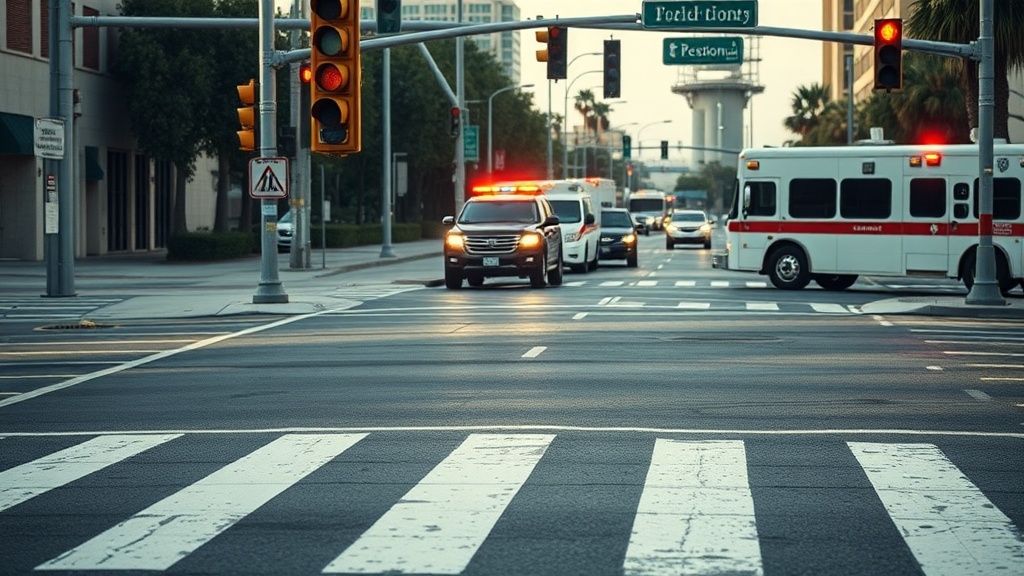
Being hit by a car while walking is terrifying — and the minutes, hours, and days after the crash determine whether you recover what you're truly owed or walk away with far less than you deserve. California law gives pedestrians strong protections, but those protections only work if you act in the right order.
Call 911 immediately after being hit by a car in California — a police report is the foundation of every pedestrian accident claim.
Here are the 9 steps every pedestrian accident victim in California needs to take — in order.
Quick summary — what to do after a pedestrian accident in California:
- Call 911 and wait for a police report, even if you feel okay.
- Accept medical evaluation at the scene; adrenaline masks serious injuries.
- Get the driver's insurance information, license number, and license plate.
- Photograph the scene, crosswalk, signals, and your visible injuries immediately.
- Collect witness names and phone numbers before they leave.
- Do not admit fault or say you are fine to anyone at the scene.
- Know that pedestrians have right-of-way in California — but comparative fault still applies.
- Check your own auto policy: MedPay and UM/UIM coverage can pay your bills.
- File your personal injury claim within two years under Cal. Code Civ. Proc. §335.1.
1. Call 911 and Get a Police Report
Call 911 immediately after being hit by a car in California — a police report is the foundation of every pedestrian accident claim.
Call 911 the moment you are struck, even if the driver stops and says everything is fine. A police report documents the time, location, driver's information, road conditions, and the responding officer's initial observations — all facts that are nearly impossible to reconstruct later. California law under Cal. Veh. Code §20008 requires drivers to report any collision involving injury to law enforcement. You should make that call yourself regardless of whether the driver does.
Without a police report, an insurer can argue the crash happened differently than you describe — or that your injuries were pre-existing. A report filed the same day the crash occurs is worth far more than one filed a week later.
Takeaway: Stay at the scene, call 911, and wait for the officer to arrive before leaving.
2. Accept Medical Evaluation at the Scene
Adrenaline can hide serious injuries like traumatic brain injury and internal bleeding for hours, so accept medical evaluation on the spot even if you feel fine.
Your body floods with adrenaline in the seconds after impact. That chemical response genuinely suppresses the sensation of pain — which means a fractured pelvis, a brain bleed, or a torn ligament may not hurt at all for hours. Accept evaluation from paramedics on scene. If they recommend transport to an emergency room, go.
This step also matters legally. If you decline medical care and symptoms appear three days later, an insurance adjuster will argue the injury was not caused by the crash. A same-day medical record ties your injury directly to the accident.
Common pedestrian accident injuries that are masked by adrenaline include traumatic brain injury (TBI), internal bleeding, hairline fractures, and soft tissue injuries to the neck and back. None of these are visible from the outside. All of them can worsen if untreated.
Takeaway: Tell paramedics yes — and follow up at an emergency room or urgent care the same day, even if you feel okay an hour later.
3. Get the Driver's Insurance, License, and Plate Number
California law under Cal. Veh. Code §16025 requires every driver involved in a collision to provide their name, address, driver's license number, and vehicle registration information to the other party. Collect all of it:
- Full name and address
- Driver's license number and state of issue
- License plate number
- Insurance carrier name and policy number
- Vehicle make, model, and color
Take photos of their license and insurance card directly — typos on a handwritten note can cost you hours of investigation later. If the driver refuses to provide their information, tell the responding officer immediately. Leaving the scene without exchanging information is a crime under Cal. Veh. Code §20001 — a hit-and-run felony when injuries are involved.
Takeaway: Photograph the driver's license and insurance card with your phone before they drive away.
4. Photograph the Scene, Crosswalk, Signals, and Your Injuries
Physical evidence disappears fast. Skid marks fade within days. Crosswalk paint wears off. Signal timing gets reset. Blood dries and washes away. Take photographs immediately — before you are transported — if you are physically able to do so.
Focus on:
- The full intersection or roadway showing where you were struck
- Crosswalk markings, pedestrian signal states (walk / don't walk), and any traffic signals
- Skid marks or the absence of skid marks (which shows the driver never braked)
- Damage to the vehicle — dents, broken glass, and blood or clothing material on the bumper
- Your visible injuries: cuts, bruising, road rash, swelling
- Your clothing and footwear exactly as you were wearing them
If you are transported before you can photograph, ask a bystander or family member to stay and document. Scene evidence gathered in the first hour after a crash is significantly stronger than anything reconstructed afterward.
Takeaway: Take as many photos as possible from multiple angles before anyone moves the vehicle or you leave the scene.
5. Collect Witness Contact Information Before They Leave
Eyewitness testimony is one of the most persuasive forms of evidence in a pedestrian accident claim. A bystander who saw the driver run a red light, fail to stop at a crosswalk, or look down at their phone has information that no physical evidence can replicate.
Witnesses leave within minutes. Ask anyone nearby — at the bus stop, outside a storefront, in a stopped car — for their name and phone number. You don't need a formal statement right now. A name and a phone number is enough for your attorney to follow up.
Do not rely on the police report alone to capture witnesses. Officers arrive after the fact, and bystanders often leave before police get there.
Takeaway: Ask every person nearby for their name and number immediately — do it before you ask anyone else for help.
6. Do Not Admit Fault or Say "I'm Fine"
Never say you are fine, apologize, or offer any explanation of what happened to the driver, bystanders, or insurance adjusters at the scene. Two specific statements cause serious damage to pedestrian accident claims:
"I'm fine" or "I'm okay" — This is used by insurance carriers as evidence that you did not sustain significant injuries. Months later, when your attorney is demanding compensation for a herniated disc, the adjuster will cite the statement. You cannot know how injured you are in the first minutes after a crash.
"I wasn't paying attention" or "I'm sorry" — California uses a pure comparative fault system under Cal. Civ. Code §1714. Any percentage of fault assigned to you reduces your recovery by that percentage. A single offhand comment at the scene can hand the insurer the argument they need to cut your compensation.
Speak to medical personnel about your physical condition. Speak to the police officer only to state the basic facts — where you were walking, which direction the car came from. Say nothing else.
Takeaway: Limit your words at the scene. Do not apologize, do not describe your pain level as minor, and do not speculate about what happened.
7. Understand Pedestrian Right-of-Way and Comparative Fault
California gives pedestrians the right-of-way in marked and unmarked crosswalks under California Vehicle Code Section 21950, but comparative fault rules can still reduce your recovery.
California Cal. Veh. Code §21950 gives pedestrians the right-of-way in both marked crosswalks and unmarked intersections. Drivers must yield. That rule is strong — but it is not absolute.
California applies pure comparative fault, codified in CACI 405 and rooted in Cal. Civ. Code §1714. If you crossed mid-block, crossed against a signal, or stepped into traffic without looking, a jury can assign you a percentage of fault — and your recovery is reduced by exactly that percentage. If a jury finds you 20% at fault and awards $100,000, you collect $80,000.
Common ways insurers argue pedestrian fault:
- Crossing outside a crosswalk (jaywalking)
- Crossing against a pedestrian signal
- Walking with headphones in or eyes on a phone
- Stepping into traffic from between parked cars
Right-of-way in a crosswalk is still powerful — it establishes that the driver had a legal duty to yield. The job of your attorney is to maximize the driver's fault percentage and minimize yours. That work starts with evidence gathered at the scene.
Takeaway: Right-of-way helps — but comparative fault can still reduce what you recover. Document everything that shows you were using the crosswalk lawfully.
8. Check Your Own Auto Policy for MedPay and UM/UIM Coverage
Your own car insurance MedPay and uninsured motorist coverage can pay your medical bills as a pedestrian even if you were not in a vehicle at the time of the crash.
Most pedestrian accident victims do not know this: your own car insurance policy may cover you even when you were on foot.
MedPay (Medical Payments Coverage): Pays your medical bills regardless of who was at fault, up to the policy limit. Applies to you as a pedestrian struck by a vehicle — you do not need to be in a car. It is no-fault, meaning it pays even before fault is determined.
UM/UIM (Uninsured/Underinsured Motorist Coverage): Covers you if the driver who hit you had no insurance or not enough insurance to cover your damages. Under Cal. Ins. Code §11580.2, California requires insurers to offer UM/UIM coverage on auto policies. If you carry it, it applies to pedestrian accidents.
These coverages exist on your own policy — the driver's insurer is separate. Do not wait on the at-fault driver's carrier to begin paying medical bills. Pull out your own policy and call your insurer the same week as the crash.
Takeaway: Call your own auto insurance carrier immediately and ask about MedPay and UM/UIM coverage — you may have benefits you didn't know applied.
9. File Before the 2-Year Deadline Under CCP §335.1
California's statute of limitations for pedestrian accident injury claims is two years from the date of the crash under California Code of Civil Procedure Section 335.1 — miss that deadline and you permanently lose the right to sue.
Under Cal. Code Civ. Proc. §335.1, you have exactly two years from the date of the pedestrian accident to file a personal injury lawsuit in California civil court. Miss that date and your case is permanently barred — no matter how severe your injuries or how clearly the driver was at fault.
There are narrow exceptions, but they are narrow:
- Government entity defendant: If a city bus, government vehicle, or public agency is involved, you must file a government tort claim under the California Government Claims Act within 6 months of the crash — far shorter than the general statute.
- Minor plaintiff: The clock does not start until the injured person turns 18.
- Discovery rule: In rare cases where an injury was not immediately diagnosable, the clock starts when you discovered — or reasonably should have discovered — the injury.
Do not count on exceptions. Two years sounds like a long time, but medical treatment, insurance negotiations, and case investigation take months. Most pedestrian accident attorneys will tell you the best time to hire an attorney is in the first 30 days — before witness memories fade, before surveillance footage is deleted, and before the insurance carrier's investigation locks in a version of events that favors the driver.
Takeaway: You have two years from the crash date to sue — but the real deadline is much sooner if a government vehicle was involved, and every week of delay costs you evidence.
What Happens If You Were Hit While Working?
If you were struck by a car while performing your job duties — crossing a street as a delivery driver, walking a job site, or traveling between work locations — your situation involves both a personal injury (PI) claim against the at-fault driver and a workers' compensation claim under California Labor Code. Both claims can run simultaneously. The workers' comp carrier may have a right to reimbursement from your PI recovery (a "lien"), which affects settlement math.
This is one of the most complex intersections in California injury law. An attorney who handles both claims can structure them to maximize your total recovery rather than letting one undercut the other.
Talk to a California Pedestrian Accident Attorney Before You Sign Anything
Insurance adjusters move fast. The at-fault driver's carrier may call within 24 to 48 hours of the crash with a settlement offer. That offer is almost never the full value of your case — it is the amount the carrier calculates you will accept before you understand what your injuries are actually worth.
We've recovered over $150,000,000 for injured Californians. We handle pedestrian accident cases on a contingency basis — $0 upfront, no fee unless we win.
If you were hit by a car in California, call (818) 794-9947 for a free case review. We'll tell you exactly what your claim may be worth, what coverage applies, and what steps to take next.
Frequently Asked Questions
What should I do immediately after being hit by a car as a pedestrian?
Call 911, accept medical evaluation on the scene, and do not leave until police arrive and file a report. Collect the driver's license and insurance information, photograph the scene from multiple angles, and get the contact information of any witnesses. Do not say you are fine or apologize — those statements can reduce your compensation later.
Who is at fault in a California pedestrian accident?
Fault in a California pedestrian accident depends on the specific facts of the crash. Under Cal. Veh. Code §21950, drivers must yield to pedestrians in crosswalks. However, California's pure comparative fault rule means that if you were crossing mid-block or against a signal, a portion of fault may be assigned to you — reducing your recovery proportionally.
Does my car insurance cover me as a pedestrian?
Yes, in many cases. MedPay coverage on your own auto policy pays medical bills regardless of fault and applies to you as a pedestrian. Uninsured/underinsured motorist (UM/UIM) coverage under Cal. Ins. Code §11580.2 applies if the driver who hit you had no insurance or not enough to cover your damages. Call your own insurer the same week as the crash to confirm what coverage you carry.
What if the driver who hit me had no insurance?
You can still recover through your own UM (uninsured motorist) coverage if you carry it. California law requires auto insurers to offer UM/UIM coverage on every policy. If you declined it or carry minimal limits, your recovery options narrow — but an attorney can identify other potential sources of compensation, including the vehicle owner if different from the driver.
How long do I have to file a pedestrian accident lawsuit in California?
Two years from the date of the crash under Cal. Code Civ. Proc. §335.1. The deadline is six months if a government vehicle or public entity is involved — in that case, you must file a government tort claim with the agency first. Do not wait: evidence disappears and witness memories fade quickly.
What is comparative fault and how does it affect my pedestrian accident claim?
Comparative fault is the California rule that reduces your recovery by your own percentage of fault. Under California Civil Code §1714 and CACI 405, if a jury finds you 25% at fault for stepping into traffic without looking, a $200,000 award becomes $150,000. A pedestrian accident attorney's job is to build the evidence that maximizes the driver's share of fault and minimizes yours.
Should I talk to the other driver's insurance company after a pedestrian accident?
No — at least not without an attorney present. The at-fault driver's insurance carrier is not on your side. Their adjuster's job is to settle your claim for as little as possible. Anything you say about your injuries or the circumstances of the crash can be used to reduce your payout. Refer all contact from the at-fault carrier to your attorney.
What compensation can I recover as a pedestrian hit by a car in California?
You may recover economic damages (past and future medical bills, lost wages, reduced earning capacity) and non-economic damages (pain and suffering, emotional distress, loss of enjoyment of life). In rare cases involving egregious driver conduct — such as DUI — punitive damages may also be available. The total value depends on injury severity, fault percentages, available insurance coverage, and how strong your evidence is.
If you've been hit by a car as a pedestrian in California, every day of delay costs you evidence and leverage. Call (818) 794-9947 for a free consultation with a California pedestrian accident attorney. No fee unless we win. Available in English and Spanish.