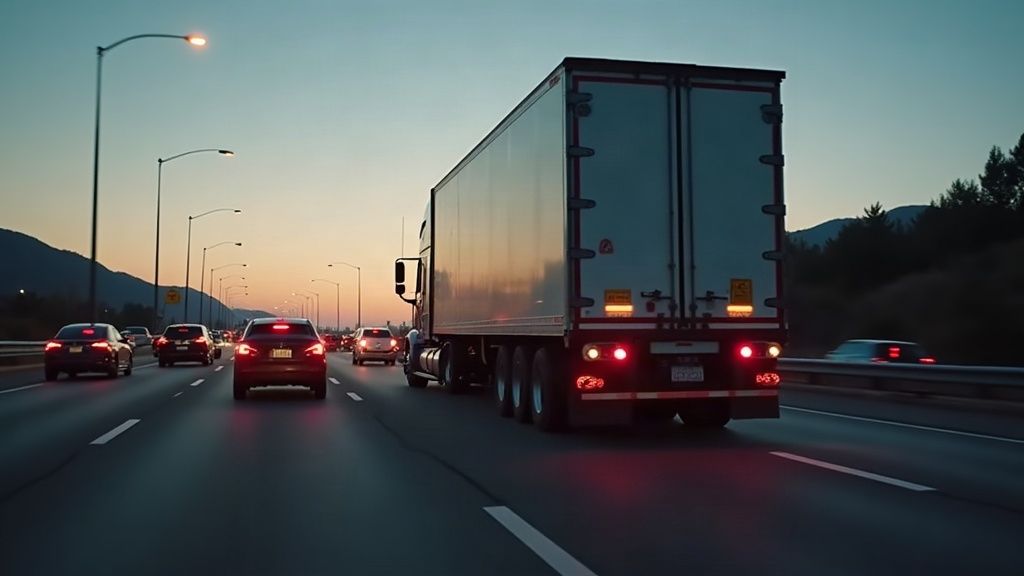
If you were injured in a crash with a commercial truck in California, you already know how different these collisions feel compared to a car accident. A loaded 18-wheeler can legally weigh up to 80,000 pounds under Cal. Veh. Code §35551, roughly 20 to 30 times the weight of a passenger car. That mass difference turns what would be a fender-bender between two cars into a catastrophic, life-altering event.
California roads carry some of the highest commercial truck traffic volumes in the United States, making the state one of the most active theaters for truck accident litigation. Understanding the specific type of crash that happened to you matters, because the crash type determines which federal regulations were violated, which parties can be named as defendants, and what evidence your attorney needs to preserve before it disappears.
Below are the nine types of truck accidents most commonly seen on California roads, why each one causes such serious injuries, and what legal rules govern each scenario.
Quick summary:
- Jackknife: trailer swings outward and sweeps multiple lanes
- Underride: car slides under the trailer, often shearing the roof
- Rollover: top-heavy truck tips sideways, crushing nearby vehicles
- Rear-end: long stopping distance closes fast on a loaded truck
- Wide-turn (right-turn squeeze): car gets trapped at the curb
- Blind-spot (no-zone): car disappears from the driver's view
- Tire blowout: sudden loss of control from a failed tire
- Lost cargo or shifting load: freight spills or destabilizes the truck
- Head-on: fatigued or distracted driver crosses the center line
1. Jackknife Accident
A jackknife accident happens when a truck's trailer swings out at an angle relative to the cab, sweeping across multiple lanes and giving surrounding drivers almost no time to escape.
The trailer rotates around the coupling point and the combination forms a sharp V-shape, like a folding pocket knife. This typically happens when a driver brakes hard or suddenly on a slick surface and the trailer's momentum overpowers traction. In a fraction of a second, the trailer occupies two, three, or even four lanes of traffic.
Federal braking standards under 49 CFR Part 393 require commercial trucks to have braking systems adequate to stop the vehicle without jackknifing under normal conditions. When a trucking company skips brake maintenance or a driver engages the brakes improperly, those violations become evidence of negligence in a California personal injury claim.
Practical takeaway: Preserve skid-mark evidence and the truck's electronic control module (ECM) data immediately. ECM data records brake application force and speed in the seconds before impact.
2. Underride Collision
An underride collision is one of the most deadly truck accident types because a passenger vehicle slides beneath the trailer, and the roof shears off at occupant head level.
Underrides split into two subtypes. A rear underride happens when a car strikes the back of a trailer and slides underneath. A side underride happens when a car slides under the trailer's side skirt. Federal law under 49 CFR Part 393.86 mandates rear underride guards on trailers, but side underride guards are not universally required under federal rules. California advocates have pushed for stricter standards, and the absence of a side guard where one could have been installed can support a product liability or negligence claim against the trailer manufacturer or trucking company.
Injuries in underride crashes frequently include traumatic brain injury, decapitation, and spinal cord damage because the passenger compartment is compromised at the most vulnerable zone for occupants.
Practical takeaway: If a side underride guard was absent or visibly inadequate, the trailer manufacturer may be a named defendant alongside the trucking company.
3. Truck Rollover
A truck rollover happens when a top-heavy or improperly loaded commercial truck tips onto its side, crushing vehicles in adjacent lanes and creating large debris fields on the roadway.
Rollovers are most common on freeway on-ramps and off-ramps, where centrifugal force combines with a high center of gravity. A flatbed carrying steel beams or a tanker filled unevenly with liquid is at particular risk. California Vehicle Code Section 35551 sets maximum weight and load distribution standards, and a truck that is overloaded or improperly balanced violates those standards. That violation can establish negligence per se, meaning the plaintiff does not need to separately prove that the conduct was unreasonable, only that the statute was violated and the violation caused the injury.
Rollover crashes also trigger secondary collisions as other drivers swerve or brake to avoid the tipped truck, multiplying the victim count.
Practical takeaway: Request the truck's weigh-station records and the shipper's bill of lading immediately. These documents reveal load weight and distribution at the time of the crash.
4. Rear-End Collision by a Truck
A rear-end collision caused by a commercial truck is far more dangerous than one caused by a passenger car, because the physics are entirely different at 80,000 pounds.
At highway speeds, a fully loaded semi-truck requires roughly 40 percent more stopping distance than a passenger car. That gap closes in about two seconds when traffic ahead slows. Federal Hours of Service regulations under 49 CFR Part 395 exist specifically to prevent fatigued driving, which is the most common contributing factor in rear-end truck crashes. A driver who exceeded the 11-hour daily driving limit or the 60-hour weekly limit has a documented violation that plaintiff attorneys use to establish negligence.
California courts also allow victims to pursue claims under respondeat superior, which holds the trucking company directly liable for a driver's negligence committed within the scope of employment.
Practical takeaway: Demand the driver's electronic logging device (ELD) records within the first 72 hours after the crash. Trucking companies can overwrite or lose ELD data quickly.
5. Wide-Turn (Right-Turn Squeeze) Accident
In California, truck accident victims can file personal injury claims against multiple defendants at once, including the driver, the trucking company, the cargo loader, and the maintenance contractor.
A wide-turn accident, sometimes called a right-turn squeeze, happens when a truck driver swings the cab left before completing a right turn, creating an open gap between the truck and the curb. A car, cyclist, or motorcyclist in that gap gets pulled into the turn path and crushed against the curb or a structure.
These crashes are common in California's urban freight corridors, including the areas around the ports of Los Angeles and Long Beach. California drivers are legally permitted to use the lane to the right of a slow-moving vehicle, which is exactly the space a swinging truck turns into. The FMCSA requires truck drivers to receive training on wide-turn procedures, and a company that failed to provide or document that training faces direct negligence exposure.
Practical takeaway: Witnesses and surveillance cameras at intersections are critical in wide-turn cases, because the crash happens slowly enough that bystanders often see the full sequence.
6. Blind-Spot (No-Zone) Collision
Blind-spot collisions happen when a passenger vehicle travels inside one of a large commercial truck's four no-zones, the areas directly in front, directly behind, and along both sides where the driver's mirrors cannot capture surrounding traffic.
The Federal Motor Carrier Safety Administration (FMCSA) requires that commercial trucks carry mirrors adequate to allow the driver to see the full width of the vehicle and at least 200 feet behind it. A truck with missing, broken, or improperly adjusted mirrors violates 49 CFR Part 393.80 and can create equipment-failure liability for the trucking company in addition to driver negligence.
A common misconception is that the driver carries no fault if the other car was in a no-zone. That is not correct under California's pure comparative fault rule. California follows pure comparative negligence, meaning even a partially at-fault truck driver owes proportional damages. The court assigns a percentage of fault to each party, and the plaintiff recovers their share of total damages regardless of their own percentage of fault.
Practical takeaway: If the truck's mirror condition is in dispute, the post-crash inspection report from the California Department of Transportation (Caltrans) or the investigating CHP officer's findings can establish whether mirrors were adequate.
7. Tire Blowout Accident
A tire blowout on an 80,000-pound commercial truck can send the vehicle into adjacent lanes in a fraction of a second, and federal regulations under 49 CFR Part 393.75 require tires to be free of cuts, bulges, or tread separation.
When a front tire fails on a loaded commercial truck, the driver loses steering control almost instantly. The truck can veer across the center line or into a guardrail, and the shredded tire itself becomes a road hazard that can puncture the tires or windshields of following vehicles.
49 CFR Part 393.75 prohibits operating a commercial truck with tires that have exposed cords, regrooved tread past legal limits, cuts that expose the cords, or any condition that makes the tire likely to fail. Trucking companies are required to conduct pre-trip and post-trip inspections of all tires under 49 CFR Part 396.11. Skipped inspections leave a paper trail, and that trail is evidence of negligence.
Practical takeaway: The failed tire is physical evidence. Make sure your attorney sends a preservation demand letter to the trucking company within days of the crash before the tire is disposed of or destroyed.
8. Lost Cargo or Shifting Load Accident
California Vehicle Code Section 23114 requires all cargo on a commercial vehicle to be securely fastened, and a violation can support a negligence per se claim against the trucking company or cargo loader.
A lost cargo accident happens in two ways. First, cargo falls directly from the truck onto the roadway, creating an instant obstacle field. Second, cargo shifts inside the trailer during braking or cornering, changing the truck's center of gravity and triggering a rollover or jackknife. Both scenarios can injure or kill multiple drivers across multiple lanes.
Cal. Veh. Code §23114 makes it unlawful to operate any vehicle transporting any material unless the load is covered, contained, or secured to prevent it from escaping the vehicle. Federal cargo securement standards under 49 CFR Part 393, Subpart I specify the number, type, and working load limits of tie-downs required for different cargo categories.
Importantly, California law allows victims to name the cargo loader or shipper as a separate defendant if that party is responsible for securing the load. The carrier, driver, shipper, and loader can each carry a portion of liability.
Practical takeaway: Photographs of the debris field taken immediately after the crash are among the most persuasive evidence in a lost-cargo case. If you are not physically able to take them, ask a bystander or call an attorney who can dispatch an investigator.
9. Head-On Truck Collision
Federal Hours of Service rules under 49 CFR Part 395 cap how many hours a truck driver can operate in a single day and week, and logbook violations are a primary evidence target after a fatigue-related crash.
A head-on collision between a truck and a passenger vehicle is the deadliest scenario in commercial truck accident litigation. When a fully loaded truck crosses the center line at highway speed and strikes an oncoming car, the combined closing speed can exceed 120 miles per hour, and the mass differential means the passenger vehicle absorbs the overwhelming majority of the kinetic energy.
Fatigue is the leading cause of head-on truck crashes. The FMCSA's Hours of Service rules under 49 CFR Part 395 cap commercial drivers at 11 hours of driving after 10 consecutive hours off duty, and at 60 hours over seven consecutive days. Drivers are required to keep electronic logs of their on-duty and driving time. A head-on crash that happens in hour 13 of an 11-hour driving day is a documented federal violation, and that violation is the cornerstone of the negligence case.
Other contributing factors include distracted driving, prescription drug impairment, and mechanical steering failure. California juries treat head-on truck crashes with particular seriousness given their catastrophic outcomes.
Practical takeaway: In head-on crashes with fatalities, California allows surviving family members to bring a wrongful death claim under Cal. Code Civ. Proc. §377.60 and a survivor action under §377.30, allowing recovery for both the decedent's pre-death suffering and the family's own losses.
Why Truck Accidents Are More Serious Than Car Crashes
Four factors make every truck accident on this list materially more dangerous than an equivalent car crash.
Mass and momentum. California permits commercial trucks up to 80,000 pounds. Physics determines that at equal speed, a vehicle 25 times heavier transfers exponentially more energy on impact. Passenger vehicles are not engineered to absorb that force.
Multiple defendants. Unlike a two-car accident, a truck crash can involve the driver, the trucking company, the truck's owner, the trailer's owner, the cargo loader, the shipper, and the maintenance contractor. Each party carries separate insurance policies, and each faces separate potential liability. California's pure comparative fault rules allow all parties to be named and apportioned fault simultaneously.
Federal regulatory framework. Truck drivers and carriers operate under a separate body of federal law, including the Federal Motor Carrier Safety Regulations (FMCSRs), that creates additional duties, inspection requirements, and documentation obligations. Violations of those regulations can establish negligence per se, strengthening a plaintiff's case significantly.
Evidence preservation timelines. ECM data, ELD logs, driver qualification files, maintenance records, and dashcam footage all face short preservation windows. Federal regulations under 49 CFR Part 379 set minimum document retention periods, but evidence not formally demanded in writing can be overwritten, lost, or destroyed before litigation begins.
What to Do After a Truck Accident in California
The steps you take in the hours and days after a truck crash directly affect the strength of your claim.
- Seek emergency medical care immediately, even if you feel fine. Some injuries, including traumatic brain injuries and internal bleeding, do not produce obvious symptoms for hours or days.
- Report the crash to the California Highway Patrol (CHP). A CHP report creates a formal record of the scene and the parties involved.
- Document the scene. Photograph the truck, its license plate, DOT number, company name, the cargo, skid marks, and your vehicle from every angle.
- Do not give a recorded statement to the trucking company's insurance adjuster before speaking with an attorney. Adjusters are trained to capture statements that minimize the company's liability.
- Call an attorney with truck accident experience quickly. Your attorney can send a litigation hold letter demanding preservation of the ECM, ELD, dashcam, and maintenance records before the trucking company's normal data-deletion cycle runs.
We've recovered over $150,000,000 for injured clients in Southern California. If a truck crash injured you or someone in your family, call (818) 794-9947 for a free case review. No fee unless we win.
Frequently Asked Questions
What are the different types of truck accidents?
The nine most common types of truck accidents in California are jackknife crashes, underride collisions, rollovers, rear-end crashes, wide-turn (right-turn squeeze) accidents, blind-spot (no-zone) collisions, tire blowout crashes, lost cargo or shifting load accidents, and head-on collisions. Each type is governed by specific federal regulations and California Vehicle Code provisions that determine which parties can be held liable.
What is a jackknife accident?
A jackknife accident happens when a commercial truck's trailer swings outward from the cab, forming a sharp V-shape. This usually occurs during hard braking on a wet or slick surface when the trailer's momentum overcomes the tires' traction. The swinging trailer can sweep across multiple lanes in under two seconds. Federal braking standards under 49 CFR Part 393 require commercial trucks to have braking systems that prevent jackknifing under normal conditions, and a brake maintenance failure can establish trucking company negligence.
What is an underride truck accident?
An underride truck accident occurs when a passenger vehicle slides under the rear or side of a commercial trailer, often resulting in the roof of the car being sheared off at the occupant's head level. Federal law under 49 CFR Part 393.86 requires rear underride guards on trailers, but side underride guards are not universally mandated, which is a known safety gap. Underride crashes produce some of the highest fatality rates of any truck accident type.
Why are truck accidents more serious than car crashes?
Truck accidents are more serious than car crashes for four primary reasons. First, commercial trucks can legally weigh up to 80,000 pounds in California, creating exponentially greater crash forces than a passenger vehicle. Second, multiple parties including the driver, trucking company, cargo loader, and maintenance contractor can each share liability. Third, the federal regulatory framework governing commercial trucks creates additional duties and evidence sources that strengthen personal injury claims. Fourth, critical electronic evidence including ECM and ELD data has short preservation windows, making early legal action critical.
How long do I have to file a truck accident lawsuit in California?
California's general statute of limitations for personal injury claims is two years from the date of injury under Cal. Code Civ. Proc. §335.1. Wrongful death claims also carry a two-year window from the date of death under §377.60. However, if a government-owned truck or a government contractor is involved, the claims process requires a government tort claim to be filed within six months under Cal. Gov. Code §911.2. Missing either deadline can permanently bar recovery.
Who can be sued after a California truck accident?
In a California truck accident, potentially liable defendants include the truck driver, the motor carrier (trucking company), the truck owner if different from the carrier, the trailer owner, the cargo loader or shipper, the truck or component manufacturer if a defect contributed to the crash, and the maintenance contractor if a mechanical failure was involved. California's pure comparative fault system allows all defendants to be named and apportioned fault in a single lawsuit.
Does it matter if I was partly at fault for the truck accident?
No. California follows a pure comparative negligence rule. Even if you were partially at fault, you can still recover damages. The court assigns a percentage of fault to each party, and your recovery is reduced by your own percentage of fault. For example, if your total damages are $500,000 and you were found 20 percent at fault, you recover $400,000. You are not barred from recovery the way you would be in a contributory negligence state.
If a truck accident in California injured you or a member of your family, the type of crash that happened matters to your case. Call (818) 794-9947 for a free consultation with our personal injury team. No fee unless we win. You can also request a free case review online.