Quick Answer: What You Need to Know Right Now
If you were hurt as a passenger in a rideshare crash in California, here is the short version before we go deeper:
- You are not at fault. As a passenger, you almost never share liability for a rideshare crash.
- Uber and Lyft each carry a $1,000,000 liability policy that applies once your driver accepted your trip and throughout the entire ride.
- Which insurance pays depends on the "period" of the trip — a California-specific framework Uber and Lyft are required to follow under state law.
- If a third-party driver caused the crash, you can pursue that driver's insurer and the rideshare company's underinsured motorist coverage.
- Prop 22 changed driver employment status but did not reduce the coverage passengers are entitled to.
- You have two years to file suit under California's statute of limitations — but the clock starts the day of the crash, and evidence disappears fast.
- Call (818) 794-9947 for a free consultation. No fee unless we win.
Uber and Lyft's Tiered Insurance — and Where the $1 Million Applies
California requires rideshare companies — legally called Transportation Network Companies (TNCs) — to maintain specific insurance at each stage of a trip. The state framework is set out in the California Public Utilities Commission (CPUC) decisions and reflected in Cal. Ins. Code §§11580.1 and 1693. Here is how the tiers work:
Period 0 — App Is Off
The driver's personal auto insurance applies exclusively. Uber's and Lyft's commercial policies do not attach at all. If the driver's personal policy excludes commercial activity (most do), the driver may effectively be uninsured for anything beyond the state minimums.
What this means for you as a passenger: If you were not yet matched with a driver, Period 0 is irrelevant to your claim. But if the crash involved a rideshare driver who happened to be off-duty, the rideshare company's coverage will not protect you.
Period 1 — App Is On, No Ride Accepted Yet
The driver is logged into the app and available but has not yet accepted a trip request. Under Cal. Ins. Code §11580.1, Uber and Lyft must provide:
- $50,000 per person for bodily injury
- $100,000 per accident for bodily injury
- $30,000 for property damage
What this means for you as a passenger: You are unlikely to be in the vehicle during Period 1 — you haven't been picked up yet. If somehow you are (e.g., a prearranged arrangement not processed through the app), the lower-limit policy applies.
Periods 2 and 3 — Ride Accepted Through Dropoff
This is the period that covers almost every passenger injury. Period 2 begins the moment your driver accepts your trip request. Period 3 begins the moment you get into the vehicle. Both periods carry the same coverage level:
- $1,000,000 in third-party liability
- $1,000,000 in uninsured/underinsured motorist (UM/UIM) coverage
- First-party medical payments coverage (coverage limits vary by company)
As an Uber or Lyft passenger in California, you are covered by the rideshare company's $1,000,000 liability policy the moment your driver accepts a ride and throughout the entire trip.
This is the coverage layer most passengers never knew existed — and the reason why being an injured rideshare passenger is, from a coverage standpoint, one of the better positions to be in after a California car crash.
Why the "Period" of the Trip Decides Everything
California law classifies the three stages of a rideshare trip as Period 0, Period 1, and Period 2/3, and the insurance coverage available to you depends entirely on which period the crash occurred in.
Insurance adjusters at Uber and Lyft know this framework better than most attorneys. Their first move after a claim is to dispute which period applies — because knocking you from Period 2/3 down to Period 1 reduces available coverage by roughly 90 percent.
Here is what determines the period:
What Was Happening at the Time of the Crash: Driver's app was off · Period: 0 · Coverage Available: Driver's personal insurance only
What Was Happening at the Time of the Crash: Driver was logged in, waiting for a request · Period: 1 · Coverage Available: $50,000/$100,000/$30,000
What Was Happening at the Time of the Crash: Driver accepted your trip request, driving to pick you up · Period: 2 · Coverage Available: $1,000,000
What Was Happening at the Time of the Crash: You were in the vehicle, ride in progress · Period: 3 · Coverage Available: $1,000,000
How to prove the period: Both Uber and Lyft maintain timestamped electronic records of when a trip was accepted, when the driver arrived, and when the ride ended. Your attorney can subpoena those records early in the case. The GPS ping history is particularly important — it can lock the period in a way the adjuster cannot later dispute.
If you are not sure what was happening when you were hurt, pull up your Uber or Lyft app immediately after the crash and screenshot the trip confirmation, the driver's name and photo, and the trip status screen. That screenshot is often the fastest way to establish which period applies.
When the Rideshare Driver Is at Fault vs. When a Third Party Is
If Your Driver Caused the Crash
Uber's and Lyft's $1,000,000 liability policy covers you directly. You are a third party relative to the driver, which is exactly who liability coverage is designed for.
You would file a claim against Uber or Lyft's commercial carrier — not the driver personally, in most cases, because the company's policy pays first. The driver's personal policy typically does not need to be touched unless the commercial limit is exhausted, which is extremely rare on a $1,000,000 policy.
If Another Driver Caused the Crash
If a third-party driver caused your crash, you can pursue that driver's liability insurance as well as Uber or Lyft's underinsured motorist coverage, which also carries a $1,000,000 limit during an active trip.
This is a meaningful advantage. Here is how the layers stack:
- Third-party driver's liability insurance — California requires a minimum of $15,000 per person / $30,000 per accident under Cal. Ins. Code §11580.1(b). Many at-fault drivers carry only the minimum.
- Uber or Lyft's UM/UIM coverage — $1,000,000 per accident. If the at-fault driver's policy pays $15,000 and your injuries are worth significantly more, Uber's or Lyft's UIM coverage is available for the gap up to the $1,000,000 limit.
- Your own UM/UIM coverage — discussed below.
Stacking Your Own UM/UIM Coverage
If you have your own auto insurance policy with UM/UIM coverage, California law may allow you to stack it on top of what Uber or Lyft's carrier pays. Cal. Ins. Code §11580.2 governs uninsured motorist coverage in California, and whether your policy stacks depends on the policy's anti-stacking language and how your carrier interprets it.
This is not automatic. It requires your attorney to review your specific policy language and potentially fight your own insurer. That fight is worth having if your injuries are serious.
Do You Sue Uber or Lyft Directly?
This is one of the most common questions we hear — and the answer requires understanding California's Proposition 22.
The Prop 22 Independent-Contractor Rule
In November 2020, California voters passed Proposition 22, which classified rideshare and delivery drivers as independent contractors rather than employees for companies like Uber and Lyft. This was a reversal of AB 5, the 2019 law that would have made many gig workers employees.
Under California's Proposition 22, Uber and Lyft drivers are classified as independent contractors, which generally shields the companies from direct employer liability but does not reduce the mandatory insurance coverage passengers are entitled to.
What that means practically:
- You generally cannot hold Uber or Lyft vicariously liable for the driver's negligence the way you could with a traditional employer.
- You can still make a claim against Uber's or Lyft's commercial insurance policy, because California law requires TNCs to maintain that coverage regardless of the driver's employment classification.
- If Uber or Lyft was independently negligent — for example, through a failure to run adequate background checks on a driver with a known history of reckless driving — you may have a direct negligence claim against the company. These cases are harder to prove and require thorough discovery.
The practical bottom line: Most passenger injury claims run through the insurance policies, not through a lawsuit naming the company directly. Your attorney's job is to identify every available policy and maximize what each one pays before deciding whether a direct claim against Uber or Lyft is worth pursuing.
What to Do After a Rideshare Crash in California
If you were just hurt in an Uber or Lyft accident, these steps protect your claim before evidence disappears.
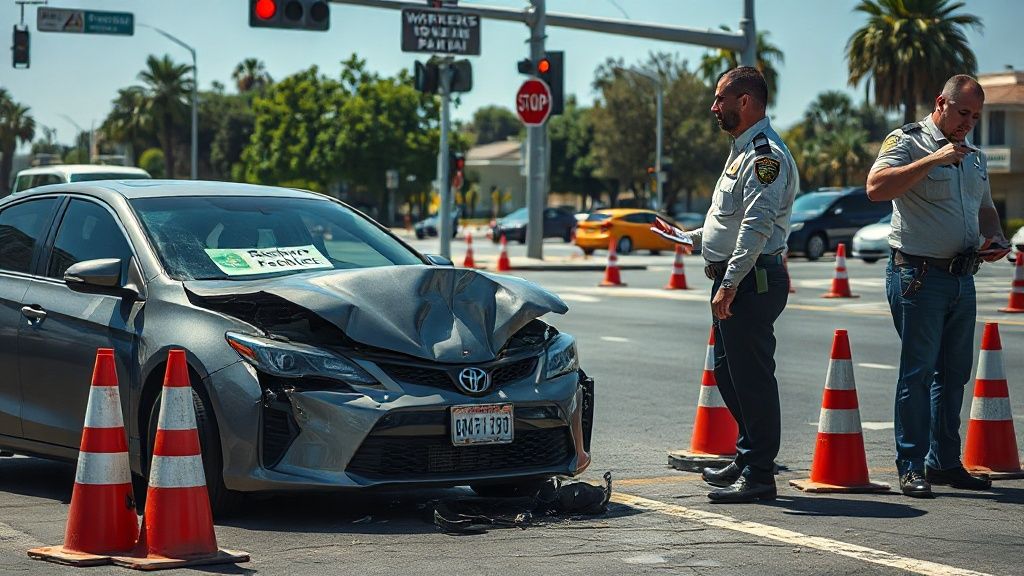
1. Call 911. A police report creates an official record of when, where, and how the crash happened. It establishes the period of the trip, which drivers were involved, and the initial determination of fault. Do not skip this step even if the crash seems minor — soft tissue injuries often do not feel severe until 24-72 hours later.
2. Screenshot everything in the app. Before you close the Uber or Lyft app, capture the trip confirmation screen, driver name and photo, pickup and dropoff points, and trip status. If the app times out, your trip history under "Past Trips" preserves the data temporarily.
3. Get medical attention the same day. California courts and insurance adjusters both look at the gap between the crash and your first medical visit. A gap of more than a few days is used to argue your injuries were not caused by the crash. Even if you feel "okay," a same-day urgent care or ER visit documents your condition while the evidence is fresh.
4. Do not give recorded statements. Uber's and Lyft's claims adjusters will call quickly. They are trained to collect statements that can be used to minimize your payout. You are not legally required to give a recorded statement to the other side's insurer. Politely decline and tell them your attorney will be in contact.
5. Preserve evidence. Save photos of the scene, your injuries, and any property damage. Keep all medical bills, records, and communications from the insurance company. Do not post about the crash on social media.
6. Call an attorney before accepting anything. Early settlement offers from Uber's or Lyft's claims teams often appear before you know the full extent of your injuries. Accepting a quick check typically means signing a full release of all claims.
Never accept a settlement from any insurance carrier — Uber's, Lyft's, or the other driver's — before speaking with an attorney, because early offers rarely reflect the full value of your injuries.
How Long Do You Have to File a Claim in California?
You have two years from the date of the crash to file a personal injury lawsuit in California under Cal. Code Civ. Proc. §335.1, but waiting that long can hurt your claim.
California's standard personal injury statute of limitations is two years from the date of injury under Cal. Code Civ. Proc. §335.1.
A few important exceptions:
- Minor passengers: If the injured passenger was under 18 at the time of the crash, the two-year clock does not begin running until their 18th birthday under Cal. Code Civ. Proc. §352.
- Government entity involvement: If a government employee or government vehicle contributed to the crash, you may be required to file an administrative claim with the public entity within six months of the incident before you can sue — a shorter deadline that catches many people off guard.
- Claims against Uber or Lyft directly: These companies are private, so the standard two-year rule applies. But their insurance policies have internal claim-reporting requirements that are much shorter. Check your trip receipts and the company's claims portal promptly.
Two years sounds like a long time. It is not. Medical records go missing. Witnesses move. Video footage gets overwritten. The GPS and trip data Uber and Lyft maintain are subject to litigation holds — but only if your attorney puts them on notice quickly.
Frequently Asked Questions
What insurance covers me if I'm hurt as an Uber passenger?
Once your driver accepts your trip request, Uber's commercial liability policy — which carries a $1,000,000 limit — covers you for bodily injury caused by the rideshare driver or an uninsured/underinsured third-party driver. California law requires this coverage under state CPUC rules. The coverage applies from the moment of trip acceptance through your dropoff.
Is Uber's $1 million policy always available?
No. The $1,000,000 policy applies only during Periods 2 and 3 — from the moment your driver accepts the trip through the end of the ride. If the crash happened while your driver had the app on but had not yet accepted a trip, the lower Period 1 limits apply ($50,000 per person/$100,000 per accident). If the driver's app was off entirely, only the driver's personal insurance applies. Establishing which period was active is often the central dispute in a rideshare injury claim.
What if the other driver caused the crash?
You can pursue the at-fault driver's liability insurance and, if that coverage is insufficient to cover your damages, Uber's or Lyft's $1,000,000 underinsured motorist policy can cover the gap. You may also be able to stack your own UM/UIM coverage depending on your personal auto policy language. An attorney can identify every available layer and ensure each is properly pursued.
Do I sue Uber or Lyft, or the driver?
Most rideshare passenger claims resolve through the insurance policies, not through a direct lawsuit against the company. Under Proposition 22, Uber and Lyft drivers are classified as independent contractors, which limits the companies' vicarious liability. However, Uber and Lyft are still required by California law to maintain commercial insurance that covers passengers — so the insurance claim runs directly through the company's commercial carrier. A direct negligence claim against Uber or Lyft is possible in specific circumstances, such as a failure to screen a driver with a serious prior record.
Can I be found at fault as a passenger?
Almost never. California follows pure comparative fault under Cal. Civ. Code §1714, which means liability is allocated based on each party's degree of fault. As a passenger, you are typically not operating a vehicle or contributing to the cause of the crash. In rare scenarios — such as if you distracted the driver in a way that contributed to the accident — some allocation might be argued. In the overwhelming majority of cases, passengers are not assigned any fault.
What damages can I recover?
In a California rideshare accident claim, you may be entitled to recover economic damages (past and future medical bills, lost wages, reduced earning capacity) and non-economic damages (pain and suffering, emotional distress, loss of enjoyment of life). In cases involving egregious conduct — such as a driver with a documented history of reckless behavior that Uber or Lyft ignored — punitive damages may also be available, though they are uncommon. The specific value of your claim depends on the severity of your injuries, your treatment course, how long you are unable to work, and the available insurance limits.
What if I don't have my own car insurance?
You do not need your own auto insurance policy to file a claim against Uber's or Lyft's commercial carrier. Those policies exist to cover injured passengers regardless of whether the passenger personally holds auto coverage. If you do have your own policy with UM/UIM coverage, it may provide an additional recovery layer — but it is not a requirement to pursue the rideshare company's insurer.
What if the driver was not logged into the app when the crash happened?
If the driver's app was off at the time of the crash, the rideshare company's commercial policy does not apply at all. The driver's personal auto insurance is the only coverage available, and many personal policies contain exclusions for commercial activity. This scenario most often arises in situations where someone was not technically a rideshare passenger — for example, a friend riding with the driver off-app. If you were booked through the Uber or Lyft app for your trip, the driver was almost certainly logged in, and the trip data will confirm it.
How Nordanyan Law Handles Rideshare Injury Claims
We've recovered over $150,000,000 for injured clients across Southern California. Rideshare accident claims are among the most insurance-layered cases in California personal injury law — the right result depends on identifying every available policy, moving quickly on evidence preservation, and understanding exactly how the CPUC's period framework applies to your specific crash.
Every case we take is handled as if it were going to trial. Insurance companies negotiate harder when they know the other side is prepared to fight — and that preparation is how our clients recover more.
If you were hurt as a passenger in an Uber or Lyft crash in California, call us before you talk to any insurance adjuster. The consultation is free. We handle rideshare injury cases on a contingency basis — no fee unless we win.
Call (818) 794-9947 today. Free consultation. No fee unless we win.
You can also visit our personal injury practice area page to learn more about how we handle motor vehicle injury claims, or start your free case review online.
Reviewed by Minas Nordanyan, CA Bar #296806. Last reviewed June 2026. This article is for general informational purposes and does not constitute legal advice. Your case depends on specific facts — call (818) 794-9947 to discuss yours.