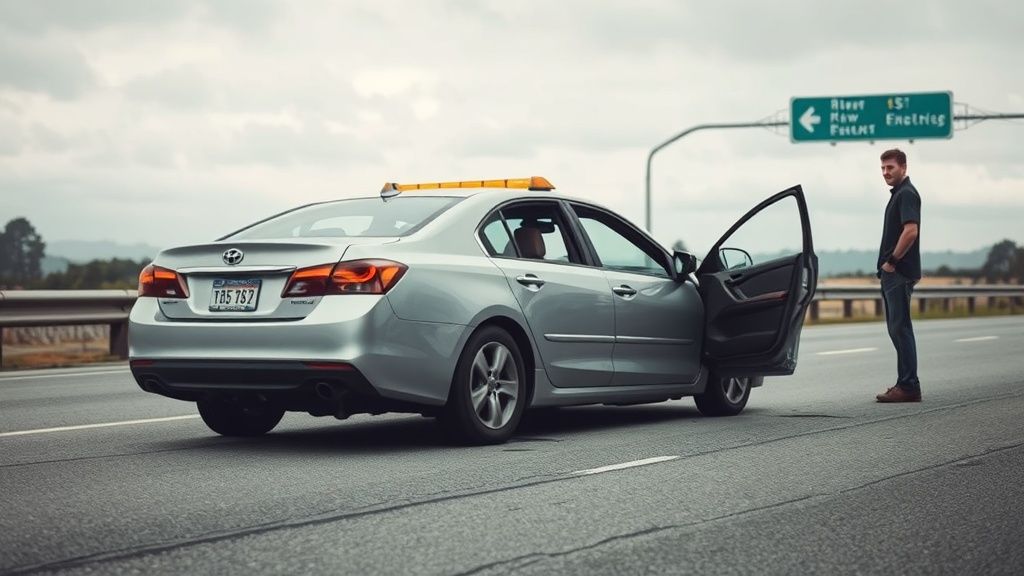
If you've been hit by an uninsured driver in California — or by someone whose insurance barely covers your medical bills — you may be wondering whether your own policy can step in. It can. But the process is more complicated than filing a standard auto claim, and your own insurer will not simply write you a check.
This article explains exactly how uninsured motorist (UM) and underinsured motorist (UIM) claims work under California law, what deadlines apply, and why having an attorney on your side matters when your insurance company becomes the adversary.
If you need to talk through your situation now, call (818) 794-9947 for a free consultation. No fee unless we win.
Quick-Answer Summary
- UM coverage pays when the at-fault driver has no liability insurance at all.
- UIM coverage pays the gap when the at-fault driver's policy is too small to cover your damages.
- California law requires insurers to offer UM/UIM coverage — but drivers can reject it in writing, and many do.
- The governing statute is Cal. Ins. Code §11580.2.
- Your own insurer handles the claim — and has every financial reason to minimize your payout.
- Settling with the at-fault driver without your UIM carrier's written consent can permanently bar your UIM claim.
- Most UM/UIM disputes go to binding arbitration, not a jury trial.
- The statute of limitations is generally two years, but your policy's internal deadlines can be shorter.
UM vs. UIM: The Difference and Why Both Matter in CA
Uninsured motorist (UM) coverage applies when the driver who caused your accident has zero liability insurance. California has some of the highest rates of uninsured drivers in the country. The DWC is not involved here — this is pure auto/personal injury territory — but the same principle applies: the person who hurt you may not be able to pay.
Underinsured motorist (UIM) coverage applies when the at-fault driver has insurance, but their policy limit is too low to cover your full damages. California's minimum liability limits are $15,000 per person and $30,000 per accident under Cal. Ins. Code §11580.1b. If your medical bills, lost wages, and pain and suffering total $120,000, a $15,000 at-fault policy leaves a $105,000 gap. That gap is what UIM is designed to close.
In California, every auto insurer is required by law to offer uninsured motorist coverage, but drivers can reject it in writing — which means many accident victims discover too late that they have no UM protection.
Why both matter:
- About one in every eight California drivers is uninsured, according to the Insurance Research Council.
- Millions more carry only the $30,000 minimum — which has not kept pace with actual medical costs in decades.
- Without UM/UIM coverage in your own policy, your only recovery from an uninsured or underinsured driver is to sue them personally — and collecting a judgment from someone who has no money is extremely difficult.
The statute: Cal. Ins. Code §11580.2 is the master statute for UM coverage in California. It mandates that every auto liability insurer offer UM/UIM coverage, sets minimum limits, defines what counts as an "uninsured motor vehicle," and governs the arbitration process. Everything in this area of law flows from §11580.2.
How UIM "Gap" Coverage Works When the At-Fault Policy Is Too Small
Underinsured motorist coverage kicks in when the at-fault driver has liability insurance, but the policy limit is lower than your total damages — your UIM policy pays the gap up to your own coverage limit.
Here is how the math works in practice:
Your total proven damages: $150,000
At-fault driver's liability limit: $15,000
At-fault insurer pays: $15,000
Remaining gap: $135,000
Your UIM limit: $100,000
UIM insurer pays (up to your limit): $100,000
Uncovered remainder: $35,000
Your UIM carrier does not pay the full gap automatically. They pay up to your UIM policy limit, and they offset what the at-fault insurer already paid. In most California policies, if the at-fault driver pays $15,000 and your UIM limit is $100,000, your UIM carrier owes up to $85,000 — the difference between your limit and what you already collected.
Stacking: Some states allow you to "stack" UIM limits across multiple vehicles on the same policy, multiplying the available coverage. California generally does not permit stacking by default. Cal. Ins. Code §11580.2(d) allows insurers to include anti-stacking provisions, and most do. Whether your specific policy permits stacking depends on its exact language — an attorney can review it for you.
Offset traps: Insurers will try to offset every dollar you collect — from the at-fault driver, from MedPay, from workers' compensation if you were driving for work. Understanding which offsets are legally permitted under §11580.2 versus which the insurer is applying improperly is one of the most critical functions of legal representation in these cases.
Why Your Own Insurer Becomes the Adversary in a UM/UIM Claim
This surprises most people: when you file a UM or UIM claim, you are making a claim against your own insurance policy. Your insurer collected premiums from you. Now they are on the other side of the table.
When you file a UM or UIM claim in California, your own insurance company steps into the shoes of the at-fault driver and has a financial incentive to pay you as little as possible.
That financial incentive is real. Your insurer will:
- Dispute the severity of your injuries. They may send you to an independent medical examination (IME) — a doctor of their choosing — to challenge your treating physician's findings.
- Dispute liability. Even in a UM claim, the insurer can argue the uninsured driver was not actually at fault, or that you share fault under California's comparative fault rules.
- Dispute your damages. They will scrutinize every medical bill, every wage-loss document, and every claim for pain and suffering.
- Use your own recorded statements against you. An adjuster may call you within days of the accident and ask you to give a recorded statement. You are not required to do so under most policy terms, and anything you say can be used to minimize your claim.
The same insurer that happily deposited your premium checks is now operating as a claims-minimizing business. That is not cynicism — it is the structural reality of UM/UIM claims, and it is why California courts have recognized the insurer's duty of good faith and fair dealing. A violation of that duty can expose the insurer to bad faith liability beyond the policy limits under California law.
Stacking, Offsets, and the Consent-to-Settle Trap
The Consent-to-Settle Requirement
This is the most dangerous trap in UIM cases. Before you settle with the at-fault driver's liability insurer, you must give your UIM carrier notice and, in most cases, obtain their written consent or allow them to "step into the shoes" of the at-fault driver and pay you themselves.
If you settle directly with an at-fault driver's liability insurer without your UIM carrier's written consent, you can lose your right to bring a UIM claim entirely.
Here is why: once you accept and release the at-fault driver, your UIM insurer loses the right to pursue that driver in subrogation (to recover what they pay you from the person who caused the accident). California courts have held that settling without consent can prejudice the UIM carrier — and courts have allowed UIM carriers to reduce or deny coverage on that basis.
What to do instead:
- Before accepting any liability settlement, notify your UIM carrier in writing.
- Give the UIM carrier the option to substitute payment of the liability policy limits and preserve their subrogation rights.
- Get their written consent to the settlement if they decline to substitute.
- Only then accept the liability payment.
An attorney handles this process routinely. Trying to coordinate this yourself — while recovering from an injury — is where people lose claims that should have been paid.
The "Hit and Run" UM Claim
A special rule applies to hit-and-run accidents under Cal. Ins. Code §11580.2(b)(2): to trigger UM coverage, the accident must be reported to law enforcement within 24 hours (or as soon as practicable), and there must generally be physical contact between the vehicles. This prevents fraudulent claims where someone invents a phantom at-fault vehicle. If you were hit and the other driver fled, call the police immediately — that report is the foundation of your UM claim.
Deadlines and Arbitration Clauses Unique to UM/UIM
Statute of Limitations
In California, UM and UIM claims are typically subject to a two-year statute of limitations under Cal. Code Civ. Proc. §335.1, but your policy's contractual deadlines — including arbitration demand windows — can be shorter.
The two-year personal-injury statute of limitations runs from the date of the accident. That is the outer boundary. But your insurance policy almost certainly contains shorter contractual deadlines that courts have upheld in California.
Arbitration: The Forum for Most UM/UIM Disputes
Unlike a standard third-party liability claim — where you can sue the at-fault driver in civil court — UM/UIM disputes in California are almost always resolved through binding arbitration. Cal. Ins. Code §11580.2(f) requires that insurers include an arbitration clause in every UM policy.
What that means for you:
- There is no jury. A neutral arbitrator (or a three-arbitrator panel) decides liability and damages.
- The arbitrator's decision is generally final. Grounds to overturn an arbitration award are narrow under Cal. Code Civ. Proc. §1286.2.
- Your policy sets the demand deadline. Most California policies require you to demand arbitration within a specific window — often one to three years from the accident date. Miss it, and your claim may be barred even if the two-year statute of limitations has not yet run.
- Pre-arbitration steps matter. Most policies require you to first attempt to reach a settlement with the insurer before demanding arbitration. The timeline for those steps is also typically defined in the policy.
California Insurance Code §11580.2 is the governing statute for uninsured motorist coverage — it sets mandatory offer requirements, minimum limits, and the arbitration process insurers must follow.
The practical takeaway: read your policy's UM/UIM section, or have an attorney read it for you, within the first weeks after an accident. Missing a contractual deadline inside your policy can be just as fatal to your claim as missing the two-year statute of limitations.
How an Attorney Changes the Outcome
An attorney can demand arbitration, challenge a lowball valuation, and prevent your insurer from using procedural traps to deny a legitimate UM or UIM claim.
Here is what legal representation actually changes in a UM/UIM case:
Documentation. An attorney builds the same kind of damages package used in jury trials — medical records, expert reports, life-care plans, vocational-rehabilitation analyses, and economic loss projections. Insurers respond differently to a demand package that looks like it was built for arbitration than to one that looks like it was assembled by an injured person alone.
Navigating consent-to-settle. As described above, the coordination between the liability insurer and the UIM carrier is a procedural minefield. An attorney manages it so you do not accidentally waive your UIM rights.
Challenging the IME. When the insurer sends you to their own examining physician, an attorney can retain a rebuttal expert and present the conflict at arbitration.
Arbitration advocacy. Arbitrators are experienced legal professionals. Presenting a UM/UIM case effectively — with proper evidence, legal argument on damages, and command of Cal. Ins. Code §11580.2's provisions — requires legal training. The insurer will have an attorney at the table. You should too.
Bad faith leverage. If the insurer unreasonably delays or denies your claim, California law gives you the right to pursue a bad faith claim separately. An attorney can evaluate whether your insurer's conduct crosses that line — and the possibility of bad faith exposure is itself a negotiating tool that often moves insurers toward reasonable settlements.
We've recovered over $150,000,000 for injured clients across Southern California. If you were hurt by an uninsured or underinsured driver, call (818) 794-9947 for a free case review. No fee unless we win.
FAQ: Uninsured & Underinsured Motorist Claims in California
What is uninsured motorist coverage in California?
Uninsured motorist (UM) coverage is an optional addition to your California auto policy — required to be offered by every insurer under Cal. Ins. Code §11580.2, but not mandatory to purchase. It pays your damages — medical bills, lost wages, pain and suffering — when the driver who caused your accident carried no liability insurance at all.
How does underinsured motorist coverage work in California?
UIM coverage kicks in when the at-fault driver has liability insurance, but their policy limit is too low to cover your full damages. Your UIM carrier pays the gap between what the at-fault insurer paid and your total proven losses, up to your own UIM policy limit. The at-fault insurer's payment is offset against your UIM limit.
Is UM coverage required in California?
No. California law requires every auto insurer to offer UM and UIM coverage, but you can reject it in writing. Many drivers do — and then discover after an accident that they have no protection against uninsured drivers. If you are unsure whether you have UM/UIM coverage, check your policy's declaration page or call your broker.
Can my own insurer deny my UM/UIM claim?
Yes. Your insurer can dispute liability (whether the uninsured driver was actually at fault), dispute the extent of your injuries, dispute the value of your damages, or assert that you violated a policy condition — such as settling with the at-fault driver without their consent. That is why having legal representation is important from the early stages of a UM/UIM claim.
What happens if I settle with the at-fault driver first?
Settling with the at-fault driver's liability insurer without first notifying your UIM carrier and obtaining their written consent — or giving them the chance to substitute payment — can permanently bar your UIM claim. Courts in California have upheld UIM denials based on prejudice to the carrier's subrogation rights. Do not accept any liability settlement before consulting an attorney if you believe you may have a UIM claim.
How long do I have to file a UM/UIM claim in California?
The general statute of limitations for personal injury in California is two years from the date of the accident under Cal. Code Civ. Proc. §335.1. However, your insurance policy almost certainly contains shorter contractual deadlines — including a window to demand arbitration — that can cut off your rights before the two-year period expires. Read your policy or consult an attorney promptly after your accident.
Do UM/UIM claims go to court or arbitration?
Almost all California UM/UIM disputes go to binding arbitration, not a jury trial. Cal. Ins. Code §11580.2(f) requires every UM policy to contain an arbitration clause. The arbitrator's decision is generally final and binding, subject only to the narrow grounds for vacating an award set out in Cal. Code Civ. Proc. §1286.2.
What is the minimum UM/UIM coverage I should carry in California?
California law only requires that insurers offer UM/UIM at the same limits as your liability coverage. The statutory minimum liability limits — $30,000 per person / $60,000 per accident — are widely considered inadequate given the cost of serious injury treatment in California. Many attorneys recommend carrying at least $100,000 per person / $300,000 per accident in UM/UIM limits. Consult an independent insurance broker for coverage advice tailored to your situation.
What if a hit-and-run driver caused my accident?
Hit-and-run accidents can trigger UM coverage, but Cal. Ins. Code §11580.2(b)(2) requires physical contact between the vehicles and a police report filed within 24 hours (or as soon as reasonably practicable). If you were hit and the driver fled, call 911 immediately, photograph the scene and your vehicle, and notify your insurer as soon as possible. Then contact an attorney before making any recorded statements to your insurer.
Every injured worker and accident victim deserves the same quality of legal representation as any corporation. That is the principle this firm was built on.
If you were hit by an uninsured or underinsured driver in California, call (818) 794-9947 for a free consultation. We handle UM and UIM claims across Southern California. No fee unless we win. Available in English and Spanish.
Reviewed by Minas Nordanyan, CA Bar #296806 — Nordanyan Law. Last legal review: 2026. This article is general legal information, not legal advice. Your rights depend on the specific facts of your accident, the language of your insurance policy, and applicable California law. Contact an attorney to evaluate your individual claim.