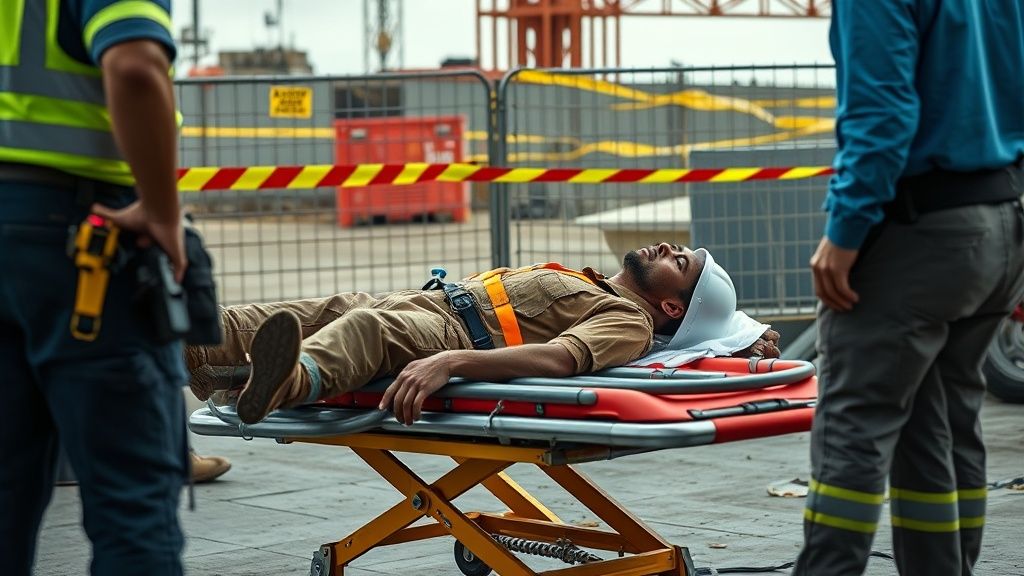
Some workplace injuries heal in weeks. The seven on this list don't.
These are the injuries that permanently alter how you work, how you move, and how you live — the ones that generate the largest California workers' compensation claims because they require the most treatment, the most time off, and in many cases, benefits that never stop. Under California Labor Code §4600, your employer's workers' comp insurer must pay for all medical treatment that is reasonably required to cure or relieve the effects of a work injury — with no dollar cap.
Here's what you need to know about the seven severe workplace injuries that carry the longest recoveries and the biggest claims in California.
Quick answer — the 7 workplace injuries with the longest recovery:
- Spinal cord injuries — possible permanent paralysis; lifetime care and weekly benefits
- Traumatic brain injuries — years of cognitive and behavioral recovery; permanent disability likely
- Complex fractures — multiple surgeries; months of non-weight-bearing recovery
- Severe burns — grafts, reconstructive surgery, and years of rehabilitation
- Amputations — permanent impairment; prosthetics covered for life
- Rotator cuff and major joint reconstructions — 6-12 months recovery; lasting functional loss
- Occupational lung disease — progressive, incurable; lifetime medical benefits available
1. Spinal Cord Injuries
Spinal cord injuries are among the most catastrophic workplace injuries in California, and workers who suffer permanent paralysis may qualify for lifetime weekly permanent disability payments under California Labor Code Section 4658.
A spinal cord injury (SCI) at work — from a fall off scaffolding, a vehicle collision on a job site, or being struck by heavy equipment — can cause partial or complete paralysis below the point of injury. Recovery timelines depend on the level and completeness of the injury, but the hard truth is this: most severe SCIs do not fully resolve. The American Spinal Injury Association grading system (ASIA A, the most severe classification) means the damage is permanent.
What California workers' comp covers for SCIs:
- All medically necessary treatment under Cal. Lab. Code §4600 — surgeries, hospitalization, spinal cord stimulators, home health aides, wheelchair accommodations, and more
- Temporary disability (TD) payments at two-thirds of your average weekly wage (up to the state maximum) under Cal. Lab. Code §4653 during your recovery period
- Permanent disability (PD) benefits under Cal. Lab. Code §4658, which for a 100% total permanent disability rating means weekly payments for life
A 100% permanent disability award is rare — but spinal cord injuries are one of the few injuries that can get there. Even a partial SCI resulting in a 70-80% PD rating generates a six-figure lump sum or structured payment stream.
Practical takeaway: If you've suffered a spinal cord injury at work in California, don't sign any settlement document — especially a Compromise & Release (C&R) — without getting a full lifetime medical cost analysis from an attorney first. A C&R closes out your medical rights permanently.
2. Traumatic Brain Injuries
A traumatic brain injury sustained at work can qualify for permanent disability benefits in California, calculated based on the worker's whole-person impairment rating under the AMA Guides to the Evaluation of Permanent Impairment.
Traumatic brain injuries (TBIs) are caused by a blow, jolt, or penetrating injury to the head. On California job sites, the most common causes are falls, being struck by a falling object, and vehicle accidents. TBIs range from mild concussions — which most workers shake off within weeks — to severe injuries that permanently change how a person thinks, behaves, and functions.
What makes TBIs uniquely difficult in the workers' comp system is their invisibility. Unlike a broken arm, a TBI doesn't show up cleanly on an X-ray. Insurance carriers frequently dispute TBI claims, arguing the worker's cognitive symptoms are pre-existing or exaggerated. A QME (qualified medical evaluator) who specializes in neuropsychology is often essential to establishing the work-relatedness and severity of the injury.
Recovery timeline: Mild TBIs may resolve in 3-6 months. Moderate to severe TBIs plateau — meaning maximum medical improvement (MMI) is reached — anywhere from one to three years after injury. For the most severe cases, the cognitive and behavioral deficits are permanent.
What California workers' comp covers for TBIs:
- Neurological treatment, neuropsychological evaluation, cognitive rehabilitation, and behavioral health services under Cal. Lab. Code §4600
- TD payments during the recovery period (up to 104 weeks for most injuries under Cal. Lab. Code §4656, extended for severe TBIs)
- PD benefits under Cal. Lab. Code §4658 based on the whole-person impairment (WPI) percentage under the AMA Guides, Fifth Edition
Practical takeaway: TBI claims require a strong medical record built early. Seek emergency care immediately after a head injury — a gap in treatment is the first thing an insurance adjuster will use to argue your symptoms aren't work-related.
3. Complex Fractures Requiring Multiple Surgeries
California workers' compensation must cover all medically necessary treatment for a work injury — including surgery, physical therapy, and prescription medication — under California Labor Code Section 4600, with no dollar cap on medical benefits.
Not all fractures are the same. A simple fracture of a finger heals in weeks with little permanent effect. A complex fracture — a shattered pelvis from a construction site fall, a comminuted femur fracture from a forklift accident, a burst fracture of a vertebra from a scaffolding collapse — is a different injury category entirely.
These injuries routinely require open reduction internal fixation (ORIF) surgery, hardware placement, and sometimes a second surgery to remove or revise the hardware. Non-weight-bearing periods of 10-16 weeks are common for lower extremity fractures. Physical therapy extends for months after that. And for fractures that involve a joint (intra-articular fractures), post-traumatic arthritis is a frequent long-term consequence that generates ongoing medical care and a permanent disability rating years down the line.
What California workers' comp covers for complex fractures:
- All surgeries, hospitalizations, anesthesia, and surgical implants under Cal. Lab. Code §4600
- TD payments at two-thirds of your pre-injury average weekly wage under Cal. Lab. Code §4653 for the entire non-weight-bearing and active-treatment period
- PD benefits once you reach MMI if the fracture left permanent functional limitations
- Supplemental Job Displacement Benefit (SJDB) voucher under Cal. Lab. Code §4658.7 if you cannot return to your usual and customary job
Practical takeaway: Document every surgery, every physical therapy session, and every limitation with your treating physician. The PD rating is built from your medical record — not from what you tell the insurance adjuster.
4. Severe Burns
Third-degree and fourth-degree workplace burns are among the most physically and psychologically devastating injuries a worker can suffer. California industries where burns occur most often include oil and gas, chemical manufacturing, electrical work, commercial kitchens, and firefighting.
Severe burns destroy the full thickness of the skin — and in the worst cases, the tissue and bone beneath it. Treatment is not a single event. It is a process that unfolds over months and years:
- Emergency stabilization and wound care
- Skin grafting surgery (often requiring multiple procedures as the wound area is addressed in stages)
- Management of infection risk
- Reconstructive surgery for functional recovery (releasing contractures that limit range of motion)
- Scar management — compression garments, silicone sheeting, laser treatment
- Psychological and psychiatric treatment for post-traumatic stress and body image adjustment
- Occupational therapy to rebuild fine motor skills and work capacity
What California workers' comp covers for severe burns:
- The entire course of treatment described above under Cal. Lab. Code §4600 — there is no cap on medical benefits
- TD payments during the active treatment and recovery phases under Cal. Lab. Code §4653
- PD benefits reflecting the permanent functional loss from scarring, contractures, and skin graft limitations
- Disfigurement is rated separately under California's PD system; extensive facial or body scarring can add to the overall PD award
Practical takeaway: Burn injury cases are frequently contested by insurance carriers on causation and treatment necessity. A specialist attorney who understands how California's utilization review (UR) and independent medical review (IMR) process works under Cal. Lab. Code §4610 is critical for ensuring you get every surgery and rehabilitation service approved.
5. Amputations
Amputations from workplace accidents in California are rated as scheduled losses under the AMA Guides, and California workers' comp must also provide prosthetic devices for life under California Labor Code Section 4600.
An amputation — whether traumatic (the limb is severed at the scene) or surgical (the limb is removed after a crush injury or severe infection) — creates a permanent, irreversible disability. California workers' comp treats amputations seriously: they generate some of the highest permanent disability ratings in the system.
California rates amputation-related impairments using the AMA Guides to the Evaluation of Permanent Impairment, Fifth Edition. A below-knee (transtibial) amputation, for example, carries a significant whole-person impairment percentage that translates directly into a PD award under Cal. Lab. Code §4658. Above-knee (transfemoral) and upper extremity amputations carry even higher ratings.
What California workers' comp covers for amputations:
- Emergency surgery, hospitalization, wound care, and stump revision under Cal. Lab. Code §4600
- Prosthetic limbs — including advanced myoelectric devices — and replacements and upgrades as technology advances and the device wears out, for life, under Cal. Lab. Code §4600
- Physical and occupational therapy for learning to use the prosthesis and rebuilding functional capacity
- PD benefits based on the AMA Guides impairment rating under Cal. Lab. Code §4658
- If the amputation prevents you from returning to your job, an SJDB voucher under Cal. Lab. Code §4658.7 for retraining
Practical takeaway: Prosthetic technology advances quickly. If you resolve your claim through a Compromise & Release that closes out future medical rights, you lose the right to upgraded prosthetics. A Stipulation with Request for Award — which keeps future medical open — is often the better structure for amputation cases. Talk to an attorney before you settle.
6. Rotator Cuff and Major Joint Reconstructions
Rotator cuff tears and major joint reconstructions (total knee replacement, hip replacement, shoulder replacement, or complex ligament reconstruction) are among the most common severe workplace injuries in California — particularly in construction, warehousing, manufacturing, and healthcare.
A full-thickness rotator cuff tear requiring surgical repair carries a standard recovery arc of six to twelve months before a worker is medically cleared. Many workers never regain full pre-injury strength and range of motion. For workers over 50, the combination of a workplace injury and age-related degeneration creates a "combined factors" PD apportionment dispute that insurance carriers use aggressively to reduce the benefit they owe.
What California workers' comp covers for major joint reconstruction:
- Diagnostic imaging (MRI), surgical repair, anesthesia, and implant costs under Cal. Lab. Code §4600
- TD payments at two-thirds of your pre-injury average weekly wage for the entire recovery period under Cal. Lab. Code §4653
- PD benefits for the permanent impairment remaining after MMI under Cal. Lab. Code §4658
- Physical therapy through the DWC's medical treatment utilization schedule (MTUS)
Apportionment — the key issue in joint cases: Under Cal. Lab. Code §4663, insurance carriers are required to apportion — or reduce — a PD award by the percentage of disability caused by non-industrial factors (like pre-existing arthritis). This is one of the most contested legal issues in California workers' comp. An experienced attorney builds the medical record to minimize apportionment and maximize your PD award.
Practical takeaway: Don't let an insurer-paid QME write the only opinion on apportionment. You have the right under Cal. Lab. Code §4062 to dispute a QME's report and pursue your own medical-legal evaluation. Use it.
7. Occupational Lung Disease
Occupational lung diseases like asbestosis and silicosis are covered by California workers' compensation as cumulative trauma injuries, and the date of injury is determined under California Labor Code Section 5412 — the date the worker first knew or should have known the condition was work-related.
Occupational lung diseases are different from traumatic injuries in one critical way: they develop slowly, over years or decades of exposure. By the time a worker is diagnosed, the damage to the lung tissue is already done — and it is irreversible. The major occupational lung diseases include:
- Asbestosis — scarring of lung tissue from asbestos fiber inhalation; common in construction, shipbuilding, and insulation work
- Silicosis — progressive lung fibrosis from crystalline silica dust; common in mining, tunneling, masonry, and countertop fabrication (an epidemic-level hazard in California's stone countertop industry)
- Occupational asthma — airway inflammation from chemical, dust, or biological exposure on the job
- Mesothelioma — a malignant cancer of the pleural lining caused almost exclusively by asbestos exposure; carries separate catastrophic claim value and potential civil tort claims in addition to workers' comp
The date-of-injury issue: Under Cal. Lab. Code §5412, the date of injury for a cumulative trauma or occupational disease is the date the worker first suffered disability from the condition AND knew, or should have known, it was work-related. This is the clock that starts the one-year filing deadline under Cal. Lab. Code §5405. Workers often don't realize their lung condition is compensable — and miss the window.
What California workers' comp covers for occupational lung disease:
- Lifetime medical treatment — pulmonology, pulmonary rehabilitation, oxygen therapy, and medications — under Cal. Lab. Code §4600
- TD payments if the disease causes you to stop working during treatment
- PD benefits based on the permanent impairment to pulmonary function under Cal. Lab. Code §4658
Workers hurt in California have one year from the date of injury to file a workers' compensation claim under California Labor Code Section 5405, but occupational disease claims have a separate discovery-rule deadline under Section 5412.
Practical takeaway: If you've worked in construction, demolition, mining, countertop fabrication, or any industry with documented chemical exposure and you've been diagnosed with a pulmonary condition, talk to a workers' comp attorney immediately. The filing deadline clock may already be running.
What These 7 Injuries Have in Common
All seven of these injuries share three features that make them the highest-value workers' comp cases in California:
- Long or permanent treatment needs — California workers' comp's obligation to pay for medical care under Cal. Lab. Code §4600 has no dollar cap. A lifetime of pulmonology visits, prosthetic replacements, or spinal cord treatment can easily exceed $1,000,000 in value.
- Significant permanent disability ratings — The higher the PD percentage, the higher the weekly benefit payments under Cal. Lab. Code §4658 and the larger the lump-sum settlement.
- Frequent insurance carrier disputes — The bigger the claim, the harder the carrier fights. Utilization review denials, apportionment arguments, and disputed QME reports are standard tactics in high-value cases.
We've recovered over $150,000,000 for injured workers in Southern California — including six-figure and seven-figure settlements in the injury categories above. The workers who recovered the most were represented. Learn more about our results.
If you've been diagnosed with a severe workplace injury in California, call Nordanyan Law at 818-794-9947 for a free case review — no fee unless we win.
Frequently Asked Questions
What workplace injuries take the longest to heal?
Spinal cord injuries and traumatic brain injuries typically take the longest to reach maximum medical improvement (MMI) — often one to three years for severe cases, and many never fully resolve. Severe burns, amputations, and occupational lung diseases also involve treatment that continues for life. California workers' comp covers all medically necessary treatment under Cal. Lab. Code §4600 for as long as it is needed.
Which injuries qualify for lifetime medical care in California workers' comp?
Any work injury where ongoing treatment is medically necessary can qualify for lifetime medical care under Cal. Lab. Code §4600. In practice, the injuries most likely to generate lifetime medical awards are spinal cord injuries, amputations (prosthetics), occupational lung diseases, and severe traumatic brain injuries. To preserve lifetime medical rights, your claim must settle as a Stipulation with Request for Award — not a Compromise & Release, which closes out future medical.
What is permanent disability in California workers' comp?
Permanent disability (PD) is a monetary benefit paid to workers whose injuries leave them with a lasting physical or mental impairment after they've reached maximum medical improvement. Under Cal. Lab. Code §4658, the weekly PD payment amount and duration depend on the PD percentage, which is calculated using the worker's whole-person impairment rating under the AMA Guides, adjusted for age and occupation. A 100% PD rating — the highest — results in lifetime weekly payments. Learn more in our guide to permanent disability ratings in California.
How long can I receive temporary disability benefits in California?
Under Cal. Lab. Code §4656, most California workers can receive temporary disability (TD) payments for up to 104 weeks within a five-year period from the date of injury. For certain severe injuries — including acute and chronic hepatitis B, hepatitis C, and pulmonary fibrosis — the limit extends to 240 weeks.
Can I get workers' comp for an occupational disease I developed over years?
Yes. California workers' comp covers occupational diseases and cumulative trauma injuries. Under Cal. Lab. Code §5412, your date of injury is the date you first suffered disability from the condition and knew — or should have known — it was work-related. That date starts your one-year filing deadline under Cal. Lab. Code §5405. If you've recently been diagnosed with a work-related lung condition, back condition, or other occupational disease, call an attorney immediately — the clock may already be running.
What happens if my employer's insurance carrier denies my severe injury claim?
You have the right to dispute a denial through the WCAB (Workers' Compensation Appeals Board). The process begins by filing an Application for Adjudication of Claim. For severe injuries with lifetime medical implications, having an attorney represent you at this stage is critical — the evidentiary record built during the dispute phase determines your lifetime benefits. Call (818) 794-9947 for a free consultation. We handle the appeals process from start to finish.
Should I settle my workers' comp case with a Compromise & Release or a Stipulation?
It depends on your injury. A Compromise & Release (C&R) is a lump-sum settlement that closes out ALL future workers' comp rights — including future medical care. For severe injuries like spinal cord damage, amputations, or occupational lung disease, closing out future medical rights can be catastrophic. A Stipulation with Request for Award preserves your right to ongoing medical treatment. Which structure is right for your case depends on your injury, your age, your prognosis, and the value of your future medical needs. Talk to an attorney before signing anything.
If you've been injured at work in California and your injury is on this list — or you're not sure whether it qualifies — every day you wait is a day the insurance carrier is building its defense without you.
Call (818) 794-9947) for a free case review. No fee unless we win. Available in English and Spanish.
Our workers' compensation attorneys have recovered over $150,000,000 for injured California workers. We handle every case from the moment you report your injury to the final settlement or award — no step is too small, no fight is too big.
Schedule your free consultation or call (818) 794-9947 now.
Reviewed by Minas Nordanyan, CA Bar #296806 — last updated June 2026.