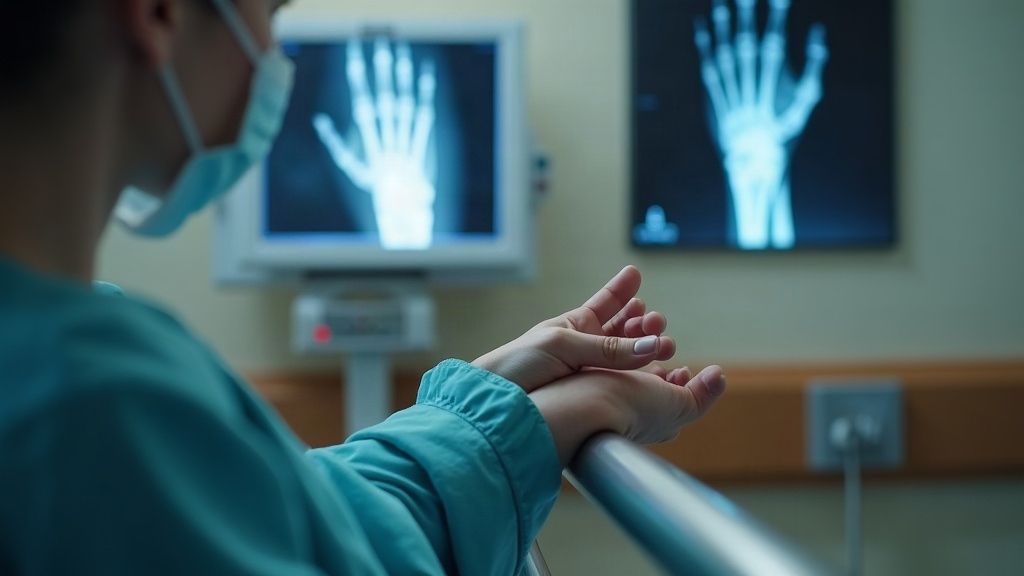
Wrist and Hand Fractures From Car Accidents: What California Claims Look Like
If you broke your wrist or hand in a California car accident, your injury is more complicated than it looks on an X-ray. Fractures in these areas heal slowly, often require surgery, and can leave lasting limitations in grip strength and range of motion. Those complications directly affect the value of your personal injury claim.
This article explains how these injuries happen, how California law determines what you can recover, and what makes some fracture claims worth significantly more than others.
Quick-answer summary:
- Wrist and hand fractures are common crash injuries because drivers brace instinctively.
- California law allows you to recover medical costs, lost wages, and pain-and-suffering damages when another driver's negligence caused your injury.
- Surgery, hardware, permanent limitations, and job impact all increase claim value.
- California's pure comparative fault rule still lets you recover even if you were partly at fault.
- The filing deadline is two years from the accident date under Cal. Code Civ. Proc. §335.1.
- No fee unless we win. Call (818) 794-9947 for a free case review.
Why Hands and Wrists Take the Brunt of Impact in a Crash
A distal radius fracture is the most common wrist injury in car accidents because drivers reflexively extend their arms against the steering wheel or brace on the dashboard just before impact.
The human body's protective instinct works against it in a collision. In the fraction of a second before impact, most drivers push their hands forward. The force of the crash then travels up through the palms and into the small bones of the wrist and hand. That same bracing reflex also forces the wrists backward into the steering column or airbag, creating hyperextension fractures.
Passengers face a similar risk. They brace against the dashboard, grab door handles, or brace against the seat in front of them. In rollover crashes, occupants may sustain crush injuries or impact fractures from the vehicle's own interior structure.
The result is that the wrist and hand absorb energy that should have been distributed across a larger area or absorbed by restraint systems. When the bones in these areas give way, the fracture patterns tend to be complex.
Common Fracture Patterns: Steering Wheel, Airbag, and Bracing Injuries
Not all fractures are the same. The pattern of your break tells a treating physician, and later an insurance adjuster or jury, a great deal about the severity of the impact and the likely recovery path.
Distal radius fracture. The distal radius is the large forearm bone that forms the base of the wrist joint. It is the single most commonly fractured bone in car-accident wrist injuries. When the wrist absorbs impact energy in extension, the distal radius often breaks at its widest point. A Colles fracture (the bone fragments tilt backward) and a Smith fracture (the bone fragments tilt forward) are both distal radius injuries. Severe versions require surgical repair.
Scaphoid fracture. The scaphoid is a small boat-shaped bone that sits at the base of the thumb side of the wrist. It is notoriously difficult to detect on initial X-rays, which means it is frequently missed in emergency rooms. A scaphoid fracture that goes untreated can develop avascular necrosis, where the bone loses its blood supply and begins to die. That complication often requires reconstructive surgery and can cause permanent wrist disability.
Metacarpal fractures. The metacarpals are the five long bones of the hand. Impact against a steering wheel or airbag can break one or several metacarpals at once. A "boxer's fracture" to the fifth metacarpal is common when a fist-like impact occurs. Multi-metacarpal fractures can destabilize the hand and require surgical fixation.
TFCC (triangular fibrocartilage complex) tears. This is the soft-tissue structure that stabilizes the wrist on the ulnar (pinky-side) of the joint. Forceful wrist rotation or extreme loading during a crash can tear the TFCC. These injuries are often found alongside fractures on MRI imaging. They produce persistent wrist pain and clicking and frequently require arthroscopic surgery.
Carpal fractures. Fractures of the smaller carpal bones, including the lunate, trapezium, and hamate, are less common but can result in significant ligament instability and chronic pain if not identified early.
Treatment Paths: Casting, Surgery, Hardware, and Physical Therapy
The path your injury takes through the medical system matters for your claim in two concrete ways. First, it determines your medical special damages, which are the documented costs you can recover. Second, it shapes the evidence that establishes the severity and permanence of your injury.
Conservative treatment (casting or splinting). Stable, non-displaced fractures are treated with immobilization in a cast or splint for four to eight weeks. Even "simple" fractures require follow-up imaging, physical therapy, and functional testing. For many patients, formal hand therapy continues for weeks after the cast is removed.
Surgical repair: ORIF. An unstable or displaced fracture typically requires open-reduction internal fixation (ORIF). A surgeon opens the joint, repositions the bone fragments, and secures them with plates, screws, or pins. ORIF surgery carries hospital facility fees, anesthesia costs, surgeon fees, and a longer recovery, typically three to six months before a return to full function, if full function is achievable.
When a wrist or hand fracture requires surgery with plates, screws, or pins, those hardware costs add to your medical special damages, and a second surgery for hardware removal adds even more.
Hardware removal. Many patients require a second procedure to remove internal fixation hardware once the bone has healed, particularly when hardware causes irritation or limits range of motion. This second surgery adds medical costs to the claim and extends the period of pain and interference with daily activities.
Physical and occupational therapy. Hand therapy after a wrist or hand fracture is not optional. It is medically necessary to regain grip strength and range of motion. Therapy can last months. The documented costs of therapy sessions, splints, and home exercise equipment all count as recoverable medical special damages.
Arthritis and long-term consequences. Post-traumatic arthritis is a well-recognized complication of intra-articular wrist fractures. When the fracture line runs through the joint surface, even a surgically repaired fracture can result in uneven joint wear over time. Future medical costs for pain management, cortisone injections, and eventually joint replacement are recoverable as future damages when documented by a treating physician or expert.
How California Law Governs Your Claim
In California, all drivers owe a duty of reasonable care to others on the road under California Civil Code §1714, and a driver who breaks that duty and causes a wrist or hand fracture is liable for the injured person's medical bills, lost wages, and pain and suffering.
To win a California personal injury claim, you must establish four elements: duty, breach, causation, and damages. When another driver ran a red light, rear-ended you, or failed to yield and caused the collision that broke your wrist, those first three elements are usually straightforward. The litigation battle is almost always over damages.
California's pure comparative fault rule. California courts apply pure comparative fault, which means that even if you were partly at fault for the collision, you still recover damages proportionally reduced by your own percentage of fault. This rule comes from the California Supreme Court's decision in Li v. Yellow Cab Co. (1975) 13 Cal.3d 804, now codified in practice through Cal. Civ. Code §1714 and modified for non-economic damages in multi-defendant cases by Proposition 51.
California follows a pure comparative fault rule, which means you can still recover damages even if you were partly at fault for the crash, but your recovery is reduced by your own percentage of fault.
Damages you can recover. California law recognizes two categories of compensatory damages:
- Economic damages (special damages): Medical expenses already incurred, future medical costs, lost wages, lost earning capacity, out-of-pocket costs like medications and medical equipment, and the cost of household services you could not perform during recovery.
- Non-economic damages (general damages): Physical pain, emotional distress, loss of enjoyment of life, and loss of consortium for a spouse or domestic partner.
Statute of limitations. [SPEAKABLE] California's two-year statute of limitations for personal injury claims starts running on the date of the accident under California Code of Civil Procedure §335.1, so acting promptly is essential. Missing that deadline will generally bar your claim regardless of how severe your injuries are. Exceptions exist for claims against government entities, which follow a much shorter 180-day administrative claim requirement under Cal. Gov. Code §911.2. If a government vehicle caused the crash, your deadline is different and tighter.
How Grip Strength and Range-of-Motion Loss Affect Your Claim Value
Insurance adjusters evaluate soft-tissue sprains and bone fractures differently, but what they weigh most heavily in either case is the permanence and functional impact of the injury. A broken wrist that heals in eight weeks with no lasting limitation produces a very different damages picture than one that results in permanent grip-strength loss or restricted range of motion.
Why functional limitations matter. California juries are allowed to award non-economic damages for pain and loss of enjoyment of life based on what those limitations actually mean to the injured person's life. A 42-year-old carpenter who loses 40 percent of grip strength in his dominant hand is not in the same position as someone who works at a desk and recovers full function. The jury hears about the person's actual life, the activities they can no longer perform, and the permanence of those losses.
Documenting the limitation. Permanent limitations must be documented by objective medical testing, not just the patient's reported symptoms. Grip-strength testing with a dynamometer, range-of-motion goniometry, and functional capacity evaluations performed by a certified hand therapist all create the objective record that supports non-economic damages. A physician's narrative report explaining the permanence of the impairment and its cause, that is, the accident, is essential.
Impairment ratings. In some cases, particularly when a dispute exists about the permanence of the injury, an independent medical examination or a treating physician's AMA Guides impairment rating may be used to quantify the loss. This is distinct from workers' compensation permanent disability ratings, but the underlying methodology overlaps.
Impact on Manual-Labor and Detail-Oriented Jobs
Permanent grip-strength loss in the dominant hand can significantly increase the non-economic damages portion of a California personal injury claim, especially for workers who depend on their hands.
The impact of a wrist or hand fracture on your ability to earn income falls into two different damages categories.
Lost wages (past). These are the wages you actually lost while you were off work or working in a reduced capacity during recovery. They are documented through pay stubs, tax records, and an employer's written statement of your inability to work or to work at full capacity.
Lost earning capacity (future). This is more significant in many serious fracture cases. If a permanent functional limitation prevents you from performing the essential duties of your occupation at the same level or at all, you have a future economic loss. California courts allow recovery for the reduction in your ability to earn income over the remainder of your working life.
Certain occupations carry particularly high stakes when it comes to wrist and hand function:
- Construction workers, carpenters, and tradespeople who depend on gripping tools, hammering, and precise manual tasks.
- Truck drivers and equipment operators who need full wrist strength to manage steering and controls safely.
- Surgeons, dentists, and other medical professionals whose license to practice may require a level of dexterity a fractured or arthritic wrist can no longer provide.
- Musicians, tattoo artists, and barbers whose income depends on fine motor control in the hand.
- Assembly workers and warehouse workers whose jobs require repetitive gripping and lifting.
If your job falls into any of these categories, your attorney may engage a vocational rehabilitation expert to project your future earning capacity loss and present that projection as economic damages.
If your injury occurred while you were performing work duties and another person's negligence caused the crash, you may have both a workers' compensation claim and a personal injury claim against the third party. Those claims operate in parallel under California law, and a lien from your workers' compensation insurer may attach to the personal injury recovery. An attorney familiar with both practice areas can structure the resolution of both claims to maximize your net recovery.
Calculating Damages for Scarring, Hardware Removal, and Future Arthritis Risk
Several specific elements of wrist and hand fracture claims are frequently undervalued by injured people who negotiate on their own.
Surgical scarring. An ORIF procedure leaves a scar on the wrist or hand. In California, permanent disfigurement is a recognized component of non-economic damages. Visible scarring on the hand, which is exposed in daily life in a way that a scar on the torso is not, is weighed by juries based on its location, size, and visibility.
Hardware removal surgery. If a second surgery is medically recommended to remove plates or screws, it is a distinct medical event with its own costs, recovery period, and associated pain and limitations. The prospect of a future hardware removal surgery, if it has not yet occurred at the time of settlement or trial, is a documented future medical cost that belongs in your damages calculation.
Future arthritis treatment. Post-traumatic arthritis following an intra-articular fracture is well-documented in orthopedic literature. If your treating surgeon has documented a risk of arthritis in the affected joint, that risk is a future medical cost. A life care planner or a treating physician can project the cost of cortisone injections, anti-inflammatory medications, and eventual joint-replacement surgery over your life expectancy.
Psychological impact. Chronic pain from a wrist or hand injury can produce anxiety, sleep disruption, and depression. These are recoverable components of non-economic damages when documented by a treating therapist or psychologist. Do not dismiss the psychological dimension of a painful, functionally limiting injury.
FAQ: Wrist and Hand Fracture Car Accident Claims in California
How much is a broken wrist worth in a car accident settlement in California?
There is no set dollar amount. The value depends on your medical costs, whether surgery was required, the nature and permanence of any functional limitation, your occupation, and your lost wages. California law does not cap compensatory damages for personal injury claims. The honest answer is that it depends on the specific facts of your injury, your treatment, and your life situation. An attorney can evaluate the full picture of your damages after reviewing your medical records and employment history.
Why do drivers break their wrists in car accidents?
Drivers break their wrists because of the protective bracing reflex. In the moment before a collision, the body instinctively pushes the arms forward against the steering wheel or dashboard. The force of the crash is then transferred into the wrist and hand. Airbag deployment can also cause hyperextension wrist injuries when the driver's hands are on the steering wheel and the bag inflates at high speed.
Do wrist fractures need surgery after a car accident?
It depends on the fracture type and severity. Stable, non-displaced fractures are treated conservatively with casting and physical therapy. Unstable, displaced, or intra-articular fractures typically require surgical repair, most commonly open-reduction internal fixation. Your orthopedic surgeon determines the appropriate treatment based on imaging and clinical assessment.
Can a hand injury affect my ability to work?
Yes. A wrist or hand fracture can prevent you from working entirely during recovery, or it can limit you to light-duty work that may pay less than your regular rate. If the injury results in a permanent functional limitation, it may reduce your future earning capacity. Both past lost wages and future lost earning capacity are recoverable damages in a California personal injury claim.
How long do I have to file a personal injury claim for a broken wrist in California?
The general rule is two years from the date of the accident under Cal. Code Civ. Proc. §335.1. If a government entity or government vehicle was involved, you must file an administrative claim within 180 days under Cal. Gov. Code §911.2. Do not wait until the deadline approaches. Medical records, witness memories, and accident scene evidence all degrade over time.
What if I was partly at fault for the crash?
California follows pure comparative fault. If you were 20 percent at fault and the other driver was 80 percent at fault, you recover 80 percent of your total damages. You do not lose the right to recover entirely unless you were 100 percent at fault.
Can I claim for the future risk of arthritis in my wrist?
Yes, if your treating physician has documented the risk of post-traumatic arthritis based on the nature of your fracture, that risk can be quantified as a future medical expense and included in your damages calculation. This is one reason it is important to have complete, documented medical care rather than stopping treatment prematurely.
What if my wrist fracture was missed in the emergency room?
A missed fracture, particularly a scaphoid fracture, can complicate your case. The key is to follow up with an orthopedic specialist and obtain proper imaging, including CT scan or MRI if plain X-rays were inconclusive. A delay in diagnosis that led to a worse outcome may also be a separate basis for a medical malpractice claim, though that is evaluated separately from the auto accident claim.
Talk to a California Personal Injury Attorney
A wrist or hand fracture is a serious injury. The medical costs alone can be substantial, and the functional consequences can follow you for years, especially if you work with your hands.
We've recovered over $150,000,000 for injured Californians since 2014. We handle personal injury cases on a contingency basis, which means you pay $0 upfront and no fee unless we win.
If you broke your wrist or hand in a California car accident, call (818) 794-9947 for a free consultation. We'll review your medical records, evaluate your damages, and tell you honestly what your case looks like.
No fee unless we win. Available in English and Spanish.
Reviewed by Minas Nordanyan, CA Bar #296806. Last updated 2026.