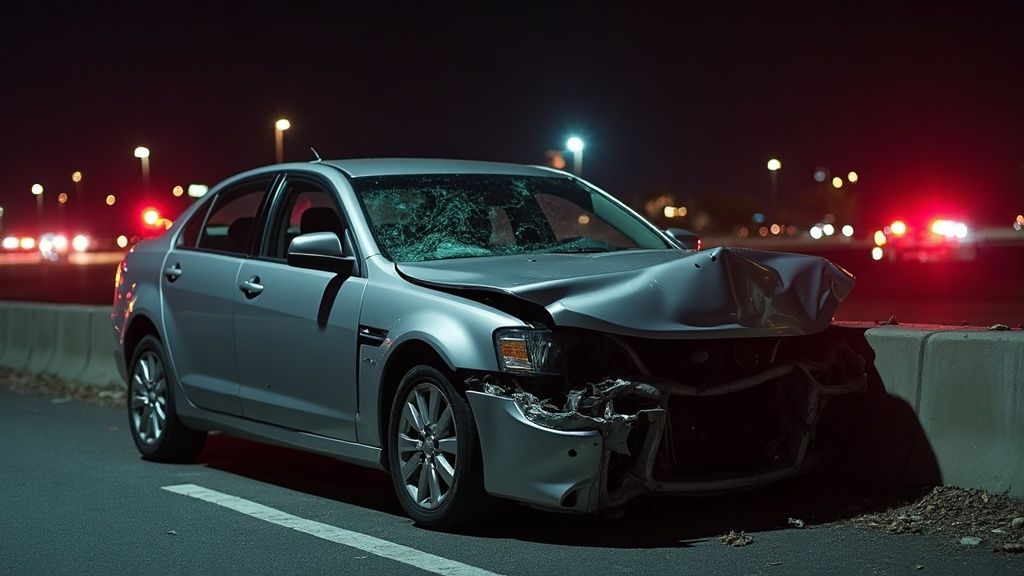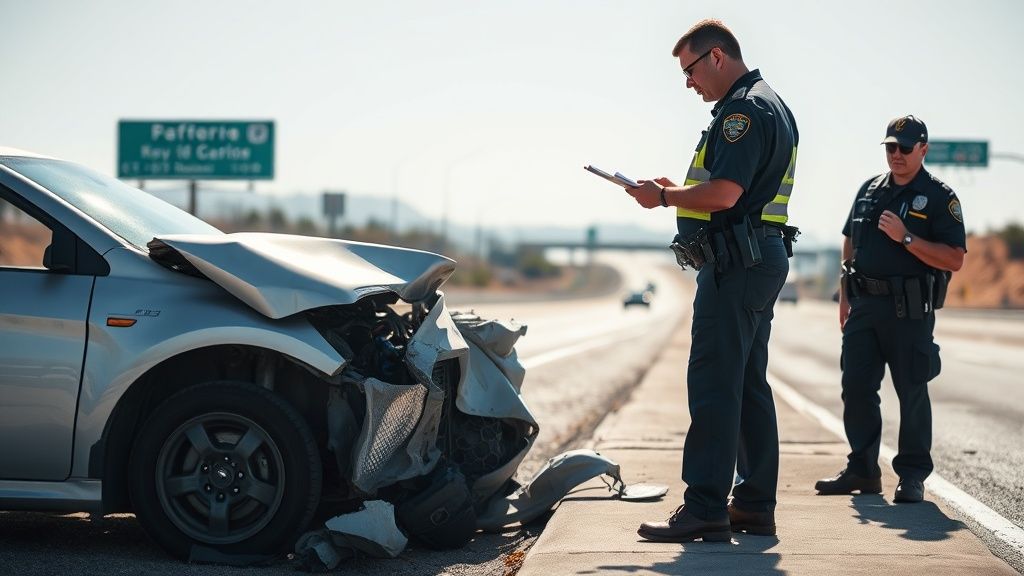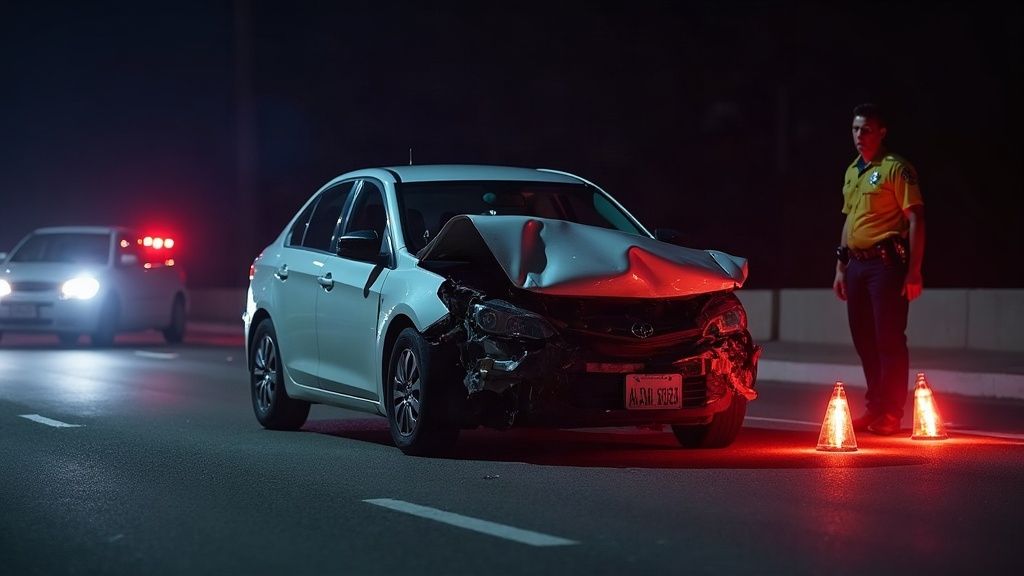
If you've been hit by a wrong-way driver in California, you are likely dealing with one of the most violent crash types on the road. Head-on impacts at freeway speeds destroy vehicles and leave survivors with injuries that take months or years to heal. At the same time, you face insurance adjusters, police reports, and legal deadlines that start running the moment the crash happens.
This article explains exactly who is at fault, how California insurance law works, what evidence matters most, and what to do right now to protect your claim.
Quick-answer summary:
- The wrong-way driver almost always bears primary fault under Cal. Veh. Code §21650.
- California's pure comparative fault rule still lets you recover even if you share some blame.
- Your own uninsured motorist coverage kicks in if the at-fault driver has no policy.
- The evidence window closes fast: crash scene evidence, dashcam data, and witness memories fade quickly.
- You have two years from the crash date to file a lawsuit under Cal. Code Civ. Proc. §335.1.
- A free consultation costs you nothing. Call (818) 794-9947.
Why Wrong-Way Crashes Cause Some of the Most Severe Roadway Injuries
Most traffic collisions are angled or rear-end impacts. Wrong-way crashes are different. When a vehicle traveling in the wrong direction meets oncoming traffic, the two cars collide head-on. The physics are brutal: the combined closing speed of two vehicles each traveling 60 mph is 120 mph of energy absorbed by both drivers and passengers in a fraction of a second.
That physics reality explains why wrong-way crashes produce injuries that are categorically more severe than other collision types. Airbags deploy. Seat belts lock. Crumple zones are consumed. And still, the human body absorbs forces it was not built to survive intact.
Freeway wrong-way crashes in California draw immediate California Highway Patrol (CHP) response and typically generate detailed crash reconstruction. That CHP involvement is actually useful to your claim, as we explain below.
Common Causes: DUI, Confused Freeway Entries, and Nighttime Driving
Understanding why a wrong-way crash happened matters for both fault analysis and for identifying every liable party.
DUI is a dominant factor. Studies and CHP data consistently identify impaired driving as one of the leading causes of wrong-way freeway crashes. A driver under the influence of alcohol or drugs loses the ability to read directional signage, process lane markings, and respond to oncoming headlights. If the wrong-way driver in your crash was arrested or tested for DUI, that evidence is powerful in your civil case. A criminal DUI conviction can be introduced as evidence of fault in a personal injury proceeding.
Confused entry points. Freeway on-ramps and off-ramps are not always intuitively designed. An older or disoriented driver who misreads an exit ramp as an entrance ramp can quickly find themselves facing oncoming highway traffic. In these cases, fault still rests with the wrong-way driver, but the investigation may also examine whether Caltrans signage was adequate.
Nighttime driving and fatigue. Wrong-way crashes cluster in late-night and early-morning hours. Reduced visibility, faded pavement markings, and driver fatigue all contribute. If lighting or signage conditions played a role, a government entity may share liability under Cal. Gov. Code §830, which governs dangerous conditions on public property.
Medical emergencies. Occasionally a driver suffers a stroke, seizure, or other medical event that leads to wrong-way travel. This scenario does not automatically excuse the driver, and it does not prevent you from pursuing recovery through their insurer.
Establishing Fault When the Other Driver Was Going the Wrong Way
In California, a wrong-way driver who travels against traffic on a public road violates Vehicle Code §21650, which requires every driver to stay to the right of the center line.
That statutory violation creates what courts call "negligence per se." Under Cal. Evid. Code §669, a defendant who violates a safety statute and causes the type of harm the statute was designed to prevent is presumed negligent. In practical terms: the wrong-way driver violated the law, you are exactly the type of person that law was meant to protect, and their insurer carries the burden of explaining why you should not recover.
California uses a pure comparative fault rule, so even if both drivers share some blame, you can still recover compensation reduced only by your own percentage of fault.
That rule comes from Cal. Civ. Code §1714 and the California Supreme Court's decision in Li v. Yellow Cab Co. (1975) 13 Cal.3d 804. "Pure" means there is no threshold, even a driver who is 99% at fault can theoretically recover the 1% from the other party. In a wrong-way crash where the other driver was clearly traveling the wrong direction, your comparative fault percentage is typically zero or very low. That is a strong position.
Possible additional defendants:
- A bar or restaurant that served alcohol to a visibly intoxicated driver may face liability under California's dram shop provisions.
- An employer whose employee caused the crash while on duty may be liable under respondeat superior.
- Caltrans or a local government agency if inadequate signage contributed to the wrong-way entry.
- A vehicle manufacturer if a defective component (steering, brakes, lighting) contributed to the crash.
Identifying every responsible party is one of the most important things an attorney does in these cases. Missing a defendant can leave substantial compensation on the table.
What Happens If the Wrong-Way Driver Is Uninsured or Flees the Scene
Wrong-way crashes sometimes end with the at-fault driver dead, incapacitated, or, in hit-and-run scenarios, fled. That reality means you need to understand your own policy's protections.
If the wrong-way driver is uninsured, your own uninsured motorist coverage under Cal. Ins. Code §11580.2 steps in and pays your damages up to your policy limits.
Cal. Ins. Code §11580.2 requires California auto insurers to offer uninsured motorist (UM) coverage on every personal auto policy. Unless you expressly waived it in writing, you likely have it. UM coverage pays for your medical bills, lost wages, pain and suffering, and other damages when the at-fault driver has no insurance or cannot be identified (hit-and-run).
Underinsured motorist (UIM) coverage applies when the at-fault driver has some insurance, but not enough to cover your full damages. California's current minimum bodily injury liability limits are $30,000 per person and $60,000 per accident under Veh. Code §16056 as amended by SB 1107, effective for policies issued or renewed on or after January 1, 2025. If your damages exceed what the wrong-way driver's policy covers, your UIM coverage bridges the gap up to your own policy limit.
Hit-and-run requirements. To make a UM claim for a hit-and-run, most policies require you to report the crash to law enforcement promptly and to cooperate with the insurer's investigation. Get a CHP or local police report number at the scene.
MedPay and health insurance. If you carry Medical Payments (MedPay) coverage, that pays your medical expenses without waiting for the fault determination to resolve, useful in the weeks before a settlement. Health insurance covers treatment as well, though insurers may assert a subrogation lien against your eventual recovery.
Evidence Unique to Wrong-Way Collision Investigations
The California Highway Patrol crash report, dashcam footage, witness statements, and electronic data recorder data from both vehicles are the most powerful pieces of evidence in a wrong-way collision case.
Evidence degrades fast. Skid marks wash away. Debris is cleared. Witnesses scatter. Here is what to preserve immediately and what an attorney can compel through discovery.
CHP crash report. The investigating officer documents the direction of travel, point of impact, road conditions, lighting, signage, and preliminary fault determination. Request this report as soon as it is released. Note any field sobriety or chemical test results recorded by the officer.
Electronic data recorder (EDR) / "black box" data. Modern vehicles log pre-crash speed, braking, throttle position, and steering angle in the seconds before impact. This data can confirm that the wrong-way driver was traveling at speed in the wrong direction and made no evasive maneuver. Attorneys can obtain EDR data through a preservation letter and, if needed, a court order. Once a vehicle is repaired or scrapped, this data is gone.
Dashcam and traffic camera footage. Your own dashcam footage showing the wrong-way driver approaching head-on is some of the most persuasive evidence available. Caltrans maintains traffic monitoring cameras on many California freeways; that footage may be retained for only 30 days. A preservation demand must go out immediately.
Cell phone records. If the wrong-way driver was on their phone, distracted driving adds another layer of fault. Subpoenaing cell carrier records is a standard litigation step in serious crashes.
Witness statements. Bystanders who saw the vehicle entering a freeway going the wrong way, or who witnessed the crash, are critical. Collect names and contact information at the scene. Their accounts corroborate the CHP report.
Toxicology and blood alcohol results. If the at-fault driver was tested, those results become part of the criminal investigation file and are generally discoverable in the civil case.
Accident reconstruction. For catastrophic or fatal wrong-way crashes, a forensic accident reconstructionist uses physical evidence, EDR data, and scene measurements to produce a technical report establishing speed, direction, and impact dynamics. This is standard in litigation and persuasive to juries.
Injuries Commonly Seen in High-Speed Head-On Impacts
The closing speed of a head-on crash on a freeway frequently exceeds what any vehicle safety system can fully absorb. Emergency physicians and trauma surgeons who treat these patients see a consistent pattern of injuries.
Traumatic brain injury (TBI). Even with airbag deployment, the rapid deceleration forces the brain to impact the interior of the skull. TBI ranges from concussion to severe cognitive impairment requiring lifetime care.
Spinal cord injury. Cervical and thoracic spine fractures are common in violent frontal impacts. Damage at or above certain vertebral levels can cause partial or complete paralysis.
Internal organ damage. The liver, spleen, kidneys, and bowel are vulnerable to blunt trauma from the seatbelt and steering column forces. Internal bleeding may not produce obvious symptoms for hours after the crash.
Chest trauma. Sternum fractures, rib fractures, pneumothorax (collapsed lung), and aortic injury are seen in high-energy frontal impacts. Aortic tears are immediately life-threatening.
Broken bones. Femur, tibia, pelvis, wrist, and shoulder fractures occur when limbs are trapped or subjected to crush forces.
Facial and eye injuries. Airbag deployment and windshield glass cause lacerations, fractures, and ocular injuries that can have lasting effects on vision and appearance.
These injuries carry treatment costs, lost income, and pain-and-suffering damages that can reach well into six or seven figures for serious cases. Settling before the full extent of your recovery is known is one of the most common mistakes injured drivers make. An attorney helps you understand what your case is actually worth before you sign anything.
Working With CHP Reports and Accident Reconstruction
California Highway Patrol officers are trained traffic accident investigators. Their reports carry weight with insurers, mediators, and juries. But a CHP report is not the end of the investigation, it is the beginning.
Insurers routinely hire their own accident reconstruction experts to challenge the official report. A qualified attorney retains a plaintiff-side reconstructionist to counter that narrative. The battle of the experts is a real part of serious crash litigation.
What the CHP report does NOT include that can help your case:
- Cell phone usage data (requires a subpoena)
- Surveillance or traffic camera footage (requires a preservation demand to Caltrans or private businesses)
- The at-fault driver's full history of prior driving violations
- Witnesses who left the scene before the officer arrived
An experienced personal injury attorney knows what the report leaves out and builds the supplemental evidence file that fills those gaps.
Government claims. If road design or signage failures contributed to the wrong-way entry, you may have a claim against a California government entity. Under the California Tort Claims Act (Cal. Gov. Code §911.2), you must file a government claim within six months of the injury. That deadline is much shorter than the two-year personal injury statute of limitations, so do not wait.
You have two years from the date of a wrong-way collision to file a personal injury lawsuit in California under Cal. Code Civ. Proc. §335.1.
DUI is a leading cause of wrong-way crashes in California, and a criminal conviction for driving under the influence can be introduced as evidence of fault in a civil personal injury case.
What to Do Right Now If You Were Hit by a Wrong-Way Driver
- Get medical care immediately. Even if you feel okay, see a doctor that day. Adrenaline masks pain. Internal injuries are silent. A documented medical visit establishes causation and starts the treatment record your case depends on.
- Call CHP or local police. You need an official crash report. Do not leave the scene without one.
- Collect evidence at the scene if you can. Photograph the other vehicle, your vehicle, the road, the signage, the lane markings, and any skid marks. Get names and numbers of witnesses.
- Send a preservation demand. Your attorney should send letters to Caltrans, nearby businesses, and the at-fault driver's insurer within days to prevent footage and EDR data from being destroyed.
- Do not give a recorded statement to the at-fault driver's insurer. You are not required to. Adjusters are trained to extract statements that minimize your claim. Speak to an attorney first.
- Report the crash to your own insurer. You have a duty to report under your own policy. This preserves your UM/UIM rights without waiving any claim.
- Call an attorney. We work on contingency, $0 unless we win. A free case review costs you nothing and puts the right legal framework around your claim from day one.
FAQ
Who is at fault in a wrong-way driver accident in California?
The wrong-way driver is presumptively at fault. Traveling against the flow of traffic violates Cal. Veh. Code §21650. Under the negligence per se doctrine codified at Cal. Evid. Code §669, that statutory violation raises a presumption of negligence that the at-fault driver's insurer must overcome. In most wrong-way crash cases, the collision is caused entirely by the wrong-way driver, placing 100% of the fault on them.
What should I do if a wrong-way driver hits me?
Call 911 immediately, seek medical care even if you feel uninjured, get a CHP or police report number, photograph the scene and collect witness contact information, and call a personal injury attorney before giving any recorded statement to the at-fault driver's insurer. A preservation demand for dashcam and traffic camera footage should go out within days.
Are wrong-way crashes usually caused by DUI drivers?
DUI is a leading factor in wrong-way freeway crashes in California. Impaired drivers lose the ability to read directional signage and respond to oncoming headlights. Other causes include confused freeway entry, driver medical emergencies, and extreme fatigue. In every case, the wrong-way driver bears the legal responsibility for being on the wrong side of the road.
What if the wrong-way driver has no insurance?
Your own uninsured motorist (UM) coverage, required on California auto policies by Cal. Ins. Code §11580.2 unless waived in writing, steps in to pay your medical bills, lost wages, and pain-and-suffering damages up to your policy limit. If the driver had minimal insurance that does not cover your full losses, underinsured motorist (UIM) coverage fills the gap. An attorney reviews your own policy to identify every available source of recovery.
How long do I have to file a lawsuit after a wrong-way crash in California?
The general personal injury statute of limitations is two years from the date of the crash under Cal. Code Civ. Proc. §335.1. If a government entity's road design or signage contributed to the crash, a government claim must be filed within six months under Cal. Gov. Code §911.2, a much shorter window. Missing either deadline typically bars the claim entirely.
Can I recover if I was partly at fault?
Yes. California's pure comparative fault rule under Cal. Civ. Code §1714 allows you to recover damages reduced only by your own percentage of fault. In most wrong-way crash cases where the other driver was clearly traveling the wrong direction, your share of fault is low or zero. Even if an insurer argues you share some blame, you can still recover the remaining portion.
What damages can I recover after a wrong-way collision in California?
You may recover economic damages including medical bills (past and future), lost wages, lost earning capacity, vehicle repair or replacement, and out-of-pocket expenses. You may also recover non-economic damages including pain and suffering, emotional distress, loss of enjoyment of life, and loss of consortium for a spouse. In cases involving DUI or other egregious conduct, punitive damages are also available under Cal. Civ. Code §3294.
What if the wrong-way driver died in the crash?
If the at-fault driver died, your claim proceeds against their estate and their auto insurance policy. You file a creditor's claim with the probate court within the statutory period and pursue the insurer directly. The driver's death does not eliminate your right to compensation, it only changes which parties you deal with.
Do I need an attorney for a wrong-way crash claim?
Wrong-way crashes involve complex insurance layers (liability, UM/UIM, MedPay, health insurance subrogation), potential government entity liability, rapidly expiring evidence, and serious injuries with long-term financial consequences. Unrepresented claimants routinely settle for far less than the actual value of their case. An attorney identifies every source of recovery, preserves critical evidence, and handles the insurer so you can focus on healing.
How much does it cost to hire a personal injury attorney for this type of case?
Nordanyan Law handles personal injury cases on a pure contingency basis: $0 upfront, no fee unless we win. You pay nothing to have an attorney on your side from day one.
Your Next Step
A wrong-way crash can upend everything in a fraction of a second. The legal process that follows is complicated, the deadlines are unforgiving, and insurers move quickly to limit what they pay.
We've recovered over $150,000,000 for injured workers and accident victims across Southern California. We handle every case as if it were going to trial, because that preparation is exactly what moves insurance carriers toward a fair number.
Call (818) 794-9947 for a free case review. No fee unless we win. Available in English and Spanish.
Reviewed by Minas Nordanyan, CA Bar No. 296806. Last reviewed 2026-08-21. This article is general legal information about California law and is not legal advice for your specific situation. Contact an attorney to evaluate your individual claim.