If you were hurt in a multi-car pileup on a California freeway or surface street, you already know one thing: it is complicated. Multiple vehicles, multiple drivers, multiple insurance companies, and everyone pointing the finger at someone else. Figuring out who actually owes you money is not simple, and the insurance adjusters know that.
This guide explains exactly how California law divides fault in a multi-vehicle crash, how the insurance claims process works when several policies are involved, and what you need to do right now to protect your recovery.
Quick answers for skimmers:
- California uses pure comparative fault, so more than one driver can be responsible for the same crash.
- Your compensation is reduced by your own percentage of fault, if any, but it is not eliminated.
- Each defendant pays their proportionate share of pain-and-suffering damages but is jointly liable for your economic losses like medical bills.
- The driver who rear-ended you because another car pushed them may still share liability.
- You have two years to file a lawsuit, but evidence vanishes fast. Start preserving it today.
- If the at-fault driver is underinsured, your own UIM policy may cover the gap.
- Call (818) 794-9947 for a free consultation. No fee unless we win.
How Multi-Car Pileups Happen and Why Fault Is Complicated
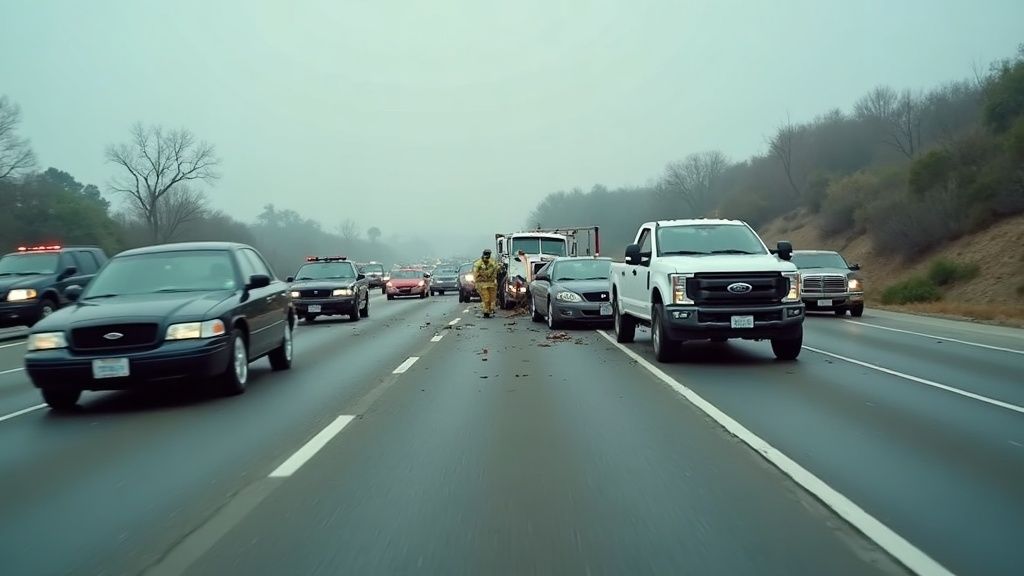
A multi-vehicle pileup is not just a bigger version of a rear-end crash. It is a sequence of events, each one triggering the next. A semi-truck brakes late on Interstate 5. The SUV behind it swerves and clips a pickup. The pickup spins across two lanes and is hit by a sedan. The sedan is then rear-ended by a minivan that had no time to react.
Every collision in that chain happened a fraction of a second apart. Every driver's decision, or failure to make one, added to the total harm. That is what makes these crashes so legally complex. The question is never just "who hit whom." It is "who made the first negligent choice, who else made a bad choice along the way, and how much did each person's choices contribute to your specific injuries?"
California law is built to handle exactly this situation. But the insurance companies will use that complexity to their advantage. When no single driver appears to be 100 percent at fault, each carrier will argue their insured contributed less than the others. The result, for unrepresented injured drivers, is often a much lower settlement than they deserve.
California's Pure Comparative Fault Applied to Three or More Cars
California uses pure comparative fault, so even if you are found 20 percent at fault in a multi-car pileup, you can still recover 80 percent of your total damages.
California follows the pure comparative negligence rule, established in Li v. Yellow Cab Co. (1975) and codified in practice through Cal. Civ. Code §1431.2. Here is what that means in plain terms:
- A jury or adjuster assigns each party, including you, a percentage of fault that adds up to 100 percent.
- Your total damages, covering medical bills, lost income, future care, and pain and suffering, are then reduced by your percentage.
- If you are zero percent at fault, you recover the full amount.
- Even if you are found 99 percent at fault, California still allows you to recover the remaining 1 percent of damages. No other state's comparative system is this plaintiff-friendly.
The critical split between economic and non-economic damages:
Under Cal. Civ. Code §1431.2, each defendant in a California multi-vehicle accident is only responsible for their proportionate share of non-economic damages, such as pain and suffering.
Cal. Civ. Code §1431.2 creates an important distinction for multi-defendant cases:
- Economic damages (medical expenses, lost wages, future medical care, property damage): all at-fault defendants are jointly and severally liable. That means if Driver A is 60 percent at fault and Driver B is 40 percent at fault, and Driver A has no money, Driver B can be held responsible for the entire economic loss.
- Non-economic damages (pain and suffering, emotional distress, loss of enjoyment of life): each defendant is liable only for their proportionate share. Driver B pays 40 percent of your pain-and-suffering award; Driver A is responsible for 60 percent. If Driver A cannot pay, Driver B is not required to cover the gap on this portion.
This distinction matters enormously when one driver is underinsured or insolvent. Understanding it before you settle can be the difference between thousands and tens of thousands of dollars in your pocket.
Sorting Out Who Started the Chain Reaction
In a chain-reaction accident, California law can hold multiple drivers liable at the same time, with each person responsible for the percentage of harm they caused.
One of the most common questions we hear from clients after a pile-up: "The car behind me was pushed into me. Is that driver responsible?" The answer is: it depends, and often, yes, at least partially.
California negligence law asks three questions about each driver in a chain-reaction crash:
- Did that driver have a duty to operate their vehicle safely? Every licensed driver does, by law.
- Did they breach that duty? Following too closely, speeding, distracted driving, and failure to brake in time are all breaches.
- Did their breach cause or contribute to your harm? Even a driver who was "pushed" into you may be partly liable if they were following too closely to avoid the impact, or if they could have steered to avoid you.
Common fault patterns in multi-vehicle pileups:
- A driver who rear-ends another car at highway speed because they were speeding is often the primary at-fault party who starts the chain.
- A driver who was following too closely behind the first car may share fault for adding momentum to the crash.
- A driver who had bald tires or defective brakes may carry additional liability through vehicle negligence.
- A driver who was distracted by a phone may share fault even if they were "in the middle" of the chain.
- A government entity may share liability if a road defect, missing barrier, or inadequate signage contributed to the crash.
Third-party liability:
Fault does not always stop with the drivers. If a commercial truck driver caused the initial impact, their employer may be vicariously liable. If a vehicle's brakes failed due to a manufacturer defect, the manufacturer may be a defendant. If a municipality failed to maintain a dangerous road condition, a government tort claim under Cal. Gov. Code §910 may apply, and the filing deadline for government claims is just six months from the date of injury.
When Several Insurance Policies Must Cover One Crash
In a two-car accident, one insurance company is usually on the hook. In a five-car pileup, you may be dealing with five separate insurers, each with their own adjuster, their own theory of fault, and their own financial incentive to minimize your claim.
Here is how the insurance layer typically stacks in a California multi-vehicle crash:
Step 1: Identify all at-fault parties and their carriers.
Every driver involved is required to carry minimum liability coverage under Cal. Ins. Code §11580.1b. California's minimum limits as of the 2025 legislative increase are $30,000 per person and $60,000 per accident for bodily injury. Many drivers carry only the minimum. In a serious pileup with multiple injured occupants, that pool is exhausted fast.
Step 2: File claims against each at-fault party's liability policy.
You are entitled to seek compensation from every driver who contributed to your injuries. Each insurer will investigate independently and attempt to shift as much blame as possible onto the other drivers.
Step 3: Layer in your own coverage where applicable.
If the at-fault parties' policies are insufficient to cover your damages, your own policies may provide additional recovery:
- Underinsured motorist (UIM) coverage covers the gap between what the at-fault driver's insurance pays and your actual damages, up to your UIM policy limit.
- Med-Pay (medical payments coverage) pays your medical bills regardless of fault, up to your policy limit.
- Collision coverage can pay for your vehicle damage while fault disputes are still unresolved.
The coordination problem:
Multiple insurers rarely cooperate. Each one will conduct its own investigation and may take inconsistent positions on fault percentages. Without representation, injured drivers often accept the first offer from whichever insurer calls first, not realizing there are more parties to pursue.
What Happens When the At-Fault Driver Isn't Fully Insured
If the driver who caused your injuries does not carry enough insurance, your own underinsured motorist coverage can step in to cover the gap under Cal. Ins. Code §11580.2.
This is one of the most underused protections available to California drivers.
Under Cal. Ins. Code §11580.2, every California auto policy must offer uninsured and underinsured motorist (UM/UIM) coverage. You can decline it in writing, but if you kept it, it may be the most valuable asset in your policy after a serious pileup.
How UIM works in a multi-vehicle crash:
- Say three drivers are at fault, and their combined available liability coverage totals $90,000 for your injuries.
- Your actual damages, including surgery, rehabilitation, and lost income, total $250,000.
- If your UIM limit is $250,000, your insurer can step in to cover the $160,000 gap, minus the $90,000 already paid by the at-fault parties.
Important: Your own insurer will still fight you on the value of your claim. They are not on your side simply because you pay them premiums. UIM disputes often require the same aggressive documentation and negotiation as a claim against an adverse carrier.
What if a driver fled the scene?
If one of the cars in the pileup left before police arrived, California's uninsured motorist statutes still apply. Your UM coverage can cover a hit-and-run driver's share of liability. Report the crash to police immediately and notify your insurer right away, because UM claims have strict notice requirements.
Preserving Evidence in a Scene With Many Vehicles and Witnesses
Evidence from a multi-vehicle crash, including skid marks, dashcam footage, and witness statements, must be preserved immediately because it can disappear within days.
In a two-car crash, the physical evidence is manageable. In a ten-car pileup on a freeway, the scene is cleared within hours, the pavement is repaved, and witnesses scatter. What you do in the days immediately after the crash determines how much leverage you have months later.
Evidence you must preserve as soon as possible:
- Dashcam footage: If your vehicle had a dashcam, preserve the SD card immediately. Many dashcams overwrite footage within days.
- Cell phone photos and video: Photograph every vehicle involved, skid marks, debris patterns, road conditions, weather, traffic signs, and any visible injuries.
- Witness contact information: Get names and phone numbers from every bystander or other driver who saw the crash. Witnesses move, travel, and become unavailable within weeks.
- The police report: Request a copy through the reporting agency as soon as it is filed. In California, the CHP and local agencies typically make reports available within a few days of the crash.
- Medical records from that day: Even if you felt fine at the scene, adrenaline masks pain. Get evaluated by a doctor within 24 to 48 hours and keep every record.
- Other drivers' dashcam footage: Your attorney can send preservation letters to every other driver demanding they retain any dashcam or vehicle data before it is deleted.
Formal discovery tools (once a lawsuit is filed):
- Subpoenas for commercial truck GPS and electronic logging device (ELD) data.
- Preservation requests to traffic camera operators, including Caltrans and local municipalities.
- Expert accident reconstruction, which uses the physical evidence to model how the crash unfolded and assigns percentage estimates of fault to each driver.
In a multi-vehicle case, reconstruction experts are often the difference between a fair settlement and a lowball offer. Insurers know that and price their offers against whether they believe you have one hired.
Your Timeline: Key California Deadlines
California gives injured drivers two years from the accident date to file a personal injury lawsuit under Cal. Code Civ. Proc. §335.1.
The general statute of limitations for a California personal injury case is two years from the date of injury under Cal. Code Civ. Proc. §335.1. Miss that window and you permanently lose the right to sue, regardless of how strong your case is.
Shorter deadlines that apply to some pileup cases:
- Government entity involved (city, county, Caltrans): You must file a government tort claim within six months of the injury under Cal. Gov. Code §910. After rejection, you have six months to file suit. Missing this short window forever bars your claim against the government defendant.
- Death of an injured party: A wrongful death claim has its own two-year window running from the date of death, which may differ from the crash date.
- Minor injured parties: The statute of limitations is tolled (paused) until the minor turns 18, but getting evidence preserved now is still critical.
Two years sounds like a long time. It is not. Investigation, negotiation, demand letters, and litigation preparation all take months. We consistently see clients contact us with less than 90 days remaining, which narrows our options significantly.
FAQ
Who is at fault in a multi-car pileup in California?
Fault is determined by California's pure comparative negligence standard. Every driver whose negligent act contributed to the crash can be assigned a percentage of fault. A jury or insurance adjuster looks at each driver's speed, following distance, reaction time, vehicle condition, and any other relevant factor to arrive at each party's share. There is rarely just one at-fault driver in a serious pileup.
How is fault divided in a chain-reaction accident?
Each driver in the chain is evaluated separately. The driver who initiated the collision by braking suddenly, speeding, or driving distracted often carries the highest share. Drivers behind them may carry a smaller share if they were following too closely to stop in time. California law allows the total fault across all parties to be distributed in any combination of percentages as long as the total reaches 100 percent.
What if the driver who hit me was pushed by another car?
Being pushed into you does not automatically relieve that driver of liability. California courts consider whether the driver who was pushed had enough following distance to stop if the cars ahead of them braked, whether they took any evasive action, and whether their own speed or distraction contributed to the impact. In many cases, the pushed driver shares partial liability alongside the driver who initiated the chain.
How do insurance claims work with multiple drivers?
You file a separate liability claim against each at-fault driver's insurance carrier. Each insurer investigates independently and may offer a separate settlement. You do not have to accept the first offer you receive, and you do not have to settle all claims simultaneously. Once all at-fault parties' policies are exhausted, your own UIM coverage can apply to any remaining gap in your damages.
What if the at-fault driver has the minimum California insurance?
California's minimum liability limits, $30,000 per person and $60,000 per accident for bodily injury, are frequently insufficient for serious injuries. In that scenario, your UIM coverage becomes critical. A personal injury attorney can also investigate whether the driver had any assets worth pursuing through a judgment, or whether another party, such as the driver's employer, carries additional coverage.
Can I recover damages if I was partially at fault?
Yes. California's pure comparative negligence rule allows you to recover damages even if you are partially at fault. Your total damages are simply reduced by your percentage of fault. If your damages total $300,000 and you are found 25 percent at fault, you recover $225,000.
How long does a multi-vehicle accident claim take to resolve?
It depends on the number of parties involved, the severity of injuries, and whether the case settles or goes to trial. Cases with multiple insurers and disputed fault commonly take anywhere from several months to a few years. More complex cases involving commercial vehicles, government entities, or product liability can take longer. The timeline is almost always shorter when evidence is preserved early and an attorney is involved from the start.
Do I need a lawyer for a multi-car pileup claim in California?
You are not legally required to hire one, but multi-vehicle cases are among the most difficult claims to handle without representation. Coordinating claims against multiple insurers, navigating the joint-and-several liability rules under Cal. Civ. Code §1431.2, preserving evidence across a large scene, and negotiating UIM claims all require legal knowledge most people do not have. Unrepresented injured drivers consistently recover less than represented ones in complex multi-party cases.
What if one of the cars involved was a commercial truck?
Commercial trucks fall under additional federal and state regulations, including Federal Motor Carrier Safety Administration (FMCSA) rules and California DIR oversight. The trucking company may be vicariously liable for its driver's negligence. These cases also involve additional evidence sources, such as ELD logs, GPS data, hours-of-service records, and maintenance logs, that must be preserved immediately before they are overwritten or destroyed.
What is the first thing I should do after a multi-car pileup in California?
Call 911 and stay at the scene. Get medical attention even if you feel fine. Photograph everything you can before the scene is cleared. Get contact and insurance information from every driver involved. Get witness names and phone numbers. Request a copy of the police report as soon as it is available. Then contact a personal injury attorney before speaking to any insurance adjuster about fault or settlement.
Multi-car pileup cases in California are not impossible to win. But they are harder to win alone. Insurance carriers have teams of adjusters and attorneys assigned to these cases from day one. You deserve the same level of preparation on your side.
We've recovered over $150,000,000 for injured workers and accident victims across Southern California. We handle every case as if it were going to trial, because insurance companies settle for more when they know the other side is prepared to fight.
If you were hurt in a multi-vehicle crash in California, call (818) 794-9947 for a free consultation. No fee unless we win. Available in English and Spanish.
Reviewed by Minas Nordanyan, CA Bar #296806. Last reviewed July 2026.