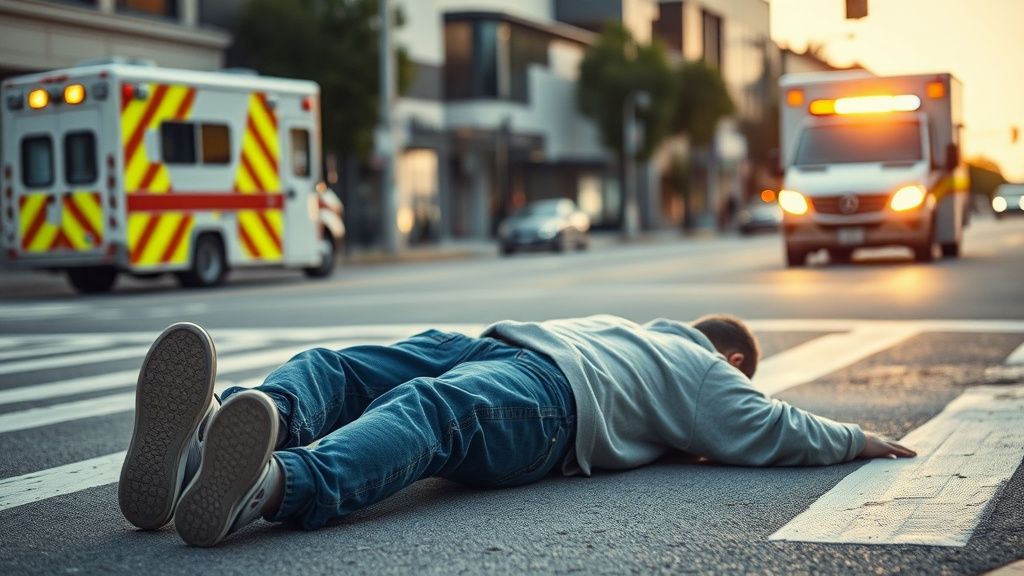
If you were hit by a car while walking in California, what you believe about your rights right now could cost you tens of thousands of dollars. Most injured pedestrians walk into the insurance process carrying at least one of the six myths below — and insurance carriers count on that.
Here is what California law actually says, myth by myth.
Quick summary — the 6 myths this article corrects:
- Myth 1: Pedestrians always have the right of way — false; comparative fault can cut your recovery.
- Myth 2: Jaywalking kills your claim — false; partial fault still allows partial recovery.
- Myth 3: No broken bones means no case — false; soft-tissue and brain injuries are fully compensable.
- Myth 4: The driver's insurance will be fair — false; adjusters are trained to minimize payouts.
- Myth 5: You can't recover if the driver had no insurance — false; UM coverage may apply.
- Myth 6: You have plenty of time to file — false; you have two years, and evidence vanishes faster.
1. Pedestrians Always Have the Right of Way
In California, pedestrians do not automatically have the right of way in every situation — and believing that myth can cost you a significant portion of your recovery.
California Vehicle Code does give pedestrians the right of way in marked crosswalks and, in many cases, unmarked crosswalks at intersections. But California also runs on pure comparative fault. Under Cal. Civ. Code §1714, every party in an accident — including the pedestrian — can be assigned a percentage of fault. Your total damages are then reduced by whatever percentage the court or insurer assigns to you.
Example: If a jury finds you were 25% at fault for stepping off the curb without looking, and your total damages are $200,000, you collect $150,000 — not the full amount.
Under California's pure comparative fault rule, a pedestrian who was partly at fault for an accident can still recover compensation — reduced by their percentage of fault.
The practical danger of this myth is that pedestrians often assume they are "in the clear" legally and skip steps that protect their recovery — like gathering witness information, documenting the scene, or calling an attorney before speaking to the insurance company. The adjuster on the other end of that first call already knows comparative fault law. You should too.
Takeaway: "Right of way" is a starting point, not a guarantee. Protect every dollar by documenting your version of events before the carrier builds theirs.
2. If I Jaywalked, I Get Nothing
Jaywalking does not bar you from recovering money after a pedestrian accident in California; it may reduce your recovery, but it does not eliminate it.
This myth stops real victims from calling an attorney. It should not.
California is a pure comparative fault state — which means even if you were 60% at fault for crossing mid-block against traffic, you can still recover the remaining 40% of your damages from the driver. There is no threshold percentage that cuts off your claim entirely. Compare this to contributory-negligence states, where any fault by the plaintiff can block recovery entirely — California has never followed that rule.
Cal. Civ. Code §1714 and California Supreme Court precedent in Li v. Yellow Cab Co. (1975) 13 Cal.3d 804 established pure comparative fault as California's standard. Every California pedestrian claim — including claims involving jaywalking — is analyzed under this framework.
What determines how much fault is assigned to a jaywalking pedestrian? Juries and adjusters look at factors like: how visible the pedestrian was, how fast the driver was traveling, whether the driver had time to stop, and whether the driver was distracted. A driver going 45 mph in a 25-mph zone who hits a jaywalking pedestrian may still carry the majority of fault.
Takeaway: Do not let the word "jaywalking" stop you from calling an attorney. The fault calculation is far more nuanced than you think.
3. No Broken Bones Means No Claim
Fractures make injuries feel "real" to people who have never been in a crash. Insurance adjusters know this — and they use it.
The truth is that some of the most serious and expensive pedestrian injuries leave no mark on an X-ray. Two examples:
Soft-tissue injuries — damage to muscles, tendons, and ligaments — can cause debilitating pain, limited mobility, and months of physical therapy. They do not show on standard X-rays and often worsen in the days after a crash as inflammation peaks.
Traumatic brain injuries (TBI) — even a "mild" TBI (concussion) can cause persistent headaches, cognitive fog, memory loss, and emotional instability that affects work performance and quality of life for months or years. A pedestrian who hit their head on a hood or pavement may not show external wounds but may have sustained a real, documented, compensable brain injury.
California personal injury law compensates for all damages flowing from the defendant's negligence — not just the damages that are visible. That includes medical bills, lost wages, loss of future earning capacity, and non-economic damages like pain and suffering. None of those categories require a fracture.
The key is documentation. See a doctor — ideally the same day or the next day — and tell them every symptom, including headaches, dizziness, difficulty concentrating, and mood changes. A documented medical record is the foundation of a compensable soft-tissue or TBI claim.
Takeaway: No broken bones is not the same as no case. Document every symptom immediately and let a physician put it in writing.
4. The Driver's Insurance Will Treat Me Fairly
This is the myth that costs injured pedestrians the most money — not in legal complexity, but in trust.
Insurance adjusters are professionals. They are trained, they are experienced, and they work for the carrier — not for you. Their job, day in and day out, is to resolve claims at the lowest possible cost to their employer. That is not an accusation; it is the business model.
Here is what "fair" often looks like in practice when you handle a pedestrian claim without representation:
- The recorded statement: The adjuster calls quickly — often within 24 to 48 hours of the crash, before you fully understand your injuries. They ask open-ended questions about how you feel. Anything you say can be used to argue that your injuries are minor or pre-existing.
- The early settlement offer: A low offer arrives early, before your medical treatment is complete and before you know the full extent of your injuries. Accepting it releases all future claims.
- The delay tactic: If the liability picture is unclear, the carrier may drag out the investigation to frustrate you into settling for less.
- The fault assignment: Under comparative fault, the adjuster has every incentive to push as much fault as possible onto you — reducing their exposure dollar-for-dollar.
The DWC — relevant when the injury also involves a workers' comp component — and the California DIR each have oversight roles, but neither agency intervenes in private-party auto insurance negotiations. You are largely on your own unless you have representation.
Studies consistently show that represented claimants recover more, even after attorney fees, than unrepresented claimants — because attorneys know the range of value for the injury, the carrier's litigation risk appetite, and the discovery tools available if negotiation fails.
Takeaway: Be polite. Do not give a recorded statement. Do not sign anything. Call an attorney before talking to the other driver's insurance company.
5. I Can't Recover If the Driver Was Uninsured
Hit by a driver with no insurance — or a driver who fled the scene — many pedestrians assume their case is dead. It is often not.
If you were hit by an uninsured driver in California, your own uninsured motorist coverage may pay your damages under Cal. Ins. Code §11580.2.
Here is how it works:
Uninsured motorist (UM) coverage is a type of coverage California insurers are required to offer under Cal. Ins. Code §11580.2. If you purchase UM coverage on your own auto policy, it can cover you when you are injured by an uninsured driver — including when you are a pedestrian. Yes, even if you were not in your car at the time.
Underinsured motorist (UIM) coverage functions similarly when the at-fault driver has some insurance, but not enough to cover your full damages.
Hit-and-run cases are also potentially covered by UM. California courts and insurers treat a hit-and-run driver as an uninsured motorist for UM-claim purposes — provided there is physical contact between the vehicle and either you or the vehicle you were occupying (or, in pedestrian cases, documented corroboration of the hit-and-run event).
There is also a state program worth knowing: the California Victim Compensation Board (CalVCB) may cover some out-of-pocket expenses for crime victims — and a hit-and-run that injures a pedestrian can qualify as a crime under Cal. Penal Code §20001.
Takeaway: Check your own auto policy for UM/UIM coverage — and call an attorney before you conclude that an uninsured driver leaves you with nothing.
6. I Have Plenty of Time to File
The two-year clock feels long. In practice, the window closes faster than most injured pedestrians expect — and the evidence problem is even more urgent than the legal deadline.
California's statute of limitations for pedestrian accident claims is two years under Cal. Code Civ. Proc. §335.1 — but surveillance footage and witness memories disappear in days or weeks.
Under Cal. Code Civ. Proc. §335.1, you have two years from the date of injury to file a personal injury lawsuit. Miss that deadline and California courts will almost certainly dismiss your case, regardless of how strong your underlying claim is. There are limited exceptions — for minors, for delayed discovery of an injury, for defendants who leave the state — but none of them are reliably available to the typical adult pedestrian.
However, the legal deadline is not the real reason to move fast. Evidence is.
- Surveillance footage from traffic cameras, business cameras, and dashcams is typically overwritten within 30 to 60 days. Once it is gone, it is gone.
- Skid marks and road conditions change. Repairs happen.
- Witness memories fade and contact information disappears.
- The driver's insurer begins building their defense file immediately.
There are also situations where the two-year clock is shorter. If the at-fault driver was a government employee operating a government vehicle — a city bus, a municipal truck, a transit authority vehicle — California's Government Claims Act requires you to file an administrative claim with the government entity within six months of the injury under Cal. Gov. Code §911.2. Miss that six-month window and you likely lose the right to sue the government defendant entirely.
Takeaway: Two years is the outer limit, not a comfortable cushion. Preserve evidence and talk to an attorney as soon as you are medically stable — or sooner.
What to Do After a Pedestrian Accident in California
The myths above share a common thread: each one encourages injured pedestrians to do less — less documenting, less calling, less acting. The insurance system is structured to benefit from inaction.
Here is what to do instead:
- Get medical care immediately. Same-day or next-day. Document every symptom in writing at the visit.
- Do not give a recorded statement to the other driver's insurance company before speaking with an attorney.
- Photograph the scene — the crosswalk or intersection, any skid marks, your injuries, the vehicle, and the road conditions.
- Get witness information — names and phone numbers, on the spot.
- Request surveillance footage in writing as soon as possible — or ask your attorney to do it. Many businesses delete footage on a rolling 30-day cycle.
- Check your own auto insurance policy for UM/UIM coverage.
- Call an attorney before accepting any settlement offer. Once you sign a release, it is final.
We've recovered over $150,000,000 for injured clients in Southern California. Pedestrian accident claims are among the most aggressively disputed by carriers — and among the cases where representation makes the largest difference in the final number.
If you've been hit by a car in California, call (818) 794-9947 for a free case review. No fee unless we win.
Frequently Asked Questions
Does a pedestrian always have right of way in California?
No. While California law gives pedestrians the right of way in marked and many unmarked crosswalks, pedestrians can still be assigned a percentage of fault under California's pure comparative fault rule (Cal. Civ. Code §1714). That percentage reduces — but does not eliminate — their recovery.
Can I sue if I was jaywalking when I was hit?
Yes. California's pure comparative fault system allows injured pedestrians to recover even if they were partially at fault. A pedestrian who was 40% at fault for jaywalking can still recover 60% of their proven damages. The calculation depends on the specific facts of the accident — speed of the driver, visibility, distraction, and other factors.
What if the driver had no insurance?
Check your own auto insurance policy for uninsured motorist (UM) coverage. Under Cal. Ins. Code §11580.2, UM coverage can apply to pedestrian accidents — even when the injured person was not in a vehicle at the time of the crash. Hit-and-run accidents may also qualify.
How long do I have to file a pedestrian accident claim in California?
The general statute of limitations is two years from the date of injury under Cal. Code Civ. Proc. §335.1. If the at-fault driver was operating a government vehicle, a six-month administrative claim deadline applies under Cal. Gov. Code §911.2.
Are soft-tissue injuries compensable in a pedestrian accident claim?
Yes. California personal injury law compensates for all damages caused by the defendant's negligence — including soft-tissue injuries, traumatic brain injuries, and psychological trauma. There is no requirement that you have a fracture or visible wound to bring a compensable claim.
Should I give a recorded statement to the other driver's insurance company?
No — not before speaking with an attorney. Insurance adjusters are trained professionals whose goal is to minimize the carrier's payout. Statements made before you understand the full scope of your injuries or the legal landscape can be used to reduce your recovery.
What if I was hit in a crosswalk — does that mean the driver is 100% at fault?
Not automatically. Being in a crosswalk gives you legal protection, but fault is still determined by the totality of the circumstances. If you stepped off the curb suddenly, were distracted, or crossed against a signal, comparative fault may still reduce your recovery. Gather evidence from the scene immediately.
What does a pedestrian accident attorney do that I can't do myself?
A pedestrian accident attorney investigates the scene, preserves evidence, identifies all available insurance sources (including UM/UIM), handles all communication with the carrier, and negotiates from a position of documented legal leverage — including the credible threat of litigation. Represented claimants consistently recover more, even after attorney fees, than unrepresented claimants.