If you were sideswiped by a driver who drifted into your lane, you already know it happened fast. What you may not know is which California statute governs who pays, how fault gets divided when both sides tell different stories, and what physical evidence an adjuster or jury will actually use to decide the case. This article answers those questions directly.
Quick answers for skimmers:
- California Vehicle Code §21658(a) requires a driver to change lanes only when it can be done safely. A driver who violates that standard is presumptively at fault.
- California's pure comparative fault rule means both drivers can share blame. Your recovery is reduced by your own percentage of fault, but you can still recover even if you were partly at fault.
- Dashcam footage, paint transfer location, and independent witness statements are typically the three most decisive evidence types in sideswipe cases.
- As of January 1, 2025, California minimum auto liability coverage is $30,000 per person / $60,000 per accident bodily injury and $15,000 for property damage.
- If you were injured, you have two years from the date of the collision to file a personal injury lawsuit (Cal. Civ. Proc. Code §335.1), and only six months if a government vehicle was involved.
- Call (818) 794-9947 for a free case review. No fee unless we win.
How Sideswipe Crashes Happen on California Roads and Freeways
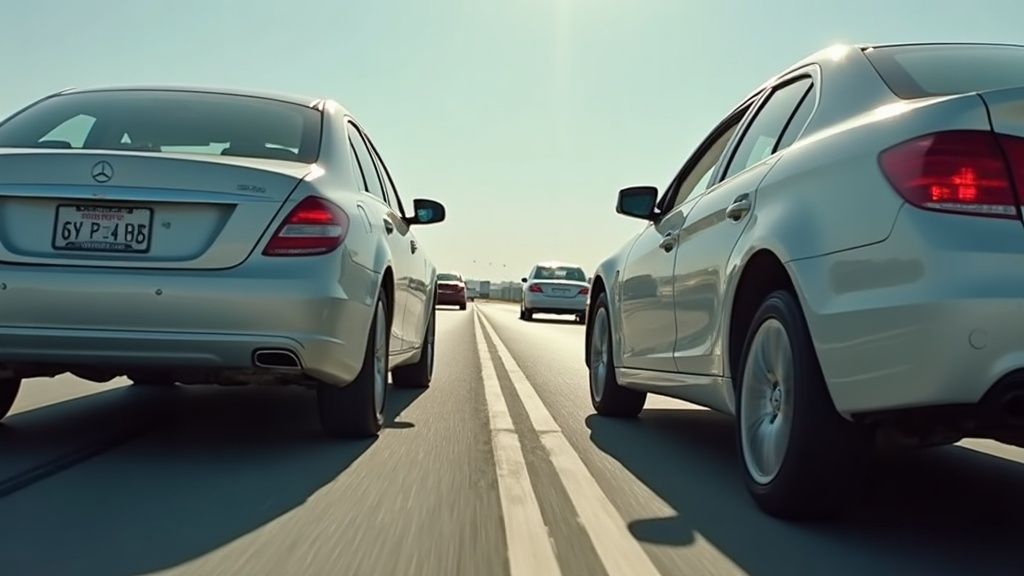
A sideswipe collision happens when two vehicles traveling in the same or opposite directions make side-panel contact. Unlike a rear-end impact, there is rarely a clean narrative about who hit whom, both drivers are usually moving, and the contact zone is the length of a car door rather than a bumper.
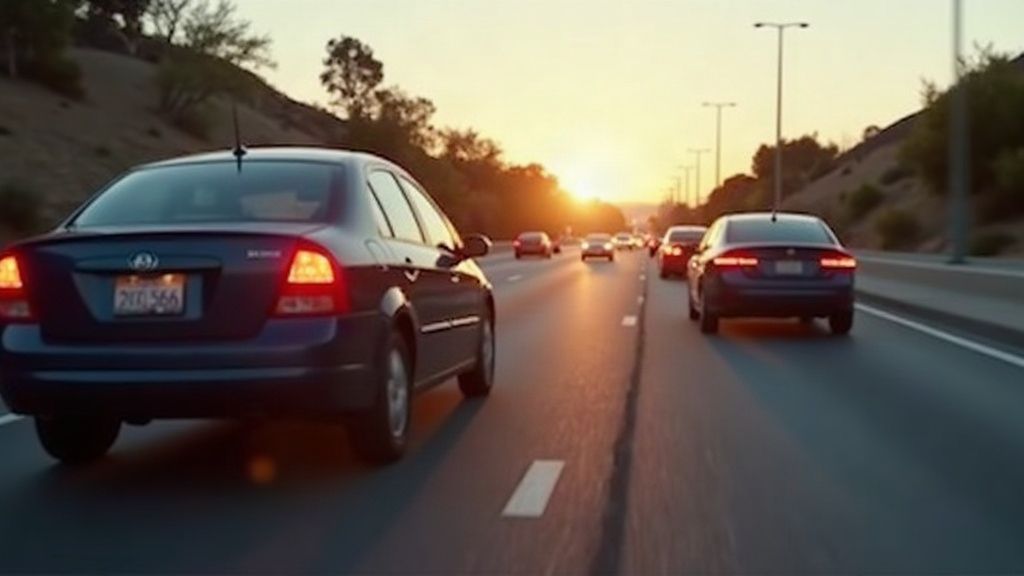
California's multi-lane freeways create the most common scenario. A driver on the I-405, I-5, or SR-101 misjudges a gap, drifts out of a distraction, or pushes into an adjacent lane before the traffic there has cleared. The impact can feel like a scrape at highway speed or a hard jolt that sends a vehicle into a barrier.
Other common settings include:
- Freeway on-ramps and merge zones, where drivers accelerating from a ramp believe they have right of way over existing freeway traffic (they do not).
- Multi-lane surface streets in Los Angeles, the San Fernando Valley, and the Inland Empire, where lane discipline erodes at intersections.
- Work zones with compressed lane widths on highways like the I-10 or SR-60.
- Nighttime driving on unlit stretches where lane markings are harder to track.
Distracted driving is the single most common contributing factor the DWC and traffic-safety researchers see in these cases. A driver glancing at a phone for two seconds at 65 mph has traveled nearly 200 feet with no eyes on the road.
California Rules on Safe Lane Changes and Signaling
Two Vehicle Code sections govern this directly.
Cal. Veh. Code §21658(a) states that a vehicle traveling in a lane shall not be moved from that lane "until such movement can be made with reasonable safety." The word "until" is operative. The driver changing lanes carries the burden of ensuring the gap exists before the wheels cross the line.
Cal. Veh. Code §22107 requires a driver to signal and ensure safety before any turn or lane-change movement. Signaling alone is not enough to satisfy the statute, the lane must actually be safe to enter.
Together, these two provisions mean that a driver who cuts into an occupied lane without sufficient clearance has violated California law, and that violation is evidence of negligence. In civil litigation, evidence of a statutory violation shifts the conversation: the other driver must explain why the unsafe movement was not their fault.
Importantly, the driver already in the lane has no general duty to yield to someone who signals their way into occupied space. Right of way belongs to the vehicle already established in the lane.
Identifying the At-Fault Driver in a Sideswipe Collision
The core liability question is: who crossed into whose lane?
In practice, both drivers almost always claim they were in their lane. That is why physical evidence matters more than testimony in sideswipe cases.
The at-fault driver is typically:
- The driver who changed lanes (merged, drifted, or cut over) without clearing the gap.
- A driver who entered a freeway from an on-ramp without yielding, California law requires the merging vehicle to yield to freeway traffic, not the other way around.
- A driver who was distracted, drowsy, or impaired, causing the drift.
- A driver whose vehicle straddled a lane marker for a sustained period before contact.
The driver already in the lane is typically not at fault unless they also contributed, for example, by speeding, driving in the other vehicle's blind spot deliberately, or making an abrupt maneuver that caused the contact.
Police reports often include an at-fault designation or cite a Vehicle Code violation. That designation is not binding on an insurer or a court, but it carries real weight in settlement negotiations.
Under California Vehicle Code §21658(a), a driver may only change lanes when the movement can be made safely, failing that standard makes the lane-changer presumptively liable for a sideswipe collision.
Injuries Common to Sideswipe and Merge-Lane Impacts
Sideswipe crashes are sometimes written off as "minor" by insurers. They are not always minor. At freeway speeds, a lateral impact can produce significant forces even when neither vehicle fully loses control.
Injuries commonly seen in sideswipe collisions include:
- Whiplash and cervical spine strain, especially when a driver or passenger is turned slightly at the moment of impact.
- Shoulder injuries, including rotator cuff tears and labrum damage, from bracing against the door or steering wheel.
- Rib fractures from seatbelt restraint forces during a sudden lateral push.
- Traumatic brain injury (TBI), in cases where the vehicle subsequently strikes a barrier, median, or other car after the initial impact.
- Lacerations and glass injuries if side windows shatter.
- Psychological injury including post-traumatic anxiety about highway driving, a real and compensable harm under California law.
When a sideswipe sends a vehicle into a barrier or causes a secondary rollover, the injuries compound quickly. Medical documentation from the day of the crash and every treatment afterward is the foundation of the damages portion of your claim.
Dashcam, Witness, and Damage-Pattern Evidence That Matters
Because both drivers often dispute who crossed the line, the evidence that breaks the tie is worth understanding before you leave the scene.
Dashcam Footage
A forward-facing or side-facing dashcam recording is the closest thing to an unimpeachable witness in a sideswipe case. It shows lane position in the seconds before impact. If the other vehicle's footage captures the event, your attorney can compel its production in discovery. If yours does, preserve the SD card immediately, do not allow it to overwrite.
Physical Damage Location
Paint transfer location on the vehicle tells an accident reconstructionist which car made first contact and from which direction, it is often the most objective piece of evidence in a sideswipe claim.
Where on the panel the contact began tells a story. Contact starting at the front quarter panel and running toward the rear suggests the other vehicle moved into yours. Contact centered on the driver's door suggests proximity in traffic. An accident reconstructionist can measure and photograph these patterns to support or contradict the competing narratives.
Tire and Skid Marks
Pre-impact lane position sometimes appears in the pavement, where tires tracked before the driver braked. These marks fade quickly, especially in California heat and traffic. Photograph them at the scene if you can do so safely, or ask the responding officer to note them in the report.
Witness Statements
Drivers and passengers in surrounding vehicles saw the sequence before you did. Their perspective from an adjacent lane is often more valuable than either party's own account. Collect names, phone numbers, and any video they captured on their phones before everyone leaves the scene.
Traffic and Surveillance Cameras
Freeway overhead cameras operated by Caltrans, business surveillance cameras near the collision point, and automated license-plate readers sometimes capture footage. These records can be subpoenaed but are often overwritten within days. The faster you retain counsel, the greater the chance this evidence is preserved.
If you were hit by a driver who drifted into your lane, the physical damage pattern on the side of your car, not just your word against the other driver's, is your strongest evidence.
When Both Drivers Are Partially at Fault
California follows a pure comparative fault system. Under this rule, your damages are reduced by your own percentage of fault, but you are not barred from recovery even if you were mostly at fault.
California uses pure comparative fault, so both drivers in a sideswipe crash can be assigned a percentage of blame, and each driver's damages are reduced by their own share of fault.
In a sideswipe case, both drivers sharing fault is genuinely common. Examples:
- The lane-changer was cutting over without clearance (primarily at fault), but the other driver had been traveling for a mile in the first driver's blind spot unnecessarily (partially at fault).
- Both drivers simultaneously moved toward the center lane from opposite sides.
- One driver drifted due to distraction, but the other driver was speeding and could not have avoided contact at a lawful speed.
Insurers are aware of comparative fault and will use any arguable contribution by you to reduce the settlement offer. This is one of the primary reasons represented claimants tend to recover more than unrepresented ones: an attorney can counter the insurer's fault-attribution argument with physical evidence before a number is locked in.
Filing Your Claim With the Right Insurer
After a sideswipe collision, you have choices about where to start your claim.
Third-party claim against the at-fault driver's insurer. This is the direct route if the other driver is clearly at fault. You file with their liability carrier. California's current minimum coverage is $30,000 per person and $60,000 per accident for bodily injury, with $15,000 for property damage. These are minimums; many drivers carry more.
As of January 1, 2025, California requires minimum auto liability coverage of $30,000 per person and $60,000 per accident for bodily injury, and $15,000 for property damage.
First-party claim under your own collision or uninsured/underinsured motorist (UM/UIM) coverage. If the at-fault driver is uninsured, underinsured, or disputes fault aggressively, your own UM/UIM coverage steps in. California requires insurers to offer UM/UIM coverage; you may have declined it, so check your declarations page.
Claims deadlines that matter:
- Two-year statute of limitations for personal injury from the date of the collision (Cal. Civ. Proc. Code §335.1).
- Six-month government tort claim deadline if a public entity or government vehicle is involved (Cal. Gov. Code §912.4), this is not the same as the lawsuit deadline and must be met first.
- Property damage claims follow the three-year statute for written contracts (Cal. Civ. Proc. Code §338).
Do not confuse the insurance company's internal deadlines for "prompt reporting" with the legal deadlines above. Insurers often pressure claimants to settle quickly before the full extent of injuries is clear. You are not required to accept a first offer.
If the sideswipe happened while you were driving for work, you may also have a workers' compensation claim running parallel to your personal injury claim. Those are separate legal tracks with separate deadlines.
Steps to Take at the Scene and Immediately After
Acting in the right order after a sideswipe protects both your health and your claim.
- Move to safety and call 911. Even if injuries seem minor, a police report creates an official record of the collision location, vehicle positions, and initial statements.
- Do not admit fault at the scene. Saying "sorry" is instinctive but can be used against you. Stick to facts when speaking to the other driver and to police.
- Document everything you can reach safely. Photos of both vehicles, the damage location on each panel, lane markings, skid marks, and the surrounding road environment.
- Get witness contact information from anyone who saw the sequence.
- Seek medical evaluation the same day, even if you feel only mild soreness. Delayed-onset injuries from lateral impacts are common, and a same-day medical record establishes the timeline.
- Preserve your dashcam footage before it overwrites.
- Notify your own insurer of the collision, most policies require prompt notice regardless of fault.
- Consult an attorney before giving a recorded statement to the other driver's insurer. Adjusters are trained to ask questions that minimize the claim.
A driver who fails to signal before a lane change violates California Vehicle Code §22107, which a claims adjuster or jury may weigh heavily when assigning fault.
How a Personal Injury Attorney Adds Value in a Sideswipe Case
In clear-cut rear-end collisions, some people manage the insurance process without a lawyer. Sideswipe cases are different. The fault dispute is almost always live, the physical evidence must be preserved and interpreted, and the insurer has every reason to split fault in a way that reduces your recovery.
Nordanyan Law has recovered over $150,000,000 for injured clients across Southern California. We handle personal injury cases including sideswipe and unsafe lane-change collisions. We come to you if your injuries prevent you from traveling to our Van Nuys office. There is no fee unless we win.
If you've been injured in a sideswipe crash in California, the evidence window closes fast. Call (818) 794-9947 for a free case review. We'll tell you plainly what your claim is worth pursuing, what evidence you need to preserve today, and what the other driver's insurer is likely to argue. No obligation. No fee unless we win.
Frequently Asked Questions
Who is usually at fault in a sideswipe accident?
The driver who changed lanes or merged is most often at fault, because California Vehicle Code §21658(a) places the obligation to ensure safety on the driver making the movement. A driver already established in a lane generally has the right to hold that lane. That said, fault is evaluated on the specific facts of each collision, and both drivers can share liability under California's comparative fault rules.
What counts as an unsafe lane change in California?
Under Cal. Veh. Code §21658(a) and §22107, a lane change is unsafe when the driver moves into an occupied or insufficiently clear lane, or moves without confirming that the gap is large enough to complete the maneuver without endangering other traffic. Failure to signal is a separate violation but does not by itself define the lane change as unsafe. The key question is whether the lane was actually safe to enter at the time the driver crossed the line.
Can both drivers share fault in a sideswipe crash?
Yes. California's pure comparative fault system allows both drivers to be assigned a percentage of blame. Each driver's recoverable damages are reduced by their own fault percentage, but neither driver is barred from recovery even if they bear a significant share of fault. For example, a driver found 30% at fault can still recover 70% of their proven damages from the other driver.
What evidence helps prove a lane-change accident claim?
The most useful evidence includes dashcam footage showing lane position before impact, the physical location and direction of paint transfer on each vehicle, tire or skid marks on the pavement, independent witness accounts from adjacent vehicles, and surveillance or traffic-camera footage. The police report and any cited Vehicle Code violations are also relevant, though not binding on the insurance company or a court.
Does the driver with the right of way always win the fault argument?
Not automatically. If the driver with the right of way was speeding, distracted, or took an evasive action that contributed to the contact, a jury can assign them a share of fault. Right of way reduces but does not eliminate the obligation to drive with reasonable care.
What if the other driver claims I drifted into their lane?
Their claim does not determine fault. Physical evidence, specifically where on each vehicle the damage begins and runs, and which direction the contact pattern suggests, tells the story more reliably than either driver's account. An accident reconstructionist can analyze these patterns. Preserving your dashcam footage and taking photographs at the scene are your most important immediate steps.
What is the deadline to file a sideswipe accident lawsuit in California?
Two years from the date of the collision for a personal injury claim under Cal. Civ. Proc. Code §335.1. If a government vehicle or public entity was involved, you must file a government tort claim within six months of the incident before you can file a lawsuit. Missing either deadline bars your claim, so do not wait.
What if the at-fault driver does not have enough insurance to cover my injuries?
Your own underinsured motorist (UIM) coverage fills the gap up to the limits you purchased. If the at-fault driver has no insurance at all, your uninsured motorist (UM) coverage applies. California insurers are required to offer UM/UIM coverage, though policyholders can decline it in writing. Check your declarations page to confirm what coverage you have.
Can I still recover if I was also partly at fault in the sideswipe crash?
Yes. Under California's pure comparative fault rule, your recovery is reduced by your percentage of fault but is not eliminated. If you suffered $100,000 in damages and are found 20% at fault, you can still recover $80,000 from the other driver.
Should I give a recorded statement to the other driver's insurance company?
You are not legally required to give a recorded statement to the other driver's insurer. Adjusters use recorded statements to establish facts that can limit your recovery. It is almost always better to consult with an attorney before agreeing to a recorded statement, especially in a case where fault is disputed.
Reviewed by Minas Nordanyan, CA Bar No. 296806. This article is general legal information about California law, not legal advice specific to your situation. If you have been injured in a sideswipe collision, call (818) 794-9947 for a free consultation. No fee unless we win.