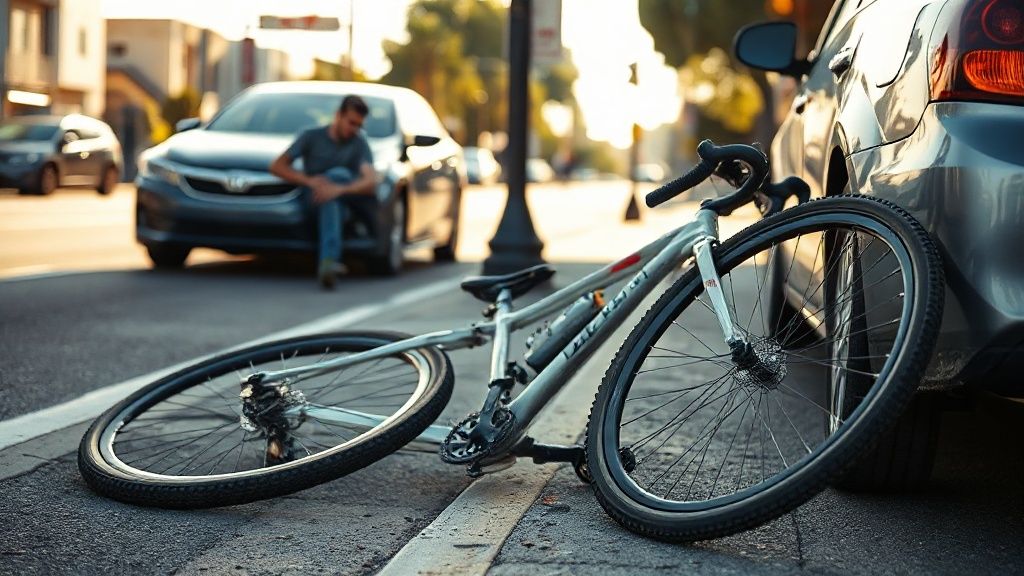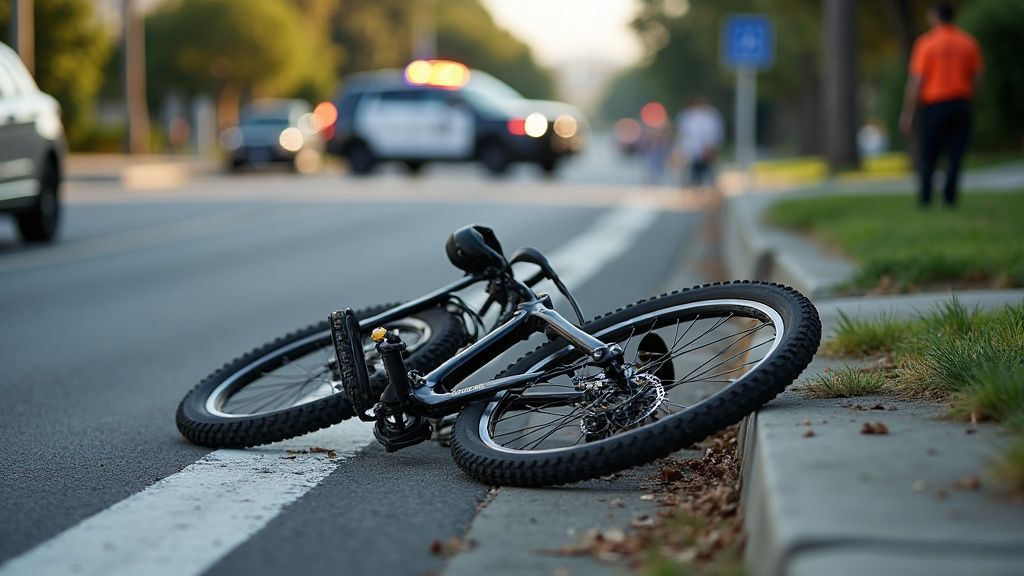
If you were just hit by a car while riding your bike in California, the next hour matters more than most people realize. Evidence disappears. Witnesses leave. Insurance adjusters start building their file before you even know you have a claim.
We've recovered over $150,000,000 for injured Californians, and we've seen how quickly a strong claim can be weakened by a few avoidable mistakes made right after a crash. These 8 steps exist to protect you the moment the crash happens, not after it's too late.
Here's what to do, in order:
- Move to safety and call 911
- Get a police report even for minor crashes
- Seek medical care immediately
- Photograph the scene, the car, and your bike
- Get the driver's insurance and witness info
- Don't negotiate at the scene
- Preserve your damaged bike and gear as evidence
- Check your auto UM/UIM and MedPay coverage
1. Move to Safety and Call 911
If you are hit by a car while riding a bicycle in California, call 911 immediately, even if the crash seems minor.
Your first priority is staying alive. If you can move without making an injury worse, get yourself out of active traffic. If you cannot move safely, stay where you are and signal for help. Do not let a bystander wave traffic around you without police present.
Call 911 the moment you are able to. A 911 call does two things at once: it gets you emergency medical services and it creates a timestamped official record of the crash. Dispatchers log the time, location, and basic facts. That record exists independent of anything the driver says later.
Do not let the driver convince you that calling police is unnecessary. That suggestion benefits only them.
Takeaway: Call 911 even if you feel fine. The call creates a record; skipping it leaves you with only your word against the driver's.
2. Get a Police Report Even for Minor Crashes
Under Cal. Veh. Code §20008, any driver involved in an accident that results in injury or death must make a written report to the California Highway Patrol (CHP) or local police. That is not optional, and it is not something you need to argue for. Request it by name.
A written police report locks in the facts before memories fade, before the driver's story changes, and before the insurance adjuster enters the picture. It documents the location, the parties involved, witness statements, and in many cases the officer's preliminary assessment of fault.
Without a police report, an insurer can claim the crash is disputed, unverifiable, or minor. With one, you have an official government document supporting your account.
Even if officers tell you the crash is too minor to generate a full report, ask them to complete an officer-involved traffic collision report and get the report number. You can also file a report directly with the DMV if injuries or property damage exceed $1,000, as required under Cal. Veh. Code §16000.
Takeaway: A police report is your foundational document. Insist on one at the scene regardless of how the driver characterizes the crash.
3. Seek Medical Care Immediately
A same-day medical exam is one of the most important steps after a bicycle accident because adrenaline masks pain and some serious injuries, like brain injuries, may not show symptoms for hours.
Adrenaline is real. Many cyclists who have just been hit feel a surge of energy and assume they are unhurt. Traumatic brain injuries (TBI), internal bleeding, spinal injuries, and hairline fractures can be invisible in the first 30 to 60 minutes after a crash. By the time symptoms appear, critical evidence-collection time has already passed.
See a doctor the same day, ideally via the emergency room or urgent care. If paramedics are at the scene and recommend transport, go. A same-day medical record creates a direct documented link between the crash and your injuries. A two-day or two-week gap gives insurers room to argue that something else caused your condition.
Tell the treating physician exactly how the injury happened. "I was struck by a motor vehicle while riding my bicycle" needs to appear in the medical notes, not just "patient reports shoulder pain."
California personal injury claims require you to prove that the defendant's conduct caused your injuries. Medical records from the day of the crash are the most powerful causal evidence available.
Takeaway: Go to the emergency room or urgent care the same day, describe the crash explicitly to the doctor, and keep copies of every medical record and bill.
4. Photograph the Scene, the Car, and Your Bike
Your phone camera is one of the most powerful evidence tools you have, and the scene will be cleared within hours. Use it before anything moves.
Photograph:
- The vehicle that hit you, including the license plate, the point of impact, and any damage
- Your bicycle, from multiple angles, showing every point of damage
- Your clothing, helmet, and any other gear, especially if torn, cracked, or bloodied
- Every visible injury on your body, including road rash, bruising, and lacerations
- Road conditions, skid marks, debris, and any traffic controls (signals, stop signs, bike lane markings)
- The surrounding intersection or roadway, with street signs visible for location identification
- Any surveillance cameras on nearby buildings or traffic signals
If witnesses are present, ask their permission and photograph them with their contact information visible on paper or on their phone screen.
Photograph everything before you move your bike off the road. Once the scene clears, none of this can be recreated.
Takeaway: Shoot first, move later. A few minutes of photos at the scene can be worth more than any amount of witness testimony when an insurer disputes your account.
5. Get the Driver's Insurance and Witness Info
Cal. Veh. Code §20002 requires every driver involved in a crash to provide their name, address, driver's license number, and vehicle registration information to anyone injured. This is not a request you are making. It is a legal obligation the driver owes you.
Collect from the driver:
- Full legal name
- Home address
- Driver's license number
- Vehicle license plate number
- Insurance company name and policy number
- Phone number
If the driver refuses or the vehicle was unregistered, note the plate number, make, model, color, and direction of travel, and give all of that information to the responding officer immediately.
From every witness, collect:
- Full name
- Phone number
- What they saw, in their own words, if they are willing to state it
Witnesses leave. Do not wait until after the police arrive to collect their information. Get it the moment someone identifies themselves as having seen the crash.
Takeaway: Photograph the driver's license and insurance card directly rather than copying numbers by hand. One clear photo eliminates transcription errors and captures every field at once.
6. Don't Negotiate at the Scene
Do not accept cash or sign anything at the crash scene. Early settlement offers are almost always far below the actual value of your claim.
Drivers sometimes offer cash at the scene to avoid an insurance claim or a police report. This offer will almost always be less, often far less, than your actual damages once medical costs, lost wages, and non-economic harms are properly calculated.
Do not:
- Accept any cash payment
- Sign any document, release, or statement
- Agree verbally that the crash was "your fault" or "partly your fault"
- Apologize, even reflexively, in a way that could be framed as an admission
In California, your right to compensation is governed by the pure comparative fault rule, established in Li v. Yellow Cab Co., 13 Cal.3d 804 (1975). Under that rule, even if you were partially at fault for the crash, your recovery is reduced only by your percentage of fault, not eliminated. That means a statement you make at the scene assigning yourself blame can cost you a real dollar amount later.
Adjusters are trained to contact injured cyclists quickly, sometimes within hours. You are not required to give a recorded statement to the other driver's insurer. Politely decline any recorded statement until you have spoken with an attorney.
Takeaway: Say as little as possible at the scene beyond what is required for the police report. Every word you say is a potential exhibit.
7. Preserve Your Damaged Bike and Gear as Evidence
Preserve your damaged bike, helmet, and clothing after a crash. They are physical evidence of the force of the impact and must not be repaired or thrown away before your case is resolved.
Your bicycle, helmet, and riding gear are physical evidence. The damage pattern on a bike frame shows the direction and force of impact. A cracked or crushed helmet proves the head strike that caused a traumatic brain injury. Torn and bloodied clothing corroborates your account of road rash and impact force.
Once you repair the bike, the evidence is gone. Once you throw away the helmet, the insurer can argue your head injury was minor because there is no physical proof of the blow.
After the crash:
- Store your bicycle, helmet, gloves, and clothing in a dry, secure location
- Do not wash the clothing
- Do not repair the bicycle or replace any components
- Photograph everything before storage and again periodically
If the other driver's insurer contacts you asking to "inspect" the bike, speak with an attorney before agreeing to anything. An unsupervised inspection can be used against you, and you have the right to have your own representative present.
Takeaway: Treat your damaged gear the same way you would treat a broken bone: do not touch it, do not fix it, and do not let anyone else handle it without your attorney present.
8. Check Your Auto UM/UIM and MedPay Coverage
Your own auto insurance policy may cover your bicycle accident injuries through uninsured motorist coverage, even if you were on a bicycle and not in a car.
Many cyclists do not realize that their own automobile insurance policy can pay for their bicycle accident injuries. Under Cal. Ins. Code §11580.2, California requires auto insurers to offer uninsured motorist (UM) and underinsured motorist (UIM) coverage. Most policies issued in California include it unless the insured signed a written rejection.
UM coverage applies when the at-fault driver has no insurance at all, or when the driver fled the scene as a hit-and-run. UIM coverage applies when the at-fault driver's policy limit is too low to fully compensate your injuries. In both cases, you make the claim against your own insurer, who then steps into the shoes of the absent or underinsured driver.
MedPay (medical payments coverage) is a separate optional coverage on many California auto policies. It pays your medical bills up to the policy limit, regardless of who was at fault. If you have MedPay, it can cover immediate emergency costs while the liability dispute is resolved.
Check your declarations page for:
- UM/UIM coverage limits (often $15,000 to $100,000 or more per person)
- MedPay coverage (often $1,000 to $5,000)
If the at-fault driver was uninsured and you have no UM coverage, you may still have other recovery options. An attorney can assess whether the driver has personal assets, whether a third party shares liability (such as a government agency responsible for a dangerous road defect under Cal. Gov. Code §835), or whether a product liability claim applies if a defective bike component contributed to the crash.
Takeaway: Pull out your auto insurance declarations page today and confirm whether you have UM/UIM and MedPay coverage. If you do, those coverages may be your fastest path to compensation after a crash with an uninsured driver.
Frequently Asked Questions
What should I do immediately after a bike accident?
Call 911, move to safety if you can do so without worsening any injury, and do not leave the scene. Your first calls should be to emergency services and, as soon as possible, to a personal injury attorney. Document everything with your phone camera before the scene clears.
Do I need a police report for a bicycle crash?
Yes. Under Cal. Veh. Code §20008, drivers involved in injury accidents are legally required to report the crash to police. You should insist on a written police report at the scene. Without one, the at-fault driver can later dispute the facts of the crash, the location, and who was involved.
Does car insurance cover a bike accident?
It can, in two ways. First, the at-fault driver's auto liability insurance covers your injuries and property damage. Second, your own auto policy's UM/UIM coverage can step in if the driver was uninsured or underinsured, as required to be offered under Cal. Ins. Code §11580.2. MedPay coverage on your policy can also pay immediate medical bills regardless of fault.
Can I recover damages if I was partly at fault for the bicycle crash?
Yes. California follows a pure comparative fault rule established in Li v. Yellow Cab Co., 13 Cal.3d 804 (1975). Your compensation is reduced by your percentage of fault, but it is not eliminated. If a jury finds you 20% at fault, you recover 80% of your proven damages.
How long do I have to file a personal injury claim after a bicycle accident in California?
Under Cal. Code Civ. Proc. §335.1, you have two years from the date of the injury to file a personal injury lawsuit against the at-fault driver. If the at-fault party is a government entity, such as a city with a defective road, you must file a government tort claim within six months of the injury under Cal. Gov. Code §911.2. Missing either deadline can bar your claim entirely.
Should I give a recorded statement to the other driver's insurance company?
No. You are not legally required to give a recorded statement to the at-fault driver's insurer. Adjusters are trained to ask questions designed to minimize your claim. Speak with an attorney before agreeing to any recorded statement.
What if the driver who hit me fled the scene?
A hit-and-run crash is covered under the UM (uninsured motorist) provision of your own auto policy, if you have that coverage. Report the crash to police immediately and to your own insurer as soon as possible. Under Cal. Ins. Code §11580.2, UM coverage applies to hit-and-run accidents.
What damages can I recover after a California bicycle accident?
California personal injury law allows you to recover economic damages (medical bills, lost wages, future medical costs, property damage to your bike) and non-economic damages (pain and suffering, emotional distress, loss of enjoyment of life). In cases involving particularly egregious conduct, punitive damages may also be available. The value depends on the severity of your injuries, your income, and the strength of the evidence.
A bicycle crash can change your life in a second. The steps you take in the hours and days after the crash often determine how much of that loss you can actually recover.
If you've been hit by a car while riding your bike in California, we're ready to review your case at no charge. Call (818) 794-9947 for a free consultation. No fee unless we win.
Reviewed by Minas Nordanyan, CA Bar #296806. Last reviewed July 2026.