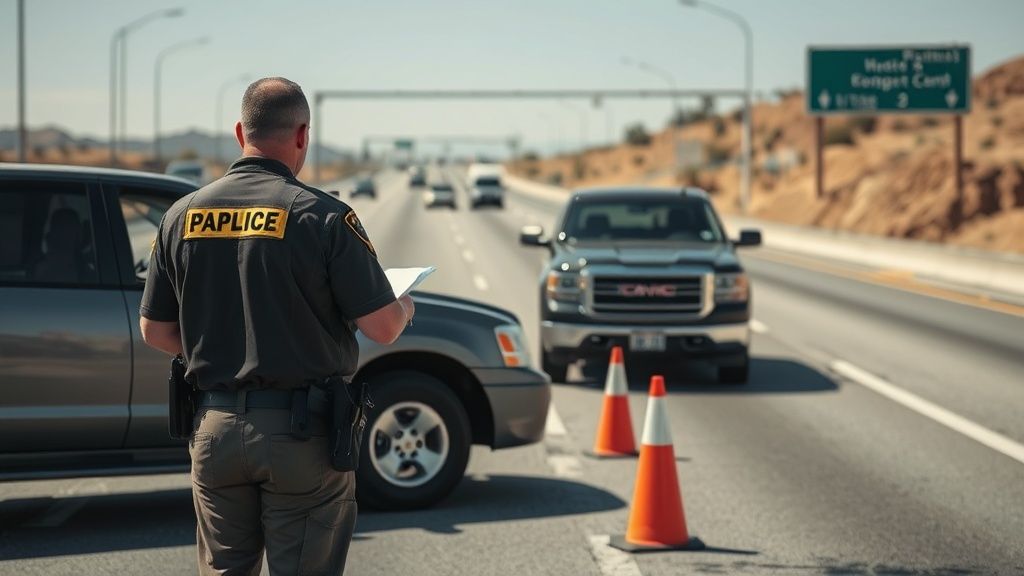
If you were in a car accident while driving for work in California, you're dealing with two crises at once — your injuries and a legal situation most people don't fully understand. A work-related car accident isn't just a standard auto collision. It can trigger a workers' comp claim, a personal injury claim against the other driver, or both — and the steps you take in the next 30 days will determine what you recover.
We've recovered over $150,000,000 for injured workers across Southern California. Here's exactly what to do.
Quick summary — the 8 steps:
- Get medical help immediately and report the crash.
- Notify your employer in writing within 30 days (Cal. Lab. Code §5400).
- Document the scene — photos, witnesses, road conditions.
- File the DWC-1 claim form your employer is required to give you.
- Understand you may have both a workers' comp claim and a third-party claim.
- Refuse recorded statements to any insurer until you have an attorney.
- Track every medical visit, expense, and missed day of work.
- Get a specialist to coordinate both claims — and the lien.
1. Get Medical Help Immediately and Call It In
If you were in a car accident while working in California, you may have two separate claims: a workers' comp claim against your employer's insurer and a personal injury claim against the at-fault driver.
Your first move after any work-related car accident is medical care. Call 911 if anyone is injured — this also creates the police report you'll need for both your workers' comp claim and any third-party case. Even if you feel fine at the scene, get evaluated. Whiplash, traumatic brain injuries, and lumbar injuries often don't produce severe symptoms until hours or days later. A gap in medical care gives insurance adjusters the argument that you weren't seriously hurt.
From a workers' comp standpoint, getting treatment also starts the paper trail that ties your injuries directly to the work accident. Under California's workers' comp system, your employer's insurer controls which doctors you see through the Medical Provider Network (MPN) — but in an emergency, you can receive treatment at any facility, and the insurer must cover it.
Practical takeaway: Call 911, accept medical evaluation at the scene, and go to an urgent care or emergency room even if you feel "okay." Your health and your claim both depend on it.
2. Report the Accident to Your Employer in Writing Within 30 Days
California Labor Code §5400 requires you to report a work injury to your employer within 30 days — missing that deadline can cost you your benefits.
Cal. Lab. Code §5400 is one of the most important deadlines in California workers' compensation. You must give your employer written notice of the injury within 30 days of the accident. Oral notice is not enough — write it down in an email, a text, or a dated letter so you have proof it happened and when.
Your notice should include: the date and location of the accident, a brief description of how it happened, and the body parts affected. You don't need to be perfectly detailed — just get something in writing within the 30-day window. If you wait longer, the employer or insurer may argue the injury isn't work-related, or that the delay itself is a basis to deny the claim under Cal. Lab. Code §5402.
There is also a broader one-year filing deadline under Cal. Lab. Code §5405 to file an application with the WCAB (Workers' Compensation Appeals Board) — but the 30-day employer notice is the clock that catches most injured workers off guard. Don't miss it.
Practical takeaway: Send your employer a dated written notice of the accident within 30 days. Keep a copy. This one step protects your entire claim.
3. Document the Scene — Photos, Witnesses, and Conditions
If you're physically able to do so, document everything at the scene before any vehicles are moved. Take photos of all vehicles from multiple angles, the point of impact, skid marks, road signs, traffic controls, weather conditions, and any visible injuries. If there are witnesses, get their names and phone numbers before they leave.
For a work-related car accident, scene documentation is doubly important. It supports your workers' comp claim (proving the accident happened during the course of employment) and your potential third-party personal injury claim against the at-fault driver. The other driver's insurer will conduct its own investigation — having your own photos prevents a "he said/she said" situation where the only evidence is theirs.
Also note the police report number at the scene. California Highway Patrol and local police reports are available within a few days of the accident and are critical evidence in both claims. Request a copy as soon as it's available.
Practical takeaway: Photos, witness names, and a police report number — collect all three before leaving the scene if you physically can.
4. File the DWC-1 Claim Form With Your Employer
Under California Labor Code §5401, your employer must give you a DWC-1 claim form within one working day of learning about your injury.
Cal. Lab. Code §5401 puts the obligation on your employer: within one working day of learning about your injury, they must provide you with a DWC-1 claim form. You fill out the "employee" section, sign it, and return it. They complete the "employer" section and forward it to their workers' comp insurer.
Filing the DWC-1 protects up to $10,000 in medical treatment while your workers' comp claim is being decided, under California Labor Code §5401.
Once the DWC-1 is filed, the insurer has 90 days to either accept or deny your claim. During that period, they are required to authorize up to $10,000 in medical treatment — which means your medical care can start immediately, even before the claim is formally decided. If your employer fails to provide the DWC-1 form, you can download it directly from the DIR (Department of Industrial Relations) website and submit it yourself.
Do not skip this step because you're also pursuing the other driver's insurance. The workers' comp claim and the third-party claim are separate legal tracks. Filing the DWC-1 does not waive your right to sue the at-fault driver — it protects your rights on both fronts.
Practical takeaway: Ask for the DWC-1 form the day you report your injury. Fill it out, keep a copy, and confirm your employer submitted it to their insurer.
5. Understand You May Have Both a Workers' Comp Claim and a Third-Party Claim
This is the item that most injured workers don't know — and the one that can make the biggest financial difference in your case.
If another driver caused your work-related car accident, California law allows you to pursue two separate claims simultaneously:
- A workers' comp claim against your employer's insurer — covering medical treatment, temporary disability (TD) payments equal to two-thirds of your pre-injury average weekly wage under Cal. Lab. Code §4653, permanent disability (PD) benefits, and supplemental job displacement vouchers if you can't return to the same work.
- A third-party personal injury claim against the at-fault driver — which can recover damages that workers' comp does not pay, including pain and suffering, full lost wages (not just two-thirds), and damages for loss of quality of life.
These two claims do not cancel each other out. You are entitled to pursue both. There is one important coordination rule, though: when your workers' comp insurer pays your benefits, they gain a lien — a legal claim — on any personal injury settlement you later receive, under Cal. Lab. Code §3856. A specialist attorney negotiates that lien down, which directly increases what you keep from the PI settlement.
This dual-claim scenario is exactly why generalist PI firms and generalist WC firms often leave money on the table. A firm that handles both — and knows how to coordinate the lien — recovers the most. See our overview of how personal injury and workers' comp intersect for a deeper breakdown.
Practical takeaway: Being hit by another driver while working means you likely have two claims. Pursue both — and get a specialist who knows how to run them together.
6. Do Not Give a Recorded Statement to Any Insurer Without an Attorney
You are not legally required to give a recorded statement to an insurance adjuster, and doing so without an attorney present can significantly reduce what you recover.
Within days of a work-related car accident, you will likely receive calls from two — or even three — insurance adjusters: your employer's workers' comp carrier, the at-fault driver's auto insurer, and possibly your own auto insurer. Each adjuster's job is to minimize what their company pays. They will ask for a recorded statement under the guise of "just getting the facts."
You are not legally required to give a recorded statement to any insurer. And anything you say in a recorded statement can be used to dispute the severity of your injuries, contradict your medical records, or argue that the accident wasn't the at-fault driver's fault. Even an innocent, off-the-cuff remark — "I'm doing okay" — can be replayed to argue you weren't seriously hurt.
Politely decline and tell the adjuster you'll respond through your attorney. This is not obstruction — it is your legal right, and it is the right move every time.
Practical takeaway: Do not give a recorded statement to any insurer — workers' comp carrier, the other driver's insurer, or your own — until you have a workers' comp and personal injury attorney on your side.
7. Track Every Medical Visit, Expense, and Lost Wage
The value of your workers' comp claim and your third-party personal injury claim is built on documentation. Every piece of paper you keep is money you can prove.
Start a folder — physical or digital — and put everything in it:
- Medical records and bills from every provider, including emergency room, urgent care, specialists, physical therapy, and pharmacy.
- Mileage logs for every trip to a medical appointment. California workers' comp reimburses mileage at the state mileage rate under Cal. Lab. Code §4600.
- Pay stubs and time records showing your pre-injury average weekly wage (AWW), which is the basis for calculating your TD rate.
- A pain and symptom journal — a simple dated log of how your injuries affect daily activities. This is important evidence in your personal injury claim, where pain and suffering damages are available (they are not available in workers' comp).
- Any correspondence from your employer, the workers' comp insurer, or the at-fault driver's insurer.
Gaps in this record cost you money. If you can't prove a medical expense, the insurer doesn't have to pay it. If your wage records are incomplete, your TD rate may be calculated lower than it should be.
Practical takeaway: Build a documentation file from day one and add to it after every appointment, every payment, and every piece of correspondence.
8. Get a Specialist to Coordinate Your Workers' Comp and Third-Party Recovery
When a workers' comp insurer pays your benefits after a third-party car accident, they gain a lien on your personal injury settlement — a specialist attorney coordinates both claims to protect your net recovery.
Running a workers' comp claim and a third-party personal injury claim at the same time — with a lien sitting between them — is not a task for two separate attorneys who don't talk to each other. The decisions made in one claim directly affect the other. A settlement in the PI case can trigger the workers' comp lien. A permanent disability rating in the WC case affects your total damages calculation in the PI case. The two tracks have to be coordinated from the start.
A workers' comp specialist with personal injury experience does three things that generalists miss:
- Maximizes your workers' comp benefits — making sure you receive every benefit you're entitled to under the WCAB: medical treatment, TD payments, permanent disability ratings, supplemental job displacement vouchers under Cal. Lab. Code §4658.7, and return-to-work supplements where applicable.
- Pursues the third-party PI claim — recovering pain and suffering, full lost wages, and other damages that workers' comp doesn't pay.
- Negotiates the workers' comp lien — when the WC insurer gets reimbursed from your PI settlement, a specialist attorney negotiates that lien down, increasing what you actually take home.
Workers represented by an attorney in California workers' comp cases recover significantly more than those who handle claims alone — call (818) 794-9947 for a free case review.
At Nordanyan Law, we handle both — and we've built $150,000,000 in recoveries for injured California workers by running these claims together, not separately. You can review our workers' compensation practice or learn more about work-related car accidents in California before you call.
Practical takeaway: A work-related car accident with an at-fault third party is one of the highest-value workers' comp scenarios — but only if both claims are coordinated by a specialist who knows both systems. Don't split the case and leave money on the table.
Frequently Asked Questions
Is a car accident at work covered by workers' comp in California?
Yes. If you were driving as part of your job duties — making a delivery, traveling between job sites, running an errand for your employer — and you were injured in a car accident, you are generally covered by California workers' comp. The key question is whether you were acting within the "scope of employment" at the time of the accident. Commuting to and from work is generally not covered, but any driving your employer assigns or requires during the workday typically is.
Can I sue the other driver if I was working when the accident happened?
Yes. California law allows you to file a third-party personal injury claim against the at-fault driver even if you're also receiving workers' comp benefits. These are two separate legal claims. Workers' comp covers your medical bills and a portion of your lost wages regardless of fault. The personal injury claim against the other driver can recover pain and suffering, full lost wages, and other damages workers' comp does not pay. The two claims can run at the same time.
What is a third-party claim in a work injury case?
A third-party claim is a personal injury lawsuit against someone other than your employer who caused or contributed to your work injury. In a car accident on the job, the third party is typically the at-fault driver. Unlike workers' comp — which pays benefits regardless of fault — a third-party claim requires proving the other driver was negligent. But it also unlocks damages unavailable in workers' comp, including pain and suffering. When both claims are filed, the workers' comp insurer gains a lien on the third-party settlement under Cal. Lab. Code §3856.
What if I was driving a company vehicle when the accident happened?
Being in a company vehicle at the time of the accident generally supports the argument that you were within the scope of employment — which strengthens both your workers' comp claim and your right to pursue a third-party claim against the at-fault driver. It may also raise questions about whether your employer's vehicle was properly maintained, which could open an additional avenue in the personal injury case. Document the vehicle's condition (especially any mechanical issues) as part of your scene documentation.
What if I was at fault for the car accident?
Workers' comp in California is a no-fault system. You are entitled to medical treatment and wage replacement benefits even if you caused the accident — with limited exceptions (e.g., injuries caused by intoxication or willful self-infliction are excluded under Cal. Lab. Code §3600). If you were at fault, you will not have a viable third-party claim against the other driver, but your workers' comp claim remains intact.
How long do I have to file a workers' comp claim after a car accident at work?
You have one year from the date of injury to file an Application for Adjudication of Claim with the WCAB under Cal. Lab. Code §5405. But the 30-day employer notice deadline under Cal. Lab. Code §5400 comes first — and missing it can jeopardize your claim entirely. If you were also injured by a third-party driver, the personal injury statute of limitations is two years from the date of the accident under Cal. Civ. Proc. Code §335.1. Don't wait on either deadline.
Do I need a lawyer if the other driver's insurance is paying?
Yes — especially in a work-related accident. The other driver's insurer is not on your side. Their goal is to minimize the payout. They do not know (and will not volunteer) how the workers' comp lien affects your settlement, or how to structure the recovery to maximize what you keep. A workers' comp specialist with personal injury experience protects your interests across both claims and negotiates the lien so more of the PI settlement stays with you.
Can my employer fire me for filing a workers' comp claim after a car accident?
No. Retaliating against an employee for filing a workers' comp claim is illegal under Cal. Lab. Code §132a. If your employer terminates you, demotes you, reduces your hours, or otherwise penalizes you after you file a claim, that is a separate violation that carries additional penalties. Document any adverse employment action and report it to your attorney immediately.
If you were injured in a car accident while working in California, the next steps you take matter more than most injured workers realize. The 30-day reporting window, the DWC-1 form, the third-party claim, the lien — each one affects what you ultimately recover.
Call (818) 794-9947 for a free case review. No fee unless we win. We handle both the workers' comp claim and the third-party personal injury case — and we've recovered over $150,000,000 for injured California workers doing exactly that.
Reviewed by Minas Nordanyan, CA Bar #296806 — Nordanyan Law, Van Nuys, California.