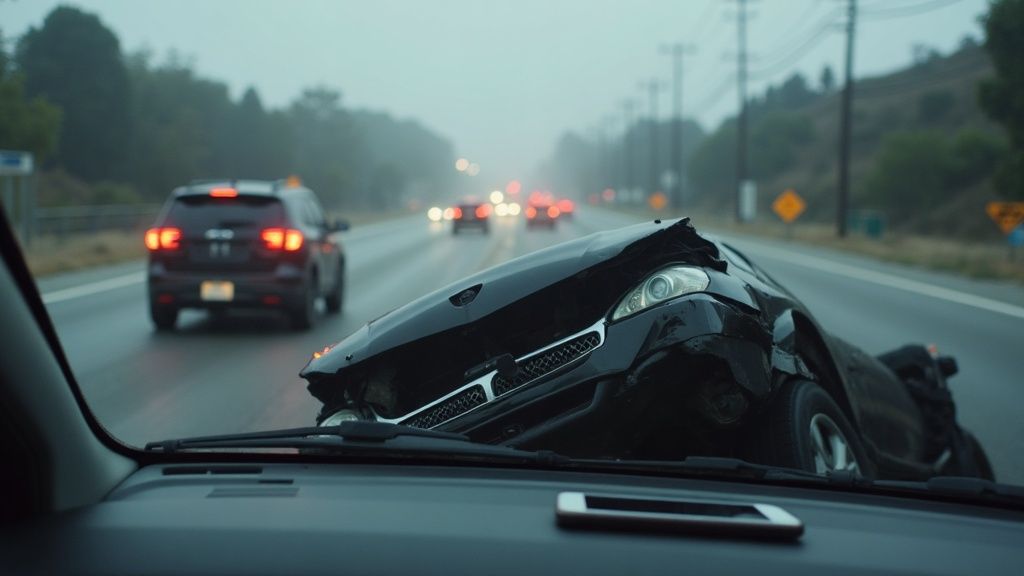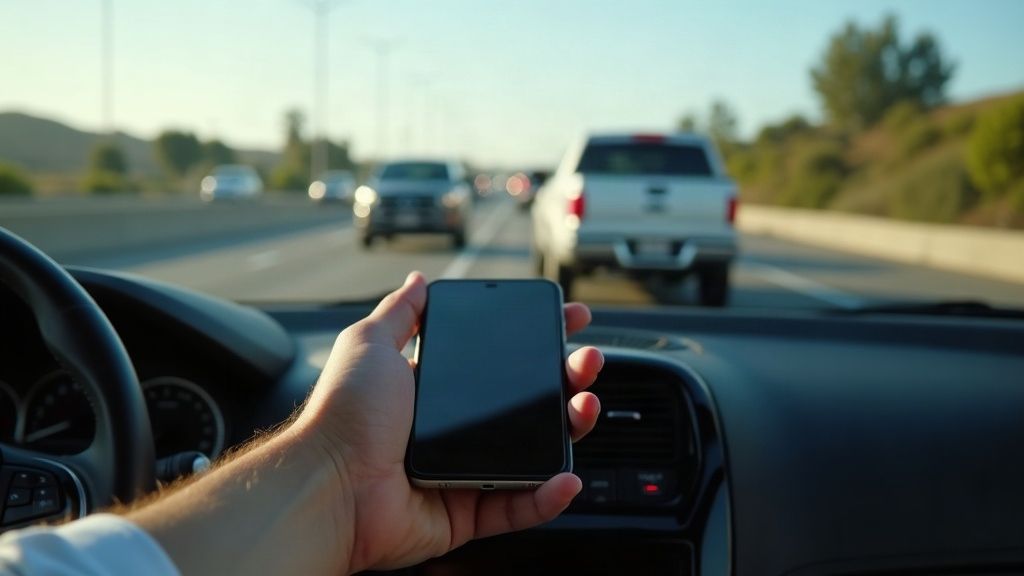
If you were hurt in a crash where the other driver was looking at their phone, eating, or simply not paying attention, you already know how fast everything can change. Distracted driving is a leading cause of serious collisions on California roads, yet the term covers far more than most people realize.
This article breaks down the 8 most common types of distracted driving, which behaviors are illegal under California law, and what that means for your injury claim if another driver's inattention put you in the hospital.
Quick summary, the 8 types covered below:
- Texting and messaging
- Talking on a handheld phone
- Using GPS or apps while driving
- Eating and drinking
- Grooming
- Reaching for objects
- Talking with passengers or managing kids and pets
- Daydreaming or zoning out
1. Texting and Messaging
California Vehicle Code Section 23123.5 prohibits any driver from holding a wireless device to write, send, or read text-based communication while driving.
Typing or reading a single short message shifts a driver's eyes away from traffic. At highway speeds, even a brief glance away covers a substantial distance without any driver input, enough for a rear-end crash or a lane departure to happen before the driver ever looks up.
California Vehicle Code §23123.5 covers handheld device use for any purpose, including messaging, social media, and email. The statute requires that any interaction with a device be done through a single swipe or tap on a device mounted in a fixed position. Holding the phone at all, even at a red light, violates the law.
Practical takeaway: If a driver was texting at the moment of impact, that Vehicle Code violation is direct evidence of negligence in your California personal injury claim.
2. Talking on a Handheld Phone
California Vehicle Code Section 23123 makes it illegal to hold a phone to your ear while driving; drivers must use a hands-free device mounted in a fixed position.
A handheld call is both a manual distraction (one hand on the phone instead of the wheel) and a cognitive distraction (brain resources go to the conversation instead of the road). Eyes may stay forward, but reaction time drops.
California Vehicle Code §23123 bans holding a phone to the ear for any driver operating a motor vehicle. Bluetooth earpieces and car speakerphone systems connected to a mounted device are the legal alternatives. Drivers 18 and under face a stricter standard: California Vehicle Code §23124 prohibits minors from using any wireless device while driving, hands-free or not.
Practical takeaway: Phone records showing an active call at the time of a crash are subpoenable evidence. An experienced personal injury attorney can use that data to establish negligence.
3. Using GPS or Apps While Driving
The three recognized types of driving distraction are visual, manual, and cognitive, texting triggers all three at the same time, which is why it is among the most dangerous behaviors behind the wheel.
Programming a navigation route or scrolling through music apps while the vehicle is moving creates three simultaneous problems: eyes off the road, hand off the wheel, and brain off traffic. It is the same distraction profile as texting, delivered through a different screen.
California Vehicle Code §23123.5 limits handheld device interaction to a single swipe or tap on a device that is mounted, either on the dashboard, a windshield mount, or another fixed location that does not block the driver's view. Holding the phone to enter a destination, or propping it on the seat while navigating, violates the statute even if the driver is "technically watching the road."
Practical takeaway: If a driver ran a red light or drifted into your lane and witnesses observed the driver looking at a phone or tablet, that testimony, combined with phone app-activity logs, can establish the distraction.
4. Eating and Drinking
Eating, grooming, and reaching for objects are not separately banned by California statute, but all three can be used to establish driver negligence in a personal injury lawsuit.
Unwrapping a burger, reaching for a coffee cup, or dripping sauce on a shirt all pull at least one hand off the wheel and redirect attention away from traffic, even briefly. The behavior is episodic but the risk is real: a spill or a dropped item can trigger an immediate, impulsive reaction that takes both hands off the wheel.
California does not have a standalone statute that names eating or drinking as a prohibited act behind the wheel. However, California's general negligence standard requires every driver to exercise ordinary care to avoid harming others on the road. Courts and juries treat eating while driving as evidence that a driver failed that duty when it contributes to a crash. Evidence of food in the vehicle, witness accounts, or dashcam footage can support that theory.
Practical takeaway: The absence of a specific law does not protect a driver who caused a crash while eating. The negligence standard is broad enough to cover any activity that reduces vehicle control.
5. Grooming
Applying makeup at a red light, shaving with an electric razor on the freeway, or fixing hair in the rearview mirror all require a driver to take one or both hands off the wheel and to focus attention on their reflection rather than the road. The behavior often continues past a stopped position, which is where the serious crashes happen.
Like eating, grooming is not enumerated in a single California statute. It falls under the same general duty of care established by California Civil Code §1714, which holds every person responsible for injury caused by their lack of ordinary care. In a lawsuit, evidence that a driver was applying lipstick or adjusting contact lenses at the moment of impact goes directly to the question of whether they were exercising that ordinary care.
Practical takeaway: Grooming habits are admissible as evidence of negligence. Passenger statements, surveillance footage from nearby cameras, and the location of cosmetic items in the vehicle at the scene can all support your claim.
6. Reaching for Objects
Dropping a phone on the floorboard, grabbing a bag from the passenger seat, or twisting around to retrieve something from the back seat each take a driver's eyes off the road and pull at least one hand off the wheel simultaneously. In a vehicle traveling at freeway speed, even a one-second reach creates significant exposure.
This distraction type is documented frequently in crash reconstruction reports. When a driver loses control immediately after reaching for an object, the sequence of events is often recoverable from witness testimony, dashcam video, or the positioning of items inside the vehicle after the crash.
California Civil Code §1714 again provides the legal framework: a driver who diverts attention from the road to retrieve an object and causes a collision has failed the duty to exercise ordinary care. No separate statute is needed to establish liability.
Practical takeaway: Post-crash scene evidence, where objects landed, the driver's own statement to officers, and any dashcam footage, can reconstruct the reaching sequence and support your negligence claim.
7. Talking with Passengers or Managing Kids and Pets
A conversation with a passenger is a cognitive distraction. Turning around to address a child in a car seat, breaking up a fight between kids, or grabbing a pet that has moved into the front seat adds a visual and manual component as well. None of these activities are prohibited by a specific statute, but all of them reduce the attention a driver can give to the road.
California law does require that children under eight years old be secured in an appropriate car seat or booster seat under California Vehicle Code §27360. A driver who failed to properly restrain a child, requiring repeated physical intervention while driving, may face compounding negligence arguments: failure to follow child restraint law AND failure to exercise ordinary care in vehicle operation.
Practical takeaway: If a driver was visibly turned around or distracted by an unrestrained child or animal at the time of impact, that information belongs in your police report and your attorney's file from day one.
8. Daydreaming or Zoning Out
To prove a driver was distracted, a personal injury attorney can subpoena phone records, obtain surveillance footage, gather witness statements, and request the vehicle's electronic data.
Cognitive distraction does not require a device. A driver whose eyes face forward but whose mind is replaying an argument, worrying about money, or simply drifting is not processing the traffic ahead of them. Brake lights and pedestrians enter the visual field but do not register quickly enough to produce a normal reaction.
The National Highway Traffic Safety Administration (NHTSA) identifies cognitive distraction, including mind-wandering, as a significant contributor to crashes, particularly rear-end collisions where the trailing driver simply does not react to a slowing vehicle ahead. Unlike phone use, zoning out leaves no digital record. Proving it depends on the circumstances surrounding the crash: excessive following distance, no skid marks, no braking before impact, and the at-fault driver's own account of what they were thinking about.
Practical takeaway: A crash with no skid marks, no evasive action, and the other driver saying "I just didn't see you" is a textbook cognitive-distraction pattern. Document the scene thoroughly and call an attorney before giving any recorded statement.
What the Law Requires of Every California Driver
Beyond the specific Vehicle Code sections above, every California driver owes a duty of ordinary care to everyone else on the road. That duty comes from California Civil Code §1714 and has been interpreted by California courts to mean that drivers must give driving their primary attention.
California follows a pure comparative fault rule, so an injured person can still recover damages from a distracted driver even if the injured person was partly responsible for the crash.
Under California's pure comparative fault rule, your right to recover damages is reduced by your percentage of fault, but it is not eliminated. If a distracted driver was 80% responsible for the crash and you were 20% responsible, you can still recover 80% of your damages. You do not need to be completely without fault to have a valid claim.
How to Prove a Driver Was Distracted in California
Proving distraction after a crash requires building a picture from multiple sources. Here is what a personal injury attorney can pursue on your behalf:
- Phone records. A subpoena to the driver's carrier can show whether the phone was in active use, calls, texts, or app activity, at the exact time of impact.
- Surveillance and dashcam footage. Traffic cameras, business security cameras, and dashcams from nearby vehicles may have captured the driver's behavior before impact.
- Witness statements. Bystanders, passengers in other vehicles, or even the at-fault driver's own passengers may have observed what the driver was doing.
- Vehicle electronic data. Modern vehicles store event data that records speed, braking, and steering inputs in the seconds before a crash.
- Police report and officer observations. Officers who respond to the scene document what they see and what the at-fault driver says. Those statements are part of the record.
- Scene evidence. The absence of skid marks, the position of objects inside the vehicle, and the point of impact all contribute to crash reconstruction.
Evidence disappears quickly after a crash. Cell phone data can be overwritten. Surveillance footage is often deleted within days. The sooner you have an attorney working the case, the better your chance of preserving what matters.
Frequently Asked Questions
What are the three types of distracted driving?
The three recognized categories of driving distraction are visual (taking your eyes off the road), manual (taking your hands off the wheel), and cognitive (taking your mind off driving). Texting while driving is considered among the most dangerous behaviors because it triggers all three at the same time.
Is distracted driving illegal in California?
Yes, in several forms. California Vehicle Code §23123 prohibits holding a phone to your ear while driving. California Vehicle Code §23123.5 prohibits holding any wireless device to write, send, or read text-based communication or to use any application while driving. Violations carry fines and are traffic infractions that appear on your driving record. Other forms of distraction, eating, grooming, reaching, are not separately criminalized but establish civil negligence when they contribute to a crash.
How do you prove a driver was distracted?
Attorneys use subpoenaed phone records, vehicle electronic data, surveillance and dashcam footage, police reports, witness testimony, and crash reconstruction to show what the driver was doing at the moment of impact. The sooner evidence is preserved after a crash, the stronger the case. Call a personal injury attorney before giving any recorded statement to the at-fault driver's insurance carrier.
What counts as distracted driving besides texting?
California crashes are caused by a wide range of distracting behaviors beyond texting: handheld phone calls, GPS programming, eating and drinking, grooming, reaching for dropped objects, managing passengers or pets, and simple cognitive zoning out. All of them can form the basis of a negligence claim if they contributed to a collision.
Can I recover damages if I was partly at fault for the crash?
Yes. California follows a pure comparative fault rule. Your recoverable damages are reduced by your percentage of fault, but you are not barred from recovery even if you share some responsibility. A driver who was distracted and caused the primary collision is still liable for their share of fault.
How long do I have to file a personal injury claim after a distracted driving crash in California?
Under California Code of Civil Procedure §335.1, the statute of limitations for most personal injury claims is two years from the date of the injury. Claims against a government entity (for example, if a government vehicle was involved) carry a six-month deadline to file an administrative claim under California Government Code §911.2. Missing either deadline typically bars your claim permanently.
Should I accept the insurance company's first settlement offer after a distracted driving crash?
No. First offers from insurance carriers are almost always lower than the full value of a claim. Once you accept a settlement and sign a release, you give up the right to seek additional compensation, even if your injuries turn out to be more serious than initially apparent. Have an attorney review any offer before you respond.
If you were hurt in a crash involving any of these distracted driving behaviors, every day you wait is a day that evidence can disappear. Call Nordanyan Law at (818) 794-9947 for a free case review. We handle personal injury claims on a contingency basis, meaning there is no fee unless we win. Available in English and Spanish.